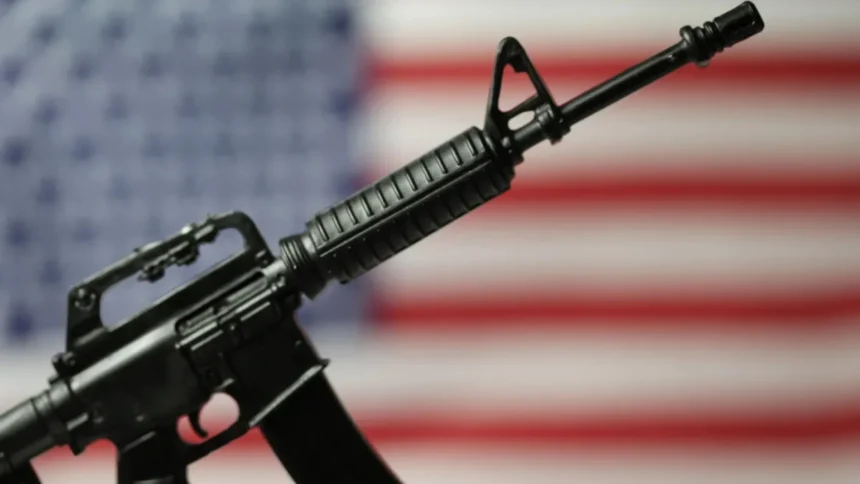
If you live in states like California, New York, Illinois, or Maryland, you’ve likely heard for years about the strict regulations that limit or ban the acquisition of semi-automatic firearms, commonly classified in local legislation as “assault weapons.” For some residents, these restrictions represent an essential barrier against gun violence; for others, they constitute a direct violation of their constitutional right to self-defense.
- The anatomy of the litigation: The legacy of the ‘Heller’ and ‘Bruen’ rulings
- 1. The historical standard of the Bruen case (2022)
- 2. The concept of “commonly used” weapons (Common Use)
- Table: The clash of positions before the Supreme Court
- Practical guide: How would a decision impact state laws and the community?
The truth is that the controversy has reached a boiling point. The U.S. Supreme Court is preparing to fundamentally resolve one of the most divisive legal questions of the 21st century: Does an average citizen have a constitutional right protected by the Second Amendment to possess a semi-automatic AR-15-style rifle, or can states freely ban them?

The constitutional litigation showdown (Snippet Bait): The U.S. Supreme Court has decided to intervene in lawsuits against state laws banning AR-15-style rifles and high-capacity magazines to determine whether these firearms fall under Second Amendment protection as “commonly used” weapons for lawful self-defense. A ruling from the court could overturn restrictions in at least ten states or, conversely, affirm the authority of local legislatures to regulate high-caliber firearms.
The anatomy of the litigation: The legacy of the ‘Heller’ and ‘Bruen’ rulings
To understand why this case has legal experts, activists, and families across the country on edge, it’s essential to step back and analyze the legal framework the Supreme Court itself has built in recent years.
1. The historical standard of the Bruen case (2022)
In the landmark ruling New York State Rifle & Pistol Association v. Bruen, the Supreme Court’s conservative majority drastically changed the rules of the game.
- The new legal test: The court ruled that any gun regulation can no longer be justified simply by arguing that the government has a “compelling public interest” in reducing crime. Instead, the state must demonstrate that the law is analogous to the historical tradition of firearm regulation at the time of the nation’s founding (late 18th and 19th centuries).
- The modern dilemma: Gun rights advocates argue that in the 18th and 19th centuries, there were no bans on civilians owning standard military weapons of the time. Meanwhile, states argue that automatic or semi-automatic firearms with rapid-fire capability are destructive technologies without historical equivalents, empowering modern governments to restrict them.
2. The concept of “commonly used” weapons (Common Use)
Since the landmark case District of Columbia v. Heller (2008), the Court established that the Second Amendment protects those weapons that are in “common use for lawful purposes,” such as home protection.
- The argument from manufacturers and owners: It is estimated that over 24 million AR-15-style rifles and similar platforms are in circulation in the United States. By the numbers, advocates claim there is no more popular rifle in the country, and the vast majority of owners use them exclusively for sport shooting, hunting, or personal defense.
- The states’ position: Attorneys general defending the bans argue that commercial popularity does not equate to an automatic right, and that the lethality of these weapons in mass shootings justifies classifying them outside the scope of lawful home defense.
According to the Pew Research Center, about one-third of U.S. adults own a gun, and according to a 2023 survey, 72% of gun owners cite protection as the primary reason. 61% of Americans say it is too easy to legally obtain a gun in the country.

38% of Hispanics believe gun rights should be protected, while 63% think they should be controlled, Pew data adds.
Education level also plays a role. The higher the education, the more likely people are to support gun control, with 65% support among those with advanced degrees compared to 41% among those with a high school education. Age is another crucial factor. Statistics show that older individuals are more likely to support the right to own guns, with 42% of those over 65 in favor, compared to 38% in the 18-to-29 age group.

Table: The clash of positions before the Supreme Court
To visualize the two opposing legal views that will define the future of gun regulations in the country, we contrast the core arguments of each side:

| Debate Axis | Plaintiffs’ Position (Pro-Second Amendment) | States’ Position (Pro-Gun Control) |
| Weapon Definition | Standard semi-automatic rifle, single-shot, commonly used by civilians. | “Assault weapon” of military style with high rate of fire and disproportionate lethality. |
| Historical Interpretation | The American tradition never banned weapons popular among citizens fit for militia service. | History shows that dangerous and unusual weapons have always been regulated by authorities. |
| Magazine Capacity | Limiting magazines to 10 rounds restricts an individual’s effective self-defense capability. | Reducing magazine size forces an attacker to reload, providing crucial seconds to save lives. |
| Impact of the Decision | Restore uniform constitutional rights across all 50 states. | Preserve state autonomy to protect communities from gun violence. |
Practical guide: How would a decision impact state laws and the community?
The consequences of this ruling won’t stay confined to the judicial chambers in Washington, D.C.; they will immediately alter the nation’s regulatory landscape.
1. What will happen in California, New York, Illinois, and other states?: Impact on states with existing bans.
If the Supreme Court declares the bans unconstitutional, state laws prohibiting the sale, transfer, or possession of AR-15-style rifles will be invalidated in whole or in part. This would allow residents of these states to purchase these firearms by complying only with federal background checks and standard registration procedures.
2. The battle over ammunition limits: The debate over high-capacity magazines.
Alongside the rifles, many of the laws under review limit magazine capacity to a maximum of 10 or 15 rounds. A broad ruling from the court could also invalidate these restrictions, standardizing the use of 20- or 30-round magazines nationwide.
3. Community safety and legal awareness: Implications for the Hispanic community.
For our community, understanding these rulings is key. Gun laws in the U.S. vary drastically when crossing state lines. If you are a legal gun owner or considering acquiring a firearm for home protection, remember that until the Supreme Court issues a final ruling, local laws in your county and state remain fully in effect. Purchasing or transporting a firearm banned in your current state of residence can result in serious criminal charges and severe immigration consequences for non-citizens.
The truth is that the AR-15 ruling will set the course for public safety and civil rights in the United States for decades to come. Between the unrestricted defense of the constitutional text and the urgency to stop community tragedies, the Supreme Court holds one of the most complex decisions in its recent history.
Image: ElHispanoParaTodos/PRESS