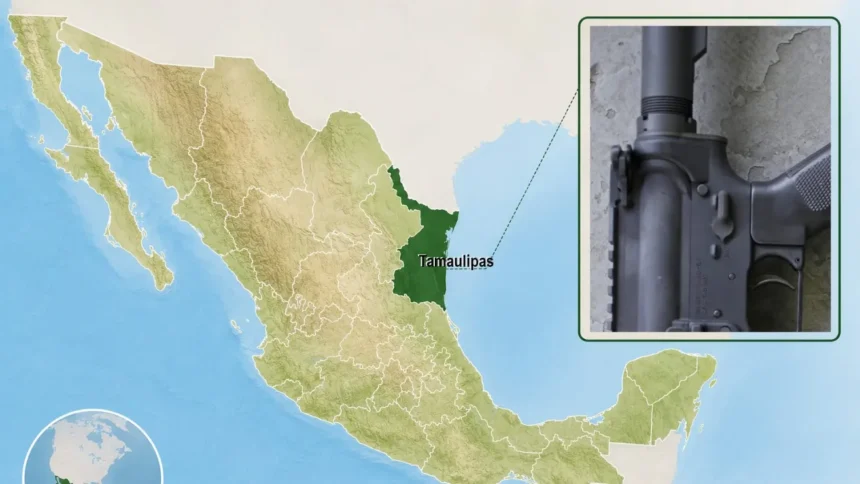
If you closely follow security reports on Mexico’s northern border, you know that the flow of U.S. weapons southward has been a chronic headache for decades. However, what state and federal authorities recently uncovered during a series of high-impact operations in Tamaulipas goes beyond any Hollywood script. We’re not talking about smuggled commercial assault rifles; we’re talking about sophisticated tactical gear with direct traceability to official U.S. government inventories.
The truth is, this discovery opens a Pandora’s box about border porosity, the diversion of military assistance resources, and the alarming logistical capacity of criminal groups to acquire cutting-edge technology reserved for elite forces. How did this arsenal end up at the heart of Mexico’s drug trade? Let’s get to the point.

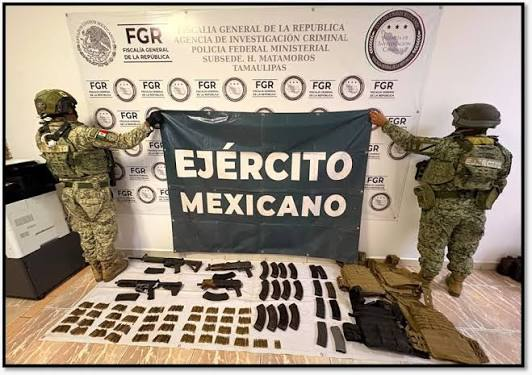
The Investigation’s Pulse (Snippet Bait): During recent operations in Tamaulipas, Mexican security forces seized a batch of firearms and tactical communication devices linked by serial number to the U.S. Department of State. This finding uncovers a possible massive leak or diversion in supply chains and international cooperation programs, triggering an urgent review of arms control protocols between Washington and Mexico.
The Anatomy of the Seizure: What Exactly Was Found in Tamaulipas?
To grasp the magnitude of the scandal, we must break down the nature of the seized equipment. This is not about obsolete pieces from the traditional black market.
1. Cutting-Edge Technology and Official Traceability
Prosecutors and ballistics experts confirmed that the serial numbers on several fuses and advanced sighting systems did not belong to civilian distributors but to specific batches acquired or transferred under diplomatic or international security cooperation schemes.
- The Gap in the Chain of Custody: When military or security equipment crosses borders under aid programs, its final destination is supposed to be strictly audited. The fact that it ended up in cartel warehouses in border municipalities reveals critical failures in arsenal accountability.
- Firepower: This type of weaponry not only increases the lethality of clashes against Mexican law enforcement but also levels the tactical playing field in favor of criminal organizations, turning urban areas into battlefields with real military capacity.
2. The Impact on the Bilateral Relationship
Incidents like this put diplomatic trust at risk. While the governments of both countries discuss joint intelligence strategies to curb the flow of fentanyl and arms smuggling, a seizure of this nature fuels mutual recriminations over who is truly to blame for border porosity.
Analysis Table: The Flow of Weaponry and Its Implications
To visualize the problem in its proper dimension, we examine how these diversion channels operate according to security experts:

| Problem Phase | Process Description | Security Impact |
| Origin and Supply | Allocation of official equipment under assistance programs or government contracts in the U.S. | High vulnerability in initial inventory audits. |
| Diversion and Leakage | Loss, theft in transit, corruption of intermediaries, or illegal sale in the secondary black market. | Creation of reverse smuggling routes (north to south). |
| Criminal Distribution | Acquisition by criminal cells in border states like Tamaulipas. | Drastic increase in the firepower of organized crime. |
| Diplomatic Scrutiny | Public revelation and demand for explanations from U.S. federal agencies. | Temporary strain on the bilateral security agenda. |
Practical Guide: How to Understand This Phenomenon Without Falling for Misinformation
Border security news often comes loaded with speculation and sensationalism on social media. Here’s how to process this information with journalistic rigor:
1. Separate Facts from Speculation: Verify Official Sources.
When reports emerge of government weapons in criminal hands, statements from prosecutors and official diplomatic reactions are the only real barometer. Avoid taking unverified videos or inventory lists circulating on digital platforms as fact.
2. Bidirectional Smuggling: Understand the Black Market.
While thousands of commercial firearms travel daily from north to south to supply cartels, cases involving official tactical or military gear are serious anomalies pointing to institutional corruption or deep logistical failures—not the norm of small-scale smuggling.

3. Tamaulipas as a Critical Zone: The Regional Context.
Tamaulipas’ long-standing territorial disputes over trafficking routes make the state a testing ground for high-end weaponry. The presence of such equipment reflects the desperation of criminal groups to maintain force monopolies in the face of federal operations.
The truth is, this seizure is much more than a routine bust; it’s a warning sign about structural vulnerabilities in the region’s shared security. We will continue to closely monitor official responses from both Mexico City and Washington to understand what measures will be taken to prevent official weaponry from continuing to fuel the drug trade’s arsenal.
Image: ElHispanoParaTodos/PRESS