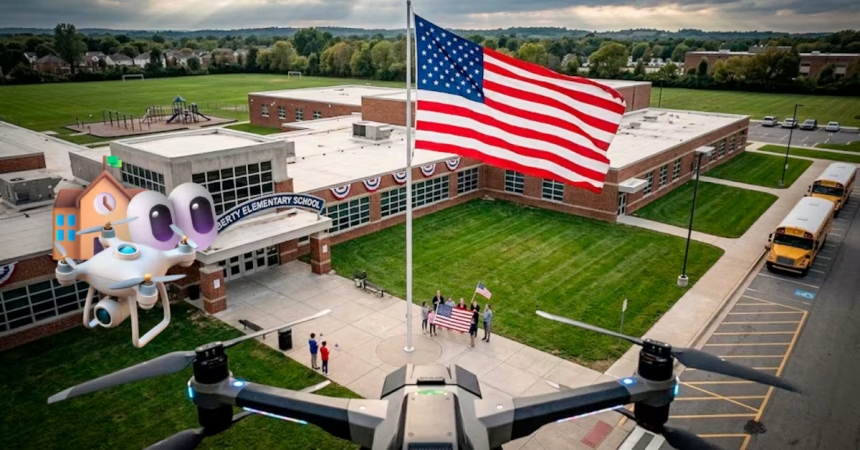
If you are a parent in the United States, the news of a school shooting is likely one of your worst fears when dropping your children off at school. The traditional response—waiting for police to arrive—has sometimes proven tragically slow. Faced with this unbearable reality, a handful of school districts across the country have decided to adopt a measure that seems straight out of a science fiction movie: deploying autonomous drones equipped with pepper spray to respond to an active threat within seconds.
The promise is bold: neutralize the attacker before police arrive at the building. But is this the solution we’ve been waiting for, or are we opening a technological Pandora’s box within educational facilities? The truth is, the technology is already here, and the debate over its implementation is hotter than ever.

The pulse of technology (Snippet Bait): Some school districts in states like Texas and Ohio have begun implementing pepper spray-equipped security drone systems, designed to be deployed automatically when a shooting alarm is activated. These devices can navigate the inside of the school and reach the threat’s location in an average of 15 seconds, dispersing the chemical irritant to incapacitate the attacker and give students and teachers vital time to hide or escape.
The anatomy of rapid response: How do these drones work?
We’re not talking about a teacher flying a drone with a remote control. These systems are far more sophisticated and, in theory, operate almost autonomously.
1. Deployment and Artificial Intelligence
The system integrates with the school’s alarms or panic buttons. When activated, a pre-programmed drone releases from its charging station and uses digital floor plans of the building to fly directly to the alert zone.
- The time advantage: In a shooting, every second counts. If police take three minutes to arrive (which is a fast response time), 15 seconds is an eternity in which lives can be lost. The drone’s goal is not to kill the attacker but to disorient them, temporarily blind them, and make it harder for them to aim.
2. Live transmission and communication
While the drone heads toward the threat, it streams high-definition video in real time to local authorities and police, giving them a clear view of the situation inside the school before they enter. This allows officers to know exactly what they’re facing, where the shooter is, and how many attackers there are.
Georgia and Florida lead implementation
Georgia became the second state to fund this type of technology. Its budget for the 2026-2027 school year includes a $550,000 subsidy to install the system in five high schools: Coffee High School, Gainesville High School, River Ridge High School, Troup County High School, and Statesboro High School.

The pilot program will evaluate the drones’ performance in schools with permanent security officers as well as those without, before deciding on a possible statewide expansion.
Florida was the pioneer, beginning to fund the project in 2025. Deltona High School was the first campus to incorporate this technology, followed by Boyd H. Anderson High School and Godby High School. Table: The balance of controversy — Drones in classrooms
Florida’s Legislature later approved another $564,500, bringing the state’s investment to over $1.1 million in two years. Colorado has also joined these states, where John Adams Academy decided to fund the program with its own resources during its first year of operation.

To help you form an opinion, we’ve compiled the main arguments for and against this extreme measure.
| Argument in favor (Safety) | Argument against (Ethics and Risks) |
| Immediate response: 15 seconds faster than police. | Risk of malfunction: What if the drone mistakenly attacks students or teachers due to a technical error? |
| Non-lethal neutralization: Pepper spray incapacitates without killing. | Collateral damage: Pepper spray affects everyone in the area, including asthmatics or people with respiratory conditions. |
| Tactical intelligence: Provides real-time video to police before they enter. | Escalation of violence: Could a shooter shoot down the drone and use it against others or see it as a challenge? |
| Deterrence: The presence of advanced technology could deter potential attackers. | Excessive surveillance: Normalizes the presence of drones and militarized surveillance in educational settings. |
| Cost-effectiveness: Potentially cheaper than having an armed officer in every hallway. | Funding diversion: The money could be invested in counselors, mental health, and security doors. |
Practical guide: What stance should the Hispanic community take?
As parents, community members, and taxpayers, we have the right and responsibility to question how money is spent in schools and how our children’s safety is ensured. This measure raises profound questions that go beyond technology.
1. Due process and technology: Security vs. Rights.
Who controls these drones? Will students be recorded in their daily activities under the guise of security? We must demand strict privacy policies and full transparency about when and how these devices are activated. Security should not come at the cost of turning schools into prisons.
2. Is this the best investment?: Real effectiveness and alternatives.
Many security experts argue that resources should be directed toward preventive measures: more psychologists and social workers in schools, anti-bullying programs, and improvements to physical infrastructure (doors that lock from the inside, better communication systems). The truth is, a drone does not prevent a shooting; it only attempts to mitigate it once it’s already happening.
3. A learning environment or a climate of fear: The psychological factor in our children.
For our children, school should be a safe place to learn and grow, not a battleground. The constant presence of security drones could increase anxiety and stress in students, affecting their academic performance and emotional well-being.
The truth is that gun violence in schools is a complex problem that requires multifaceted solutions. The implementation of pepper spray-equipped drones is a high-risk technological band-aid for a deep wound in American society. As the Hispanic community, we must stay informed, raise our voices in school board meetings, and demand that any security measure be evaluated not only for its technology but also for its human and social impact on our children and educators.
Image: ElHispanoParaTodos/PRESS