


If you’re one of those drivers who, because you’re running late to work or dropping off your own kids, speeds up when you see the flashing yellow lights of a school bus about to stop, this news is vitally important to you. The truth is that patience behind the wheel is a virtue, but when it comes to the safety of students getting on or off the school bus, the law has become relentless.
The scene is classic: the bus stops, deploys its “STOP” sign, and turns on the flashing red lights. At that moment, the entire road freezes. Or it should. Unfortunately, haste and distraction cause thousands of drivers each year to ignore this signal, putting children’s lives at risk. The states’ response has been unanimous and forceful: increase penalties to $1,000 or more for a first offense. But where exactly does this law apply, and how can you avoid falling into this costly trap?

The pulse of road safety (Snippet Bait): Most states in the U.S. have increased penalties for illegally passing a stopped school bus. A first offense can result in an administrative fine of up to $1,000, in addition to points on your driver’s license, a significant increase in auto insurance, and even jail time in repeat cases or those resulting in accidents. The golden rule is simple: if the red lights are flashing, you must stop, regardless of which lane you’re in or where you’re headed, except in rare cases on divided highways.
The anatomy of the mistake: Why is the law so strict?
To understand why the punishment is so severe, we must face the reality of child safety on public roads head-on.
1. The 10-foot danger zone
Road safety experts refer to the area around a school bus as the “Danger Zone.” These are the 10 feet (approximately 3 meters) surrounding the bus in all directions, where children are hardest for the bus driver and other vehicles to see.
- The drama of distraction: A child crossing the street to board the bus may misjudge the speed of an approaching vehicle, or a distracted driver may not see the child getting off the bus and running toward the sidewalk. It’s in those critical seconds that tragedy strikes.
- Zero tolerance: Authorities have decided there can be no excuses. A $1,000 fine is a clear message: the state prioritizes the life of the student over your need to arrive a few seconds earlier at your destination. The truth is that the cost of a child’s life is incalculable; the cost of your impatience, however, is a clear and present $1,000.
2. The financial and legal impact beyond the initial fine
Don’t think the problem ends with paying the $1,000 in municipal court. An offense of this kind triggers a series of financial consequences that will affect your wallet for years.
- Points on your license: In states like California, New York, or Texas, illegally passing a school bus carries a severe point penalty (up to 5 points in some cases). Accumulating points can lead to the suspension of your driver’s license.
- Skyrocketing auto insurance: When a serious traffic safety violation is reported to your insurance company, be prepared for an astronomical increase in your monthly premium. A 30% to 50% increase over the three years the offense remains on your record can end up costing you thousands of additional dollars in the long run.
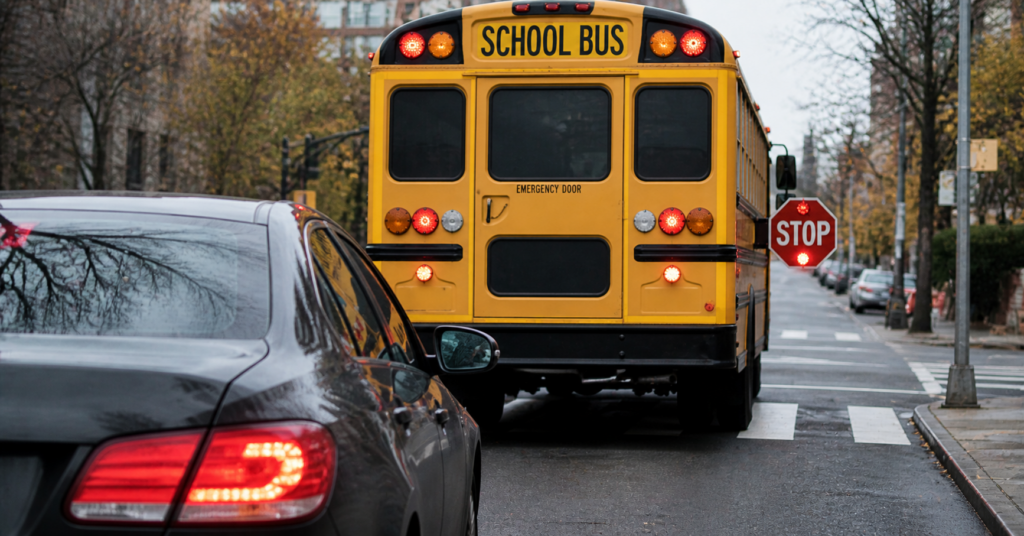
Table: The golden rule by road type — When to stop and when not to
The biggest confusion for drivers occurs on roads with multiple lanes or physical dividers. To clear up doubts, we’ve structured this visual compliance guide.

| Road Type / Traffic Situation | Traffic Direction | Must you stop if the school bus has red lights and STOP sign activated? |
| Two-lane road | Both directions | YES (Mandatory) |
| Three or more lanes (no central turn lane) | Both directions | YES (Mandatory) |
| Divided highway with raised physical median (e.g., curb, concrete barrier, grass strip) | Same direction as the bus | YES (Mandatory) |
| Divided highway with raised physical median (e.g., curb, concrete barrier, grass strip) | Opposite direction from the bus | NO (Not required to stop) |
| Road with exclusive central turn lane (two-way) | Same direction as the bus | YES (Mandatory) |
| Road with exclusive central turn lane (two-way) | Opposite direction from the bus | YES (Mandatory) |
(Note: This table is a general reference. Specific state laws may vary slightly, so it’s always recommended to consult your state’s driver manual.)
Practical guide: How to avoid the fine and protect the school community
As responsible drivers, and especially as members of the Hispanic community who value family safety, prevention is our best tool.
1. Recognize the warning lights: Stay alert to the signals.
A school bus doesn’t appear out of nowhere. It will first activate its flashing yellow lights, usually between 100 and 300 feet (30 to 90 meters) before stopping. This is your warning to slow down and prepare to stop. The truth is that many drivers try to “beat the light” by accelerating on yellow, a mistake that will cost you dearly if the red lights come on before you cross the stop zone.

2. Maintain a safe distance: The ‘vital space’ rule.
If you’re driving behind a school bus, keep a distance of at least 10-15 feet (3 to 4.5 meters) behind it. This will give you enough space to stop safely when the red lights come on and prevent you from getting too close to children crossing the street. Impatience and tailgating are common causes of accidents at these stops.
3. Watch out for bus cameras: Technology as a witness.
More and more school districts in states like New York, Texas, and Florida are equipping buses with high-resolution side-mounted video cameras, specifically designed to capture the license plates and vehicles of drivers who illegally pass the stop sign. The truth is that the fine doesn’t have to be issued by a police officer in person; it will arrive by mail at your home weeks later, based on irrefutable video evidence.
The truth is that our children’s safety is non-negotiable. A $1,000 fine is a costly lesson, but it’s preferable to the unthinkable alternative of an accident. For our Hispanic community, which often relies on school transportation to take their children to public schools, the message is clear: if you see the red lights, stop. There’s no excuse worth the risk. Stay informed, respect the law, and protect students.
Image: ElHispanoParaTodos/PRESS





