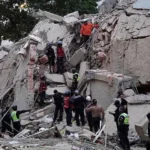
The United States Geological Survey (USGS) has issued a Red Alert through its PAGER system following the recent earthquakes in Venezuela, indicating that the toll of fatalities and economic damage could be catastrophic.
The USGS probabilistic estimates published after the disaster indicate the following regarding loss of life:

| Fatality Range | Estimated Probability |
| 1,000 to 10,000 deaths | 33% |
| 10,000 to 100,000 deaths | 42% |
| More than 100,000 deaths | 17% |

The Event: A “Seismic Doublet”
On June 24, 2026, north-central Venezuela was struck by two massive earthquakes just 39 seconds apart:
- Initial (foreshock) earthquake: Magnitude 7.2
- Main earthquake: Magnitude 7.5
This rare geological phenomenon is known as a seismic doublet. When two high-magnitude impacts occur almost simultaneously, the ground and structures do not have time to stabilize between events. This exponentially multiplies the destruction compared to a traditional earthquake followed by minor aftershocks.
Official Toll vs. Estimates
It is crucial to understand the difference between the figures being reported in the news and the USGS projection:
- Current official figure: So far, initial reports from authorities count 164 fatalities and nearly 1,000 injured, though the interim government has declared disaster zones and warned that the situation is one of “total collapse” in some areas.
- USGS estimate: This is not an actual body count but an automatic mathematical model. It crosses the intensity of ground shaking at the surface with population density and the vulnerability of infrastructure in the affected area to predict the likely impact.
Why Are the Projections So Catastrophic?
- Shallow depth: The earthquakes occurred at very shallow depths (between 10 and 20 kilometers), meaning seismic waves reached the surface with immense force and without losing much energy along the way.
- Densely populated areas: The epicenter directly impacted urban areas with millions of inhabitants, exposing cities like Caracas, La Guaira, Valencia, Puerto Cabello, and San Felipe to severe intensities.
- Structural vulnerability: The USGS points to a critical aggravating factor: a large portion of the population in the region lives in buildings highly vulnerable to severe seismic shaking, particularly unreinforced masonry and adobe block constructions, which have a high risk of immediate collapse.
Image: ElHispanoParaTodos/PRESS