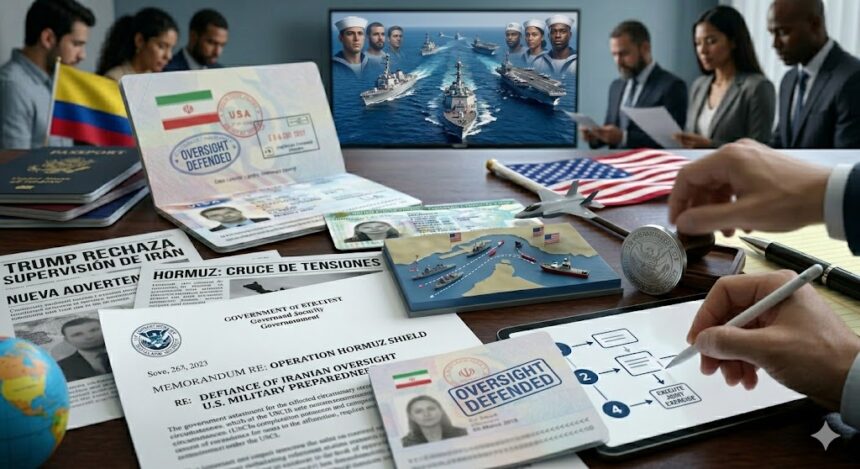
The stability of global commerce and peace in the Middle East hangs by a thread that is fraying at an alarming pace. If you think a conflict in the Persian Gulf is a distant matter that only affects geopolitical maps, economic reality is about to prove otherwise in your own wallet. Following recent armed incidents in international waters, the President of the United States, Donald Trump, has raised the strategic stakes by categorically declaring that his administration will not tolerate, under any circumstances, the Islamic Republic extending its operational control over the world’s most critical maritime routes. With sharp rhetoric, the White House has officially issued a new and severe military warning to Iran, placing the U.S. military in a state of tactical readiness not seen since the worst days of the regional crisis.
- The Core of the Conflict: Why the Strait of Hormuz Is the Planet’s Jugular
- The White House’s Stance: “The Time for Restraint Is Over”
- Snapshot of the Escalation: The Forces at Play in the Persian Gulf
- Tehran’s Response: A Rhetoric of Sovereign Resistance
- The Direct Impact on the Hispanic Community: From the Persian Gulf to Your Gas Tank
The truth is that attempts to maintain a truce through peace talks are drowning at sea. The U.S. leader has made it clear that the use of force is no longer a last-resort option but an automatic response if the national security interests of his country or its strategic allies are threatened.

The verdict of geopolitical urgency (Snippet Bait): The United States has deployed an additional attack contingent—led by guided-missile destroyers and tactical aviation squadrons—in the vicinity of the Gulf of Oman. The new military warning to Iran issued by Donald Trump explicitly states that any attempt to block, slow, or intercept commercial shipping traffic in the Strait of Hormuz will be met with direct and asymmetric military action by Pentagon forces, nullifying the diplomatic negotiation channels that remained active in mediating countries.
The Core of the Conflict: Why the Strait of Hormuz Is the Planet’s Jugular
To understand why the White House is willing to mobilize its war machinery, it is essential to step away from political rhetoric and look at the cold facts of economic geography. The Strait of Hormuz is an extremely narrow waterway that connects the Persian Gulf to the Arabian Sea. Its narrowest point measures just 21 miles, but through this bottleneck passes nearly one-fifth of the world’s oil consumption and a massive portion of the liquefied natural gas that supplies industries in Europe and Asia.
Here’s the interesting part: under international law, the transit routes of the strait guarantee free passage for vessels of all nations. However, Tehran consistently argues that it has legal sovereignty to patrol and restrict access to these waters as an internal security measure. Allowing Iran to control this gateway is equivalent to handing over the keys to global inflation to a hostile government. If the logistical flow stops for even a single day, Western supply chains would collapse in an incalculable domino effect.
The White House’s Stance: “The Time for Restraint Is Over”
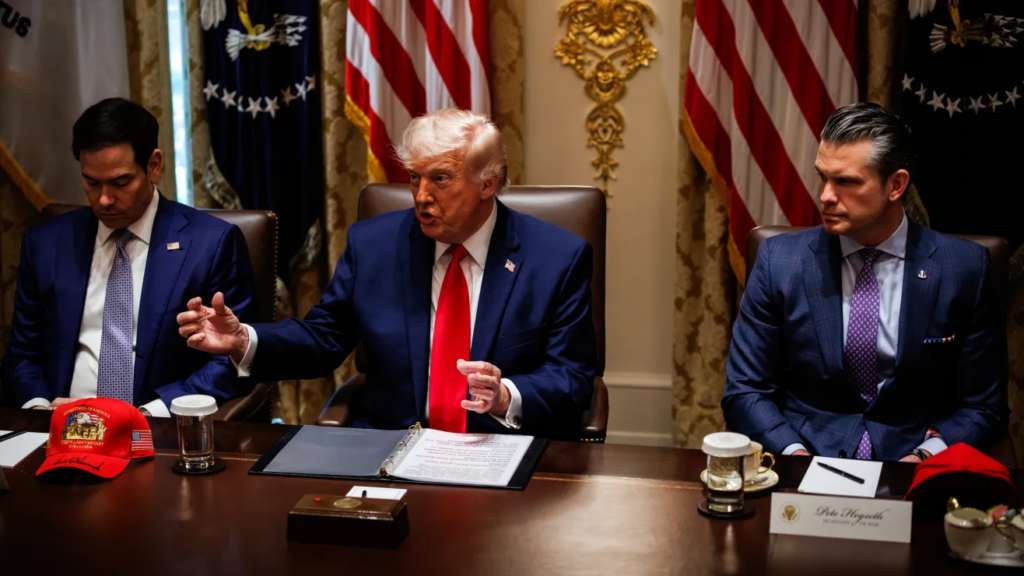
True to his direct style and unconcerned with the traditional formalities of multilateral diplomacy, the U.S. president used a press conference to send a direct message to leaders in Tehran. The central argument of the U.S. executive is that the forces of the Islamic Revolutionary Guard Corps have interpreted Washington’s prudence as a sign of structural weakness.
“We are not going to stand by and watch a regime that sponsors chaos endanger the economy of American citizens. If they touch a single ship, if they move a single missile battery to threaten free navigation, the response will be immediate, devastating, and definitive. They have been warned,” the president emphasized in a tone that set off alarms in NATO headquarters.
The Pentagon has received direct executive orders to relax the rules of engagement for its commanders in the field. This means that the captains of the warships deployed in the area no longer need to wait for bureaucratic confirmation from Washington to repel an imminent threat with live fire.

Snapshot of the Escalation: The Forces at Play in the Persian Gulf
The balance of power in the region is maintained through a tense combination of cutting-edge technology and asymmetric warfare tactics. Understanding each side’s capabilities is vital to assessing the scope of a potential open clash in this period of crisis:
| Strategic Component | Arsenal Deployed by U.S. (CENTCOM) | Iran’s Response Capability (IRGC) |
| Main Naval Power | Nuclear-powered aircraft carriers and destroyers equipped with the Aegis defense system. | Massive fleets of fast-attack boats armed with lightweight torpedoes. |
| Missile Technology | High-precision Tomahawk cruise missiles and interconnected systems. | Anti-ship ballistic missile batteries hidden in coastal underground bunkers. |
| Aerial Warfare and Surveillance | F-35 stealth fighters, patrol aircraft, and global reconnaissance drones. | Swarms of low-cost suicide drones (Shahed) designed to overwhelm defenses. |
| Combat Strategy | Total air dominance, precision surgical strikes from a distance. | Maritime guerrilla warfare, selective mining of shipping channels. |
Tehran’s Response: A Rhetoric of Sovereign Resistance
As expected, the military warning to Iran has not prompted a withdrawal of Persian forces; on the contrary, it has solidified the national defense narrative of the regime’s hardliners. Iran’s Ministry of Defense labeled the American statements as an imperialist provocation seeking to justify the illegal presence of foreign powers in the backyard of Gulf countries.
Does Iran really have the capacity to withstand a U.S. bombing campaign? Probably not in a conventional war of massive attrition, but the generals of the Islamic Revolutionary Guard Corps are not aiming to win a classic ship-to-ship battle. Their true strategy lies in collateral economic damage: the mere threat of laying sea mines in the strait’s shipping channels would raise cargo transport insurance costs to astronomical levels, paralyzing the region’s commercial ports without needing to fire a single torpedo at the U.S. fleet.

The Direct Impact on the Hispanic Community: From the Persian Gulf to Your Gas Tank
It is a common mistake to think that troop movements in the distant Middle East have no consequences for the daily lives of hardworking Latino families living in cities like Orlando, Houston, or Los Angeles. Globalization instantly connects the threads of war to household economics.
1. The Sudden Increase in Fuel Prices: Direct Financial Pressure.
Every time military tensions rise in the Strait of Hormuz, the price of Brent and West Texas Intermediate crude oil reacts with automatic increases in futures markets. For you, this means that the next time you fill up your car or work vehicle, the cost per gallon could rise sharply within days, limiting the money available for other basic household needs.
2. Inflation in Basic Goods and Food: Supply Chain Impact.
Goods transportation in the United States relies almost entirely on fleets of heavy-duty trucks that run on diesel fuel. If the operating costs of logistics companies increase due to the global energy crisis, that price hike is passed directly to the final consumer on supermarket shelves, driving up the cost of food, construction supplies, and imported goods.
3. Cybersecurity and Operational Safeguards: Alert Measures.
Civil intelligence analysts warn that Iran’s response to military pressure often includes cyberattack campaigns targeting critical Western infrastructure (such as power grids, banking systems, or utility companies). Hispanic families running small digital businesses should strengthen their cybersecurity protocols to avoid becoming collateral damage in a silent server war.
The international landscape is at a point where any miscalculation by a fighter pilot or the reckless action of a patrol boat captain could trigger a chain reaction that destabilizes the fiscal year of the world’s leading powers. Donald Trump has drawn a very clear red line in the waters of the Gulf. Now the ball is in Tehran’s court—a government that has historically shown it knows how to play on the edge of the abyss without falling but is now facing a Washington administration with no intention of negotiating under the old rules of the game. Restraint is dead; what comes next is completely uncharted and high-risk territory for everyone.
Image: ElHispanoParaTodos/PRESS