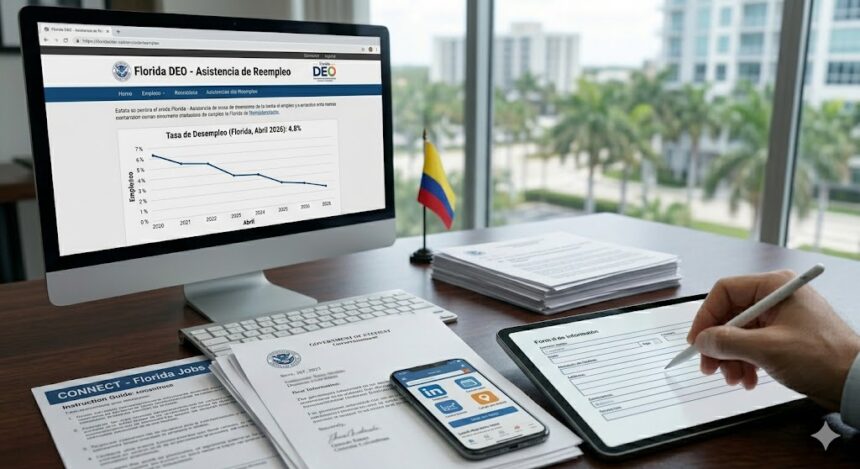
Florida’s economic stability, once a point of pride for the Sunshine State, is showing cracks that can no longer be papered over with optimistic political rhetoric. If you live in Florida, run a small business, or rely on a paycheck to cover the ever-more-expensive home insurance premiums, pay close attention. The Florida Department of Commerce has just released the official figures for April 2026, and the verdict is clear: the state’s unemployment rate has climbed to 4.8%, extending a negative streak of four consecutive months of increases.
The truth is that the myth of Florida’s economic immunity to federal pressures has begun to crumble. What seemed like an ordinary seasonal fluctuation at the start of the year has turned into a structural trend, leaving thousands of Hispanic workers in an extremely vulnerable position.

Immediate Impact Summary (Snippet Bait): The state’s labor market experienced a significant contraction during the fourth month of the year, pushing the unemployment rate in Florida to 4.8%. This figure represents the highest level recorded in the state since the post-pandemic restructuring phase. Official data confirms that the construction, retail, and hospitality sectors are leading the job cuts, reversing the massive hiring trend that characterized the last three fiscal years.
Anatomy of the Decline: Why Is Unemployment Rising in the Sunshine State?
To understand what’s happening in unemployment offices in cities like Miami, Orlando, or the coastal region of Port St. Lucie, it’s essential to look beyond the cold percentage. A sustained increase over four months doesn’t happen by accident; it’s the result of a combination of internal factors and macroeconomic pressures that have finally taken a toll on the local market.
Here’s the interesting part: Florida’s economy has become dangerously dependent on two engines that are now losing power simultaneously—the real estate sector and mass-consumption tourism. With federal interest rates remaining at restrictive levels and the local cost of living skyrocketing, small and medium-sized businesses have begun freezing job openings and, in the worst cases, cutting payrolls to maintain profit margins.
The Hardest-Hit Sectors: Where Are Jobs Being Lost?
The technical directive from the Department of Commerce reveals that job losses are not evenly distributed. Specific industries are bearing the brunt of the impact, disproportionately affecting the Hispanic workforce.
- Residential Construction: The rising cost of materials and soaring mortgage rates have stalled new housing projects. Contracting companies in South and Central Florida are reducing work hours and letting go of temporary staff.
- Retail: Household spending has contracted. Families are prioritizing rent and food, leading to a drop in sales at clothing stores, appliance retailers, and non-essential goods outlets, resulting in branch closures.
- Hospitality and Tourism Services: While airports remain busy, the average spending by domestic tourists within the state has fallen. Hotels and restaurants are optimizing their staffing through technology, eliminating frontline operational positions.

Comparative Table: Evolution of Florida’s Labor Market (First Quarter 2026)
| Evaluation Month (2026) | Official Unemployment Rate | Net Jobs Created/Lost | Sector with Greatest Contraction |
| January | 4.1% | +12,000 (Slowdown) | Corporate Services |
| February | 4.3% | -4,500 (First negative balance) | Logistics and Transportation |
| March | 4.5% | -8,200 | Retail |
| April | 4.8% | -14,100 (Worst record) | Construction and Hospitality |
The Florida Effect: Insurance and Local Inflation as Triggers
It’s logical to wonder how a state with so much internal migration is losing jobs. The answer lies in the operational cost of living and doing business here. Can a company really maintain the same wages when its commercial insurance premiums have increased by 40% in the last year? Probably not, and that’s the reality that traditional analysts often overlook.

“Florida’s real problem isn’t a lack of dynamism—it’s being choked by fixed costs. Catastrophe insurance policies, commercial property taxes, and internal inflation are forcing business owners to choose between raising prices or laying off employees. Most are opting for the latter,” details an internal financial report.
This pressure is passed on to workers. An employee who loses their job in this environment doesn’t just face a loss of income but a market where the average rent in areas like Fort Pierce or Stuart still requires more than 45 hours of work per week at the current minimum wage.
Emergency Guide: How to File for Unemployment Benefits in Florida Without Making Mistakes
If you’re among those affected by recent layoffs, improvisation is your worst enemy. Florida’s Reemployment Assistance system (formerly known as unemployment compensation) has strict rules and a confusing digital portal. There’s zero margin for error to secure this temporary income.
1. Key Documentation Preparation: Gathering Phase.
Before logging into the official portal, make sure you have your Social Security number (SSN), a valid photo ID (driver’s license or state ID), your work permit or permanent residency card if you’re not a U.S. citizen, and the exact income history and contact details for all your employers over the last 18 months. A single mistake in the legal name of a company can freeze your application for weeks.

2. Registration on the CONNECT Platform: System Access.
Visit the official FloridaJobs (Reemployment Assistance) website and create your user account in the CONNECT system. Complete the application form, detailing the reasons for your job separation. Be sure to mark that your departure was due to “lack of work” or “layoffs” if that was the case; if you ambiguously state that you quit voluntarily, the system will automatically reject your application to initiate an audit process.
3. Weekly Employment Registration Compliance: Active Job Search.
To maintain eligibility for temporary payments, the state requires proof that you’re actively seeking work. You must record a minimum of 5 job contacts for each week you claim benefits. Note the names of the companies, application dates, positions sought, and the method of contact (email, digital platform, or in-person interview). Keep copies of all these records.
4. Account Monitoring and Weekly Claims: Account Validation.
Don’t assume the process ends with submitting your application. You must log into the platform every two weeks to “certify” your weeks and confirm that you’re still unemployed. Check the digital correspondence section of the portal daily to respond to any requests for clarification from assistance officers before legal response deadlines expire.
Image: ElHispanoParaTodos/PRESS