The World Cup fever has already begun eating into the savings of thousands of fans before the first ball is even kicked. If you’re one of those who gets chills hearing Shakira’s new anthem, “Dai Dai,” and dreams of seeing your national team lift the trophy in the grand final, it’s time to come back down to earth and open your banking app. Experiencing the 2026 FIFA World Cup won’t just be a historic event due to its expanded 48-team format and ambitious tri-country hosting across the United States, Mexico, and Canada; it will, without a doubt, be the most expensive tournament in the history of the beautiful game.
- The Geographic Trap: The Real Enemy Isn’t the Ticket, It’s the Distance
- Breakdown of Expenses: Where Your Money Will Really Go
- 1. Official FIFA Tickets (The Entry Toll)
- 2. Seasonal Lodging (The Real Estate Bubble)
- 3. Internal Transportation (The Movement Tax)
- Budget Comparison Chart: What Kind of Fan Can You Afford to Be?
- The Immigration Perspective: The Hidden Cost of Visas
- Financial Contingency Plan: How to Build Your Budget Without Going Broke
The truth is that the romance of soccer has collided head-on with the harsh reality of global inflation and tourism speculation. A recent and exhaustive study by allied financial consultants has broken down the 2026 World Cup cost for an average fan, and the numbers are enough to dampen the enthusiasm of even the most passionate supporter.

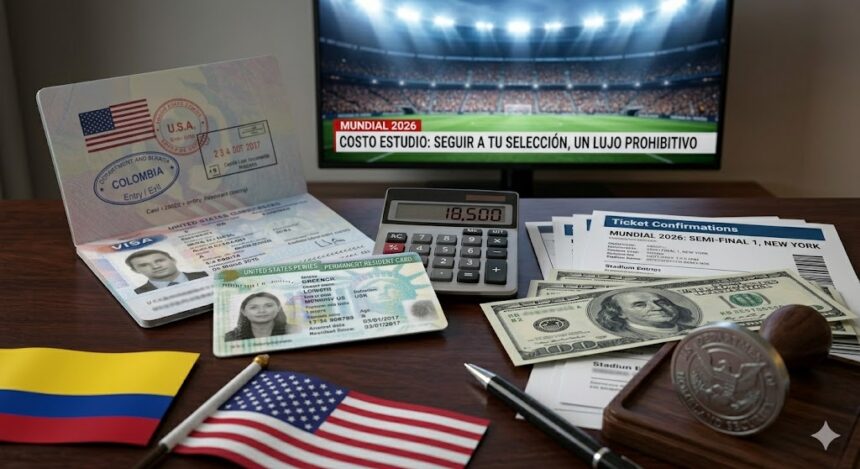
The immediate financial verdict (Snippet Bait): Following a national team during the group stage of the 2026 World Cup will require a minimum budget of between $6,500 and $9,800 per person, assuming basic internal travel and mid-range lodging. If your team advances to the knockout rounds and you plan to accompany them to the semifinals or the grand final in New York/New Jersey, the total cost easily soars above $18,500, turning this trip into a prohibitive luxury for the vast majority of working families.
The Geographic Trap: The Real Enemy Isn’t the Ticket, It’s the Distance
To understand why the traditional budgets of previous World Cups (like Russia or Qatar) fall ridiculously short this time, you have to look at the map of North America. We’re not dealing with a small country where stadiums are connected by high-speed trains. We’re dealing with an entire continent.
Here’s the kicker: A team could very well play its first group-stage match at over 7,200 feet above sea level in Mexico City, its second game in the climate-controlled dome of Houston, Texas, and wrap up the first round on the West Coast in Vancouver, Canada. This logistical puzzle destroys any chance of setting up an economical “home base.” Fans will be forced to book multiple last-minute domestic flights and face the chaotic pricing of commercial airlines, which are already using dynamic pricing algorithms to squeeze every penny during June and July of 2026.
Breakdown of Expenses: Where Your Money Will Really Go
Experiencing the World Cup means a constant drain on your wallet that will empty it if you don’t plan with surgical precision. Let’s cut to the chase with the four variables that make up the real cost of the trip:
1. Official FIFA Tickets (The Entry Toll)
Say goodbye to the affordable prices of yesteryear. Category 1 and 2 tickets for the opening matches and group-stage games have seen a significant increase in legal resale and official hospitality channels. Securing three individual tickets to watch your country in the first round means an initial outlay that will hardly dip below $900 to $1,500, provided you’re incredibly lucky to be drawn in FIFA’s ticketing platforms. If you turn to the secondary market out of desperation, multiply that figure by three.

2. Seasonal Lodging (The Real Estate Bubble)
Rates for hotel chains and vacation rental platforms in host cities like Miami, Los Angeles, Toronto, or Monterrey are experiencing a supply freeze. Standard accommodations that normally cost $120 per night are now priced at $350 to $500 per night on game days. Municipal regulations on homesteaded properties and local restrictions on informal lodging in key tourist areas will limit budget-friendly options, forcing many to seek hotels on the outskirts, more than an hour away from the stadiums.
3. Internal Transportation (The Movement Tax)
Crossing the borders of three sovereign countries requires flawless travel and immigration logistics. Between intercity trains, car rentals with mandatory insurance policies, and connecting domestic flights, an average fan will spend approximately $1,800 just to move from one stadium to another to support their team.
Budget Comparison Chart: What Kind of Fan Can You Afford to Be?
To help you project your finances without self-deception, we’ve structured three real spending scenarios based on the economic forecast study for the summer of 2026:

| Expense Category | Backpacker / Austere Profile | Standard Fan Profile | Premium Experience Profile |
| Tickets (3 group-stage matches) | $450 USD (Category 3/4) | $1,200 USD (Category 2) | $4,500 USD (Hospitality/Club) |
| Flights and Inter-Venue Travel | $1,200 USD (Long layovers) | $2,500 USD (Direct flights) | $6,000 USD (Full flexibility) |
| Lodging (14 tournament nights) | $1,400 USD (Hostels/Shared) | $4,200 USD (3-star hotel) | $9,800 USD (Boutique hotels/On-site) |
| Daily Food and Incidentals | $700 USD ($50 per day) | $1,540 USD ($110 per day) | $3,500 USD (Restaurants/Fan Zones) |
| ESTIMATED TOTAL FUND | $3,750 per person | $9,440 per person | $23,800 per person |
The Immigration Perspective: The Hidden Cost of Visas
Did you really think you’d only need money for tickets? For the Hispanic community traveling from Latin America or for U.S. residents who want to bring their families, the consular maze adds a layer of financial expense and emotional stress.
Citizens of countries that require tourist visas to enter the United States or Canada must add to their budget the costs of consular fees, trips to embassies, and, in many cases, hiring legal advisors to avoid a last-minute rejection that could ruin an investment of thousands of dollars. Additionally, increased pressures and stricter immigration procedures at border crossings will require exhaustive reviews at airport customs, so traveling with all your financial documentation printed will be essential to avoid being sent back at the first layover.
Financial Contingency Plan: How to Build Your Budget Without Going Broke
If, after reviewing the numbers, your decision to go is still firm, inaction and improvisation are your worst enemies. The margin for error to protect your assets in this macroeconomic environment is zero.
1. Establish an Emergency Exchange Fund: Shielding Phase.
Don’t travel with just the exact amount of money. Open a dedicated dollar savings account and add an extra 20% to your calculated budget. This cushion will be your lifeline in case of flight cancellations, weather-related delays during hurricane season, or any medical emergency requiring urgent care in the expensive U.S. healthcare system.
2. Prioritize Clustered Regional Venues: Smart Logistics.
Instead of blindly following your team’s erratic path, choose a single geographic region. Focusing only on stadiums in the East Coast (like Miami, Atlanta, and New York) or the southern border corridor (like Dallas, Houston, and Monterrey) will cut your internal transportation costs by more than half and allow you to negotiate better lodging rates for extended stays.
3. Hack Your Food Expenses: Consumption Optimization.
Food and beer prices inside World Cup stadiums will be marked up with premium event surcharges (expect around $15 USD for a soda and a basic snack). Use local supermarkets outside tourist zones to stock up on essentials and save restaurant meals exclusively for major celebration days. Your bank account will thank you at the end of the week.
Image: ElHispanoParaTodos/PRESS