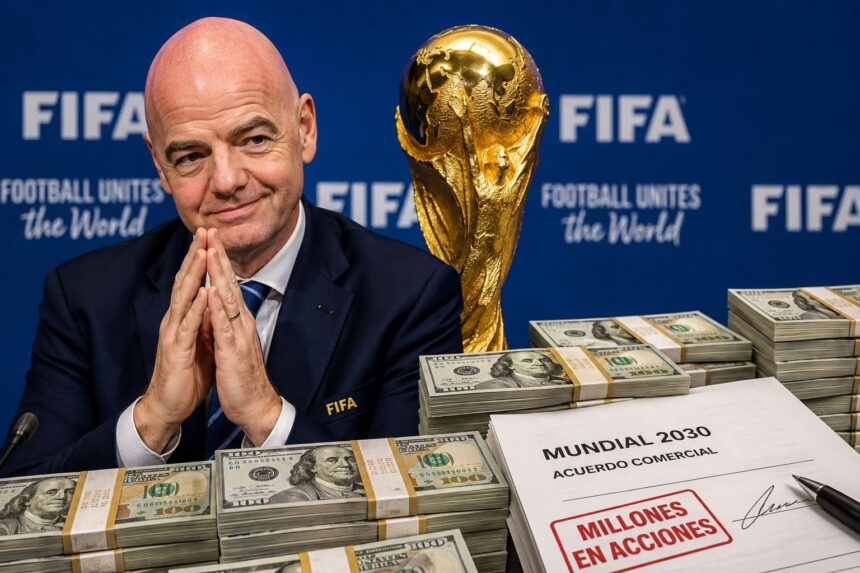
If you think soccer is just a sport of eleven against eleven on a green field, the financial reports shaking FIFA’s headquarters in Switzerland will force you to drastically change your perspective. The truth is, the beautiful game has long since become a hyper-capitalist multinational corporation where dividends drive entire economies.
A recently leaked report on restructuring plans and a potential partial privatization of the World Cup’s commercial assets—the planet’s most-watched sporting event—has put a salary figure on the table that defies imagination and borders on the obscene. We’re talking about a scheme where FIFA president Gianni Infantino would go from earning a traditional executive salary to pocketing commissions and emoluments worthy of a Silicon Valley or Wall Street tycoon. But how did we get here, and what does this mean for the future of global soccer? Let’s get to the point.

The Leak’s Core (Snippet Bait): Internal documents leaked to international media reveal that, if the privatization and corporate restructuring of the FIFA World Cup’s commercial rights goes through, president Gianni Infantino would receive a base salary and a multimillion-dollar performance-based bonus structure exceeding $50 million annually, making him one of the highest-paid sports executives in modern history.
The Anatomy of the Deal: Why Privatize the Sport’s Most Valuable Asset?
To understand why such a staggering figure is being discussed, you need to grasp the tournament’s scale. The World Cup isn’t just a soccer tournament; it’s a global brand generating billions of dollars in broadcast rights, sponsorships, and ticket sales every four years.
1. Corporate Logic vs. Sports Governance
Traditionally, FIFA has operated as a nonprofit association under Swiss law, though in practice, it manages financial flows equivalent to those of a global industrial conglomerate.
- The Investors’ Argument: Privatization proponents argue that injecting private investment funds and converting parts of the commercial structure into for-profit entities would maximize the brand’s value, modernize technological infrastructure, and ensure a more “efficient” distribution of resources to member federations.
- The Other Side of the Coin: Critics warn that privatizing soccer’s golden goose means handing the sport’s soul over to Wall Street and private capital, turning the average fan into a captive consumer of hyperinflated products.
2. Infantino’s Role and the Design of His Golden Contract
The leaks suggest the institutional redesign is subtly structured to consolidate absolute executive power. If the World Cup operates under a private corporate model, traditional salary caps and public scrutiny over direct compensation fade behind commercial private law statutes.
- Bonuses Tied to Growth: Infantino’s astronomical salary wouldn’t come solely from a fixed paycheck but from lucrative commissions directly tied to the exponential increase in TV rights revenue and the expansion of oversized tournaments, like the new 32-team Club World Cup.
Table: The Financial Impact of FIFA’s Proposed New Model
To visualize the operational and financial leap planned in soccer’s upper echelons, we contrast the traditional model with the privatized scheme:

| Management Area | Traditional Model (Nonprofit Association) | New Corporate/Privatized Model |
| Legal Structure | Association registered under Swiss laws with relative oversight. | Private commercial entities with investment fund participation. |
| Executive Compensation | High but regulated salaries subject to Council votes. | Multimillion-dollar salaries and bonuses tied to Wall Street metrics. |
| Profit Distribution | Declared reinvestment in development and local federations. | Investment return prioritized for shareholders and external funds. |
| Commercial Focus | Traditional sale of TV rights and global sponsorships. | Aggressive digital monetization, exclusive streaming rights, and venue expansion. |
Practical Guide: How Does This Privatization Affect the Average Fan?
You might think Gianni Infantino’s earnings or private investment funds have no direct impact on your life as a soccer fan. However, every financial move at the top eventually trickles down to the pitch and your wallet.
1. The Unaffordable Cost of Watching Soccer:The Inflation of Passion.
As FIFA seeks to squeeze every dollar of commercial value to justify billion-dollar market valuations, attending a stadium or even tuning into subscription-based TV platforms becomes a prohibitive luxury. Tickets for the next World Cup’s matches already show record prices that push working families away.
2. More Games, Less Player Health:The Calendar’s Oversaturation.
To generate the massive revenues demanded by private investors, FIFA and confederations expand tournaments to the athletes’ physiological limits (48-team World Cups, Super Club World Cups). The result is an oversaturated product where stars suffer constant injuries from extreme fatigue.

3. Soccer as a Financial Investment Asset:Loss of Cultural Identity.
When the sport is governed exclusively by corporate profit margins, local traditions, the romance of underdog teams, and democratic access to the game take a backseat to global marketing and the interests of major sponsors.
The truth is, the leak of this billion-dollar salary and privatization plans confirms that modern soccer is heading toward a future where business has completely devoured the sporting spirit. For our Hispanic community, which lives soccer with visceral, communal passion, this is a wake-up call to remember that the game belongs to the people—even if Zurich offices try to turn it into just another stock market asset. We’ll continue closely monitoring FIFA’s moves to bring you the unvarnished truth.
Image: ElHispanoParatodos/PRESS