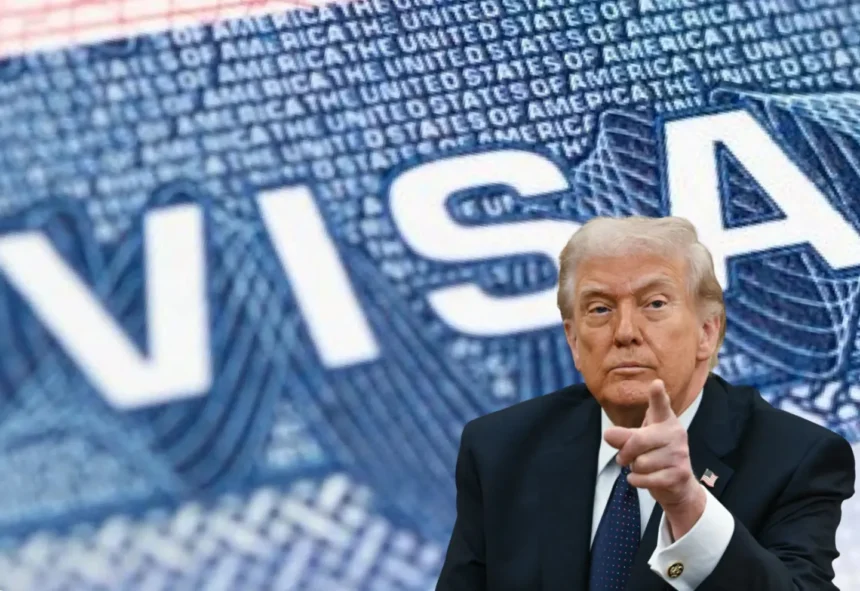
If you or a family member abroad were planning to apply for a tourist visa to visit the United States in the coming months, this news may send a chill down your spine. The era when a family trip depended solely on proving financial stability and ties to one’s home country has taken a drastic and far more costly turn.
The Trump administration, in its relentless effort to restrict immigration—both legal and illegal—has activated a quiet but forceful regulatory mechanism: the requirement of a visa compliance bond that can reach $20,000. This is no joke or social media rumor; it is an operational reality affecting citizens of roughly 50 nations, many in Africa, Asia, and, crucially, several in Latin America and the Caribbean.

But what does this really mean? How is this astronomical amount calculated, and, more importantly, who has that kind of money available to guarantee a simple leisure or business trip? Let’s get to the point.
The immediate financial impact (Snippet Bait): The State Department has implemented a pilot rule allowing consular officers to require bonds of $5,000, $10,000, or up to $20,000 for B-1/B-2 visa applicants (tourism and business) from countries with high “overstay” rates (remaining in the country after a visa expires). This measure aims to deter illegal immigration by imposing an unimaginable financial burden on most working-class individuals, affecting roughly 50 countries selected by the White House.
The Anatomy of the Bond: Why Is Your Country on the Blacklist?
To understand the logic behind this measure, we must look at the metrics used by the Department of Homeland Security (DHS). The central argument is the visa compliance rate.
1. The Overstay Rate as the Executioner
The U.S. government constantly monitors how many people enter on tourist visas and fail to leave on time. The truth is, for countries where the economic or political situation is critical, the temptation—or the need—to stay and work in the U.S. underground economy is high.
- The selection of the 50 countries: Although the full list is not published in an official, centralized manner (it changes based on quarterly reports), it is known to include nations with overstay rates exceeding 10%. Unfortunately, several Latin American countries, such as Haiti, the Dominican Republic, and Cuba, have consistently appeared in these reports, putting them directly in the crosshairs of these draconian bonds.
- The tourism paradox: This policy punishes the vast majority of honest travelers who only want to visit their grandchildren, attend a conference, or go shopping, assuming that all applicants from certain countries have hidden intentions of staying.
2. How Does the Bond Collection Process Work?
The consular officer has full discretion during the interview. If they suspect the applicant might not return to their home country but lack sufficient evidence to deny the visa under Section 214(b) (the most common reason for denial due to lack of ties), they may offer an “alternative”: the visa under bond.

- The payment and freeze: If a $20,000 bond is required, you (or your U.S. sponsor) must deposit the full amount into a U.S. Treasury account before the visa is issued. That money remains frozen for the duration of the visa (which can be up to 10 years, though the stay per visit is typically 6 months).
- The risk of loss: If the visitor stays in the U.S. even one day beyond the authorized period, the government confiscates the entire $20,000. If the visitor complies and returns home on time, the bond is refunded (after a cumbersome bureaucratic process and without interest), but the visa is automatically canceled. In practice, this turns a 10-entry visa into a single-entry visa.
Table: The Map of Exclusion — Countries Affected by Trump’s Bond
While the list is dynamic, we present an estimate of the regions and countries most vulnerable to this policy, based on historical overstay data and press reports on the pilot program’s implementation.
| Region / Continent | Potentially Affected Countries (Estimate) | Risk Factor (Overstay Rate) |
| Sub-Saharan Africa | Angola, Burkina Faso, Burundi, Cape Verde, Cameroon, Central African Republic, Chad, Democratic Republic of the Congo, Djibouti, Eritrea, Ethiopia, Gambia, Ghana, Guinea, Guinea-Bissau, Liberia, Libya, Mali, Mauritania, Niger, Nigeria, São Tomé and Príncipe, Senegal, Sierra Leone, Somalia, South Sudan, Sudan, Tanzania, Togo. | Very High (Historically high rates) |
| Middle East and Central Asia | Afghanistan, Bhutan, Iran, Iraq, Kazakhstan, Kyrgyzstan, Pakistan, Syria, Tajikistan, Turkmenistan, Uzbekistan, Yemen. | High |
| Eastern Europe and Asia | Moldova, Russia (specific cases), North Korea, Burma (Myanmar). | Medium-High |
| Latin America and the Caribbean | Dominican Republic, Haiti, Cuba, Nicaragua, Ecuador, El Salvador, Guatemala, Honduras. (Note: Criteria vary, but these countries often have high alert rates at airports) | High (Historical migration pressure) |
The truth is… For our Hispanic community, seeing the Dominican Republic or Haiti on this list is a direct blow. It means a Dominican mother who wants to attend her child’s graduation in New York now needs to have $20,000 in liquid funds to guarantee she will return. This is an almost insurmountable economic barrier for most.
Practical Guide: How to Face This New Consular Wall
If you or a family member come from one of the listed countries and need to apply for a visa, fear is natural, but preparation is your only defense.
- Professional legal advice from day one: This is not the time to fill out the DS-160 form “and see what happens.” You need advice from a certified immigration attorney before setting foot in the consulate. An expert can help you prepare a folder of evidence so solid that the consular officer may not even consider requiring a bond or can help you challenge overstay arguments.
- Extreme documentation of ties (Beyond the usual): You must demonstrate with compelling evidence that you have no need to stay in the U.S.
- Properties and businesses: Original deeds, business licenses, rental contracts showing you have a prosperous life and economic commitments in your country.
- Nuclear family: Birth certificates of minor children who will remain in the country, care for dependent elderly parents.
- Detailed employment letter: A letter from your current employer specifying your position, salary, seniority, and explicit approval of your vacation, with a confirmed return date to your job.
- The U.S. sponsor (A double-edged sword): While having a U.S. citizen family member who can pay the $20,000 bond may seem like an advantage, it can work against you. The consular officer might interpret that, by having someone who can pay for your trip and the bond, you have more incentives to stay. If you decide to use a sponsor, they must demonstrate very high income and clearly explain why they want their relative to visit the U.S. for a limited and specific time.
- Honesty is your immigration lifeline: If you lied on a previous application, if you have family members who stayed illegally in the U.S., or if your employment situation is precarious, do not hide it or make up stories. Consular officers have access to biometric databases and global border-crossing records. It is infinitely preferable for you to honestly explain your situation and plans than for the officer to discover it and deny your visa with a lifetime penalty for immigration fraud.
The truth is that the visa bond policy is a legal attempt to filter visitors not by their tourist or economic merits but by the wealth of their country of origin. For the Hispanic community, this represents a monumental challenge, a new form of economic discrimination that seeks to hinder family and professional ties with the United States. We will continue to monitor the implementation of this pilot program to bring you the most up-to-date information, without embellishments or false hopes, so you and your family can make the best decisions.

Image: ElHispanoParaTodos/PRESS