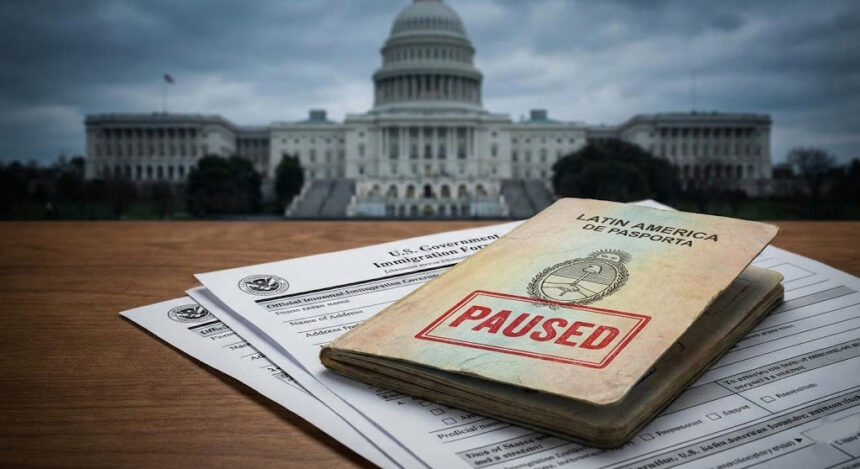
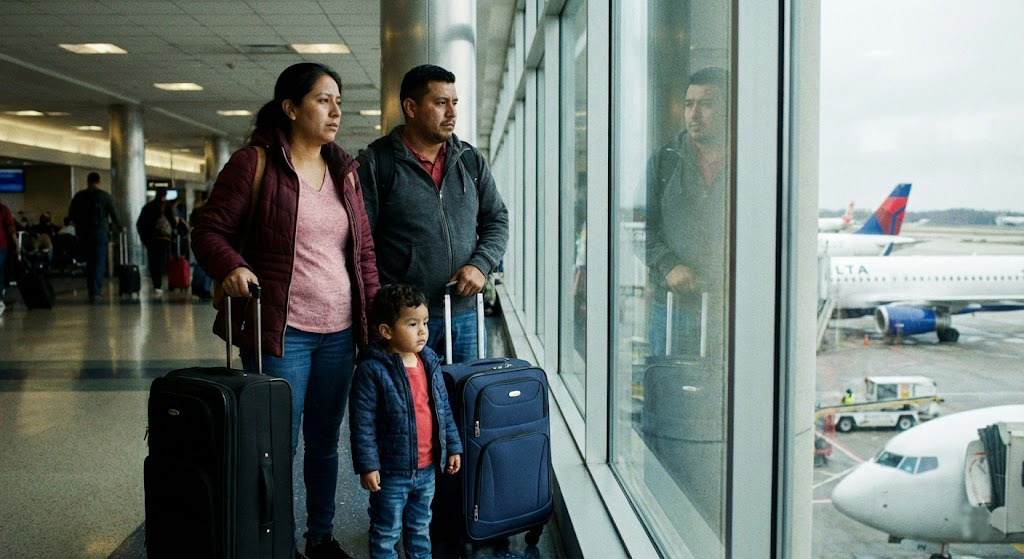
Starting next week, the Trump Administration will freeze and suspend the processing of immigrant visas for nationals from 75 countries. Uncertainty is the immigrant’s worst enemy, and the Trump administration’s recent order has hit thousands of Latino families—suitcases in hand—waiting for their turn to live legally in the United States like a bucket of ice water.
We won’t sugarcoat the reality: the situation is serious. But panic doesn’t help; accurate information does.

What does it really mean to “suspend the issuance of visas”? Is it a permanent cancellation? Does it affect everyone who wants to go on vacation or those waiting for a Green Card?

The Fact: What Will Happen on January 21, 2026? (Snippet Bait)
Starting next Wednesday, January 21, 2026, the U.S. State Department will indefinitely suspend the processing and issuance of immigrant visas for 75 countries.
This DOES NOT affect (for now) tourist visas (B1/B2) or student visas. The measure targets exclusively those seeking to live permanently in the United States (future permanent residents or Green Card holders). The official reason cited by the White House is to protect public funds and prevent new arrivals from becoming a “Public Charge.”
The List: Is My Country on the Radar?
This is the million-dollar question. While the full list includes 75 nations in Africa, Asia, and the Middle East, the impact on Latin America is significant. If you are processing consular applications in any of the following countries, your process has just been “frozen”:

Affected Latin American and Caribbean Countries:
- 🇨🇴 Colombia
- 🇨🇺 Cuba
- 🇳🇮 Nicaragua
- 🇬🇹 Guatemala
- 🇧🇷 Brazil
- 🇺🇾 Uruguay
- 🇭🇹 Haiti
- The Caribbean: Jamaica, Dominican Republic (to be confirmed in the afternoon update), Bahamas, Barbados, Belize.
(Note: If your country is not listed here, don’t celebrate just yet. The list may expand in the coming days as the memo’s annexes are published.)
In-Depth Analysis: What Is the “Public Charge” Argument?
To understand the impact, you need to understand the weapon. The Trump administration is using an ultra-strict interpretation of the “Public Charge” law.
Basically, the government believes immigrants from these 75 countries have a statistically high probability of requesting government assistance (Welfare, food stamps, Medicaid) once they arrive in the U.S.

The reality? Many immigration experts argue this is a fallacy, since legal immigrants typically have financial sponsors (you, who signed the Affidavit of Support I-864) guaranteeing they won’t request government funds. However, the executive order ignores this and calls for a “complete reevaluation” of vetting systems.
The Hard Truth: It’s not that your visa has been denied. It’s that the consular officer has been ordered not to open your file or schedule your interview until Washington designs a new financial security protocol. How long will that take? No one knows. It could be weeks or months.
Vital Difference: Immigrant Visa vs. Non-Immigrant Visa
This is where many people get confused and panic unnecessarily. Let’s clarify with a simple table:
| Visa Type | Impacted by the January 21 Order? | Example |
| Immigrant Visa | YES (SUSPENDED) | Spousal petition (CR1/IR1), Parent petition, Work visas granting direct residency. |
| Non-Immigrant Visa | NO (FOR NOW) | Tourism (B1/B2), Student (F1), Exchange (J1), Temporary work visas (H2A). |
CAUTION: While tourist visas are not officially suspended under this order, the environment is hostile. Reports indicate consular officers are applying a much stricter “risk of overstaying” criterion. If you’re renewing your tourist visa in Bogotá or São Paulo, prepare for a tougher-than-usual interrogation.
Survival Strategy: What Do I Do Now?
If you have a family petition (I-130 approved) and were waiting for an appointment at the NVC (National Visa Center) or the embassy:
- DO NOT Withdraw Your Application: You would lose your place in line and your money. The suspension is a “pause,” not a cancellation. Your turn still exists; the window is just temporarily closed.
- Strengthen Your I-864 (Affidavit of Support): Since the argument is “Public Charge,” your best defense is to demonstrate financial solidity. If your income was “barely enough” to sponsor your family member, find a co-sponsor (Co-sponsor) with high income NOW. You need to prove your family member will never need a penny from the government.
- Seek Specialized Legal Advice: Don’t rely on social media. Talk to a certified immigration attorney (AILA). Ask if your case qualifies for any exceptions (e.g., humanitarian cases or national interest visas).
Why Now?
Do we really need to freeze legal immigration from 75 countries to review forms? Probably not. This measure seems more like a political pressure tactic and a signal to the voter base than a real administrative necessity.
The sad truth is the human cost: weddings postponed, grandparents who won’t meet their newborn grandchildren, and professionals who won’t be able to contribute their talent to the U.S. economy. It’s a “sledgehammer” measure, not a “scalpel.”
What’s Next? (Immediate Future)
Civil rights groups and organizations like the ACLU are expected to challenge this measure in federal courts within the next 48 hours. We’ve seen this movie before in 2017 and 2025. It’s possible a federal judge will temporarily block the suspension.
Conclusion
The door hasn’t been locked; it’s just been barricaded. The history of immigration in this country is a marathon, not a sprint. Today, the finish line looks a little farther away for our brothers and sisters from Colombia, Cuba, and Nicaragua, but it’s not unreachable. Prepare, save, document everything, and above all, don’t lose faith.
Image: ElHispanoParaTodos/Press