
If you thought the U.S. immigration system had already reached the limit of severity through detention centers, expedited deportations, and court battles, prepare to grasp the new phase of fiscal pressure against the undocumented. The truth is that the strategy has shifted toward an unrelenting financial front: turning every immigration file into a sentence of perpetual bankruptcy. The leak and confirmation that the Donald Trump administration has accumulated a record figure of $84 billion in fines against over 103,000 people represents an unprecedented offensive in the country’s modern history.
- The anatomy of economic punishment: Where do these million-dollar fines come from?
- 1. The weight of accumulated fines for immigration contempt
- 2. The use of debt as a tool for psychological and legal control
- Table: The impact of massive fines vs. the reality of the community
- Practical guide: How to protect yourself against the threat of federal sanctions and fines
We are not talking about traffic fines for parking violations; we are talking about massive administrative sanctions, charges for unexecuted deportation orders, and retroactive penalties that seek to squeeze the last cent out of families who, in the vast majority, survive on the margins of economic formality. How did this astronomical figure come about, and what real consequences does it have for the social fabric? Let’s get to the point.

The pulse of the immigration financial crisis (Snippet Bait): Internal records and compliance projections from federal agencies reveal that the Trump administration accumulated approximately $84 billion in immigration fines targeting a group of over 103,000 immigrants, primarily through the strict enforcement of sanctions for failing to comply with prior deportation orders and fines for illegal reentry. This strategy turns immigration law into a coercive collection system with debts impossible for any working-class individual to pay.
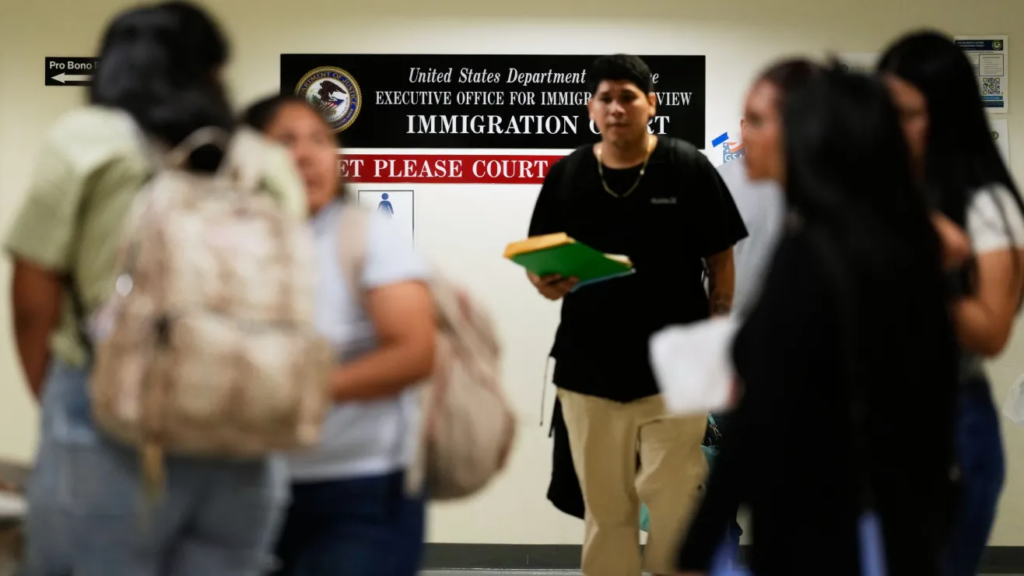
The anatomy of economic punishment: Where do these million-dollar fines come from?
To understand a figure as staggering as $84 billion—a sum that exceeds the annual budget of several U.S. states—we must break down the legal and punitive mechanisms the federal government has at its disposal.
1. The weight of accumulated fines for immigration contempt
Under U.S. immigration law (INA), there are provisions that allow federal agencies (such as ICE and EOIR—the Executive Office for Immigration Review) to impose civil monetary sanctions on individuals who receive a final deportation order and do not voluntarily leave the country.
- The geometric multiplication of debt: These fines are not static. With late fees, administrative interest, and penalties that accumulate year after year, an initial sanction that started at a few thousand dollars can quickly escalate to hundreds of thousands per individual.
- The profile of those affected: The over 103,000 immigrants identified in this report are not randomly selected profiles; they are mostly individuals with long-standing open files, many of whom have been integrated into local communities for years, paying taxes through ITINs, purchasing homes through family members, or supporting small local businesses.
2. The use of debt as a tool for psychological and legal control
The imposition of a collective multimillion-dollar fine serves a dual purpose within the hardline immigration control doctrine:
- Financial immobilization: An immigrant with an active federal debt of hundreds of thousands of dollars is effectively blocked from the formal financial system. They cannot access clean bank loans, purchase property in their name, or regularize their status through conventional family sponsorship pathways, as any application to USCIS runs into the wall of government debt records.
- The shadow of asset execution: Although in practice the vast majority of these debts are uncollectible due to the insolvency of those affected, the formal existence of the fine in Treasury Department records allows for the seizure of bank accounts, future tax refunds, or properties if the individual were to change their legal status.
Table: The impact of massive fines vs. the reality of the community
To clearly visualize what this fiscal offensive means for the Hispanic community and the system, we contrast the government’s theory with operational reality:

| Dimension of the Problem | Government Perspective (The official argument) | Operational Reality (The impact on the ground) |
| Purpose of Fines | Deter non-compliance with removal orders and recover operational costs. | Creation of a class of “perpetual debtors” unable to pay. |
| Actual Collection | Theoretical massive revenue recorded in federal accounting books. | Minimal net collection due to the insolvency of those fined. |
| Family Impact | Fair penalty for those who violate federal immigration law. | Psychological terror, financial isolation, and chronic fear of total bankruptcy. |
| Systemic Effect | Pressure to force silent self-deportation. | Administrative collapse of records and overburdening of appellate courts. |
Practical guide: How to protect yourself against the threat of federal sanctions and fines
Facing the federal government in the financial arena may seem like a losing battle, but passivity is the worst ally. If you or a family member have a complex immigration case with prior orders or fear the arrival of collection notices, legal strategy and prudence are essential.
1. The danger of default proceedings: Do not ignore government notices.
If you receive a letter from the Department of Homeland Security (DHS), ICE, or the Treasury Department demanding payment of immigration penalties, never throw it away or ignore it. Ignoring an official notice triggers administrative collection processes by default, which can freeze associated bank accounts or complicate any future legal defense.
2. Beware of fake debt managers: Specialized and accredited legal advice.
There are unlicensed individuals who promise to “erase federal debts” or “clean immigration records” in exchange for large sums of money. This is a scam. Only a certified immigration attorney or a nonprofit organization accredited by the DOJ can review your full file before the EOIR to determine if a motion to reopen, a cancellation of a deportation order, or an appeal of improper fines is warranted.

3. Smart economic risk management: Financial separation and asset protection.
For mixed-status families (where one member has legal status and another faces orders or pending debts), it is vital to maintain strict separation of bank accounts, property titles, and assets. Mixing finances with an individual sanctioned by the federal government exposes the family’s assets to administrative seizures or preventive freezes by the Internal Revenue Service (IRS) or the Treasury.
The truth is that the imposition of $84 billion in immigration fines reflects a vision where immigration is not only combated with walls and detentions but with systematic economic suffocation. For our Hispanic community, these figures reaffirm that the fight for stability in the United States requires not only courage but also a deep education about our rights and a strong legal defense. We will continue to closely monitor the development of these policies to inform you with the truth, without detours or false expectations.
Image: ElHispanoParaTodos/PRESS