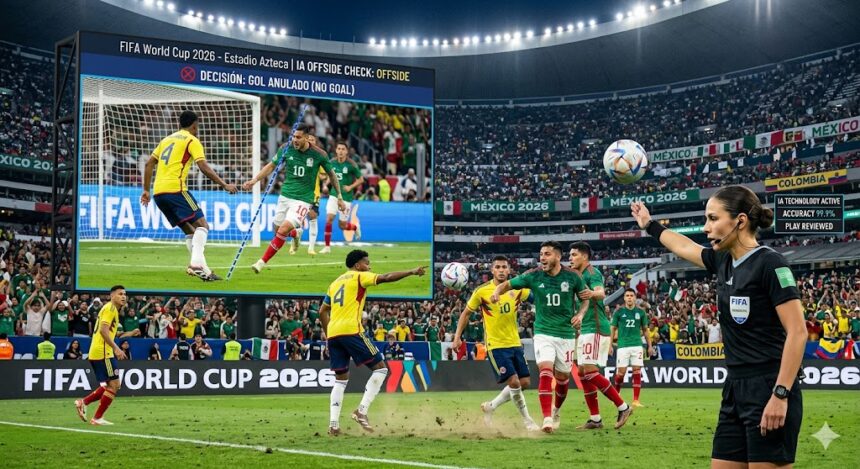
The thin line separating eternal glory from absolute failure on the field will no longer depend solely on the human eye, nor even on the interpretation of a group of referees locked in an air-conditioned room filling their screens with slow-motion replays. If you still suffer recalling the blatant officiating errors that cost our Hispanic national teams historic qualifications, or if you belong to the group of purists who argue that human error is part of soccer’s “essence” and cunning, get ready—AI will revolutionize World Cup officiating.
- The Evolution of Hawk-Eye: From Basic Chips to Artificial Brain
- Breakdown of Operations: How Will AI Decide a Controversial Play?
- Comparative Table: The Revolution of Times and Decisions in World Cups
- The End of Passion? The Human Debate Behind the Algorithm
- The Impact on Our Region’s Stadiums: Mexico Faces the Digital Challenge
- Fan Adaptation Guide: How to Understand the New Officiating Signals
The organizing committee and FIFA’s referees commission have made an irreversible decision for the North American World Cup. The 2026 World Cup technology will not be a mere TV broadcast accessory; it will become the supreme judge of every play through the deployment of an unprecedented Artificial Intelligence network.

The truth is that elite soccer has become too fast, physical, and commercially massive to leave billion-dollar decisions to the mercy of a blink. FIFA knows this, and that’s why it will transform the stadiums in the United States, Mexico, and Canada into real-time predictive analysis technological laboratories.
Immediate Technological Verdict (Snippet Bait): The 2026 World Cup officiating will operate under the command of an advanced version of the Semi-Automated Offside Technology (SAOT) integrated with Deep Learning models and Perimeter Artificial Intelligence. This system will process more than 500 data points per second from each player and the ball through neural optical tracking cameras and high-frequency internal sensors (IMU), reducing the decision-making time for controversial plays from the VAR’s traditional 70 seconds to an average of less than 5 seconds, ensuring historic millimeter precision in all 104 tournament matches.
The Evolution of Hawk-Eye: From Basic Chips to Artificial Brain
To understand where we’re headed in the summer of 2026, it’s essential to leave behind the concept of VAR we saw in Russia 2018 or Qatar 2022. That was merely the infancy of sports digitalization. In those tournaments, the system relied on a technical operator manually drawing lines on a textured screen, searching for the exact pixel where the forward’s shoulder or the defender’s boot ended—a slow, bureaucratic process, and, let’s admit it, prone to interpretive bias.
Here’s the interesting part: The Artificial Intelligence debuting in the North American tournament doesn’t “draw lines.” The software generates a three-dimensional digital twin of the match in real time. Through a deep learning ecosystem trained with millions of kinematic variables, the system automatically recognizes the complete anatomy of the players.
How is this achieved in milliseconds? The secret lies in the combination of two military-grade technologies that will work in perfect sync on the fields:

- Extreme Neural Optical Tracking: Each World Cup stadium will feature a ring of 12 to 16 high-speed cameras installed under the roof cover. These cameras don’t record ordinary video; they use artificial vision to track 29 specific body points on each player, including limbs and joints crucial for calling an offside position.
- The “Connected Ball” Smart Ball: At the heart of the official ball, a next-generation sensor (500 Hz inertial measurement unit) will be suspended. This microchip sends global positioning data to the stadium antennas 500 times per second, determining the exact moment—with millionth-of-a-second precision—when a midfielder’s foot makes contact with the ball to execute a pass.
Breakdown of Operations: How Will AI Decide a Controversial Play?
Let’s set aside the technicalities and get to the point of what you’ll see on your screen or from the stadium stands when a goal under suspicion of offside or serious foul occurs. The process will run automatically behind the scenes, following a strict algorithmic flow:
[Start of Play]
       │
       ▼
[Ball Sensor detects impact (500 Hz)]
       │
       ▼
[Neural Cameras calculate position of 29 body points]
       │
       ▼
[AI Algorithm processes information in <2 seconds]
       │
       ▼
Is There Objective Offside?
       ├── YES ──► [Automatic vibration alert to VAR Referee's watch]
       └── NO ──► [Game continues without human interruption]
Once Artificial Intelligence validates the offside position, it automatically generates a three-dimensional (3D) animation using the same body position data that served to make the decision. This graphic recreation will be displayed on the stadium’s giant screens and international TV broadcasts within no more than 25 seconds after the action, visually explaining the infraction to the viewer without any doubt.

Comparative Table: The Revolution of Times and Decisions in World Cups
To understand the magnitude of the quantum leap represented by the use of predictive models in modern officiating, let’s analyze how the speed and impact of sports justice have evolved in the last three FIFA tournaments:

| Technical Evaluation Parameter | 2018 World Cup Russia (Primitive VAR) | 2022 World Cup Qatar (Initial SAOT) | 2026 World Cup (AI and Deep Learning) |
| Average time to review an offside | 75 – 90 seconds | 25 – 40 seconds | Less than 5 seconds |
| Linear positioning error margin | +/- 12 centimeters | +/- 2 centimeters | Millimetric (Zero optical error) |
| Human factor intervention in tracing | Total (Manual operator) | Partial (Contact point validation) | None (Automated vector calculation) |
| Visualization for the Fan | TV replay on TV | Delayed 3D animation | Immediate and rendered 3D recreation |
| Impact on Added Time per Match | +6 to +8 minutes per game | +8 to +11 minutes per game | Radical optimization (-3 minutes of pause) |
The End of Passion? The Human Debate Behind the Algorithm
Questioning whether the dehumanization of officiating will take the “flavor” out of soccer is a completely valid and inevitable discussion in the bars of our region. The fiercest critics of this trend argue that automating decisions turns the world’s most beautiful sport into a console video game, where cunning, feints to deceive the referee, and the subsequent debate—fueling sports shows all week—are reduced to a cold silicon verdict.
“Soccer is a game of emotions, not laboratory algorithms. If we eliminate debate, doubt, and the drama of human error, we are turning players into lab athletes and fans into mere statistics counters,” argues a legendary South American coach in a recent opinion column.
However, FIFA’s and technology advocates’ approach points toward distributive justice in sports business. In today’s soccer, a goal wrongly disallowed due to a perception error by a linesman running at 30 kilometers per hour can mean the financial bankruptcy of a national federation or the loss of multimillion-dollar sponsorships for an entire generation of players. AI doesn’t seek to replace the center referee; it aims to relieve them of the responsibility of failing in purely physical and geometric decisions, allowing them to focus on interpreting intent, excessive force, and match discipline.
The Impact on Our Region’s Stadiums: Mexico Faces the Digital Challenge
For the Hispanic community, this transition has special significance due to the tournament’s geography. While stadiums in the United States, originally built for the NFL, have hypermodern telecommunications infrastructures capable of processing massive data volumes (ultra-wide 5G networks and low-latency local servers), traditional stadiums in Latin America, like the historic Aztec Stadium in Mexico City or the BBVA Stadium in Monterrey, are undergoing aggressive structural technological renovations to meet FIFA’s specifications.
The installation of military-grade fiber optics needed to connect the perimeter cameras’ sensors with FIFA’s local data centers represents a multimillion-dollar investment that will transform these soccer temples into permanent smart infrastructures. These technological advances will remain as a direct legacy for local leagues after the tournament concludes, raising the technical standard of broadcasts and sports justice in our domestic tournaments for the next decade.
Fan Adaptation Guide: How to Understand the New Officiating Signals
If you’re fortunate enough to attend the stadiums during the summer of 2026 or plan to gather the family at home to enjoy the match broadcasts, informational improvisation could ruin the experience. The visual language of officiating will subtly change. Follow this practical signal decoding guide so you’re not left confused when the center referee makes a determination:
1. The Center Referee’s Gesture (The Whistle Delay): The Signal on the Field.
Note that linesmen will no longer immediately raise the flag in tight offside plays. By FIFA’s direct instruction, they will let the action continue until the danger sequence ends. If Artificial Intelligence detects an objective infraction, the main referee will receive an acoustic and vibration signal on their smartwatch. Only then will they stop the game, bringing their hand to their ear, indicating the infraction’s origin without needing to consult a physical screen on the sideline.
2. Interpretation of Stadium Scoreboards: The Stadium Experience.
If you’re in the stands, pay attention to the high-definition giant screens after a dubious goal is scored. The system won’t show a simple “Reviewing Play” text. You’ll see a countdown technical support timer and, within seconds, the screen will split to display the 3D rendering of the offending player’s silhouette with the words “SAOT CONFIRMED” in red or “GOAL VALID” in green, eliminating boos due to widespread misinformation.
3. Data Analysis in TV Graphics: Broadcast Tracking.
During home broadcasts, official networks will integrate advanced telemetry widgets in the corner of their screens. You’ll be able to observe in real time the ball’s displacement speed at the moment of impact and the exact distance in centimeters by which a player was offside. Use this data to evaluate the physical and tactical performance of coaches’ strategies instead of wasting energy on sterile debates about the officiating body’s honesty.
The future of sports discipline is already here and runs on advanced programming code. The 2026 World Cup will mark soccer’s definitive divorce from old office controversies and “ghost goals” that marked the dark history of the last century.
Perfect officiating is a utopian goal because the spirit of the rule will always require human sensitivity and judgment to measure malice or chance within a play, but in the realm of physical precision, machines have taken absolute control. It’s up to fans to educate our eyes, embrace technological transformation, and understand that while VAR and AI may steal a few seconds of our unbridled goal scream, they return the certainty that the winner on the field will be so by pure sporting merit and not due to an optical perception error on a summer afternoon.
Image: ElHispanoParaTodos/PRESS