
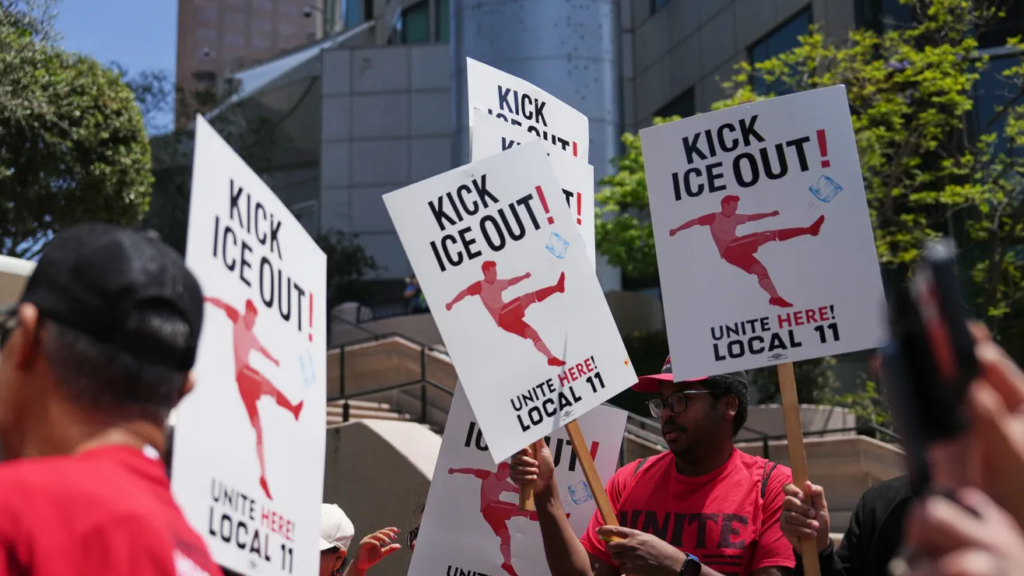
The FIFA World Cup 2026 is just around the corner, and while millions of fans worldwide prepare to belt out Shakira’s “Dai Dai,” Hispanic neighborhoods across the United States are feeling a tension entirely unrelated to the soccer celebration. And for good reason. The promise of a historic tournament, with shared host cities across North America, has collided head-on with a harsh community reality: the lingering fear of raids and family separation. In this climate of contrasts, a national coalition of immigrant rights organizations has put forward a bold proposal that’s already sparking political debate in Washington: formally demanding an ICE truce (Immigration and Customs Enforcement) during the months of the summer competition.
- The 2026 Paradox: Celebration on the Field, Panic in the Streets
- The Technical Argument: Why an ICE Truce Is Viable and Necessary
- Washington’s Stance: The Trump Administration’s Hard Line
- Comparative Table: Impact Scenarios Based on a DHS Decision
- The Economic Impact: The Tournament’s Economy Depends on Hispanic Hands
- Family Safety Plan: How to Protect Yourself If You Attend or Work During the Tournament
The truth is, mixing the geopolitics of sports with the world’s largest deportation apparatus seems like a fantasy. However, for activists, this isn’t about a sports perk—it’s a basic humanitarian and public safety measure to prevent panic from overshadowing the decade’s biggest entertainment event.

The Core of the Demand (Snippet Bait): The formal request calls for an ICE truce to temporarily suspend arrest and deportation operations in so-called “sensitive zones” and areas surrounding stadiums and Fan Fests during the 2026 World Cup. The goal is to ensure mixed-status families can attend public events or work in service and infrastructure sectors without fear of detention. So far, the Department of Homeland Security (DHS) has not issued an official directive, maintaining current enforcement policies under the Trump administration.
The 2026 Paradox: Celebration on the Field, Panic in the Streets
To grasp the scale of this demand, look at the map of U.S. host cities. Places like Los Angeles, Miami, Houston, Dallas, and New York/New Jersey will host dozens of matches, drawing an unprecedented influx of international tourists. Here’s the catch: these same cities are home to some of the largest and most established undocumented immigrant communities in the country.
The workforce building the stages, cleaning the stadiums, cooking in tourist restaurants, and driving rideshare vehicles is, overwhelmingly, of Hispanic origin and vulnerable immigration status. Forcing this population to operate under the shadow of fear while the federal government projects an image of “global welcome” is, in the eyes of the petition’s signers, a hypocritical contradiction.
+-----------------------------------------------------------------+
|               KEY POINTS OF THE IMMIGRATION TRUCE REQUEST        |
+-----------------------------------------------------------------+
|                                                                 |
|  [ POINT 1: Suspension of Operational Raids ]                    |
|  Halt community arrests in host city ZIP codes.                 |
|                                                                 |
|  [ POINT 2: Protection of Public Spaces ]                        |
|  Designate stadiums and Fan Zones as "No-Intervention Zones." |
|                                                                 |
|  [ POINT 3: Civilian Safety Focus ]                             |
|  Allow crime reporting without legal status checks.             |
|                                                                 |
+-----------------------------------------------------------------+
The Technical Argument: Why an ICE Truce Is Viable and Necessary
Questioning whether the federal government has the legal authority to pause deportations for a soccer tournament is entirely valid. Can the law really be frozen for a ball? The technical answer is yes, and it’s grounded in a legal concept DHS itself has used before: prosecutorial discretion.
Historically, federal agencies have issued memos temporarily suspending immigration enforcement during natural disasters (like hurricanes in Florida or wildfires in California) to allow civilians to seek emergency shelters without fear of arrest. Advocates argue the 2026 World Cup qualifies as an “extraordinary national interest event” where the concentration of millions in confined spaces requires law enforcement to focus exclusively on counterterrorism and crowd control—not hunting undocumented workers.

Washington’s Stance: The Trump Administration’s Hard Line
Despite the optimism of community organizations, the political reality in Washington is moving in a very different direction. With the recent USCIS directive tightening Green Card access through mandatory consular processing and a general increase in federal unemployment benefit applications, the White House’s official stance prioritizes strict enforcement of domestic law.
“Immigration law doesn’t take vacations or pause for sporting events. ICE’s job is to protect the integrity of our borders and communities 365 days a year. Any suggestion of a ‘temporary sanctuary’ to evade justice goes against presidential directives to maintain legal order,” said a source linked to the border control sector under strict anonymity.
For conservative sectors, granting an ICE truce would send a “message of weakness” that human trafficking networks could exploit to bypass border controls during the tournament season, arguing federal authorities have their hands tied.
Comparative Table: Impact Scenarios Based on a DHS Decision
To help our community assess the real risks and projections of this political standoff, we analyzed the three possible scenarios being discussed in immigration policy circles:

| Operational Scenario | ICE Actions on the Ground | Direct Impact on Immigrants | Political Probability Level |
| Total Rejection of Truce | Regular arrest and deportation operations with no changes in host city ZIP codes. | High risk of detention during commutes to work or near public events. | Very High |
| Limited or Passive Truce | Suspension of visible mass raids; selective arrests of priority profiles (criminal records) continue. | Tense calm. Greater safety in tourist zones, but lingering surveillance in residential areas. | Moderate |
| Formal and Decreed Truce | Issuance of an official memo declaring World Cup perimeters as protected zones. | Temporary peace to work and attend stadiums during the tournament weeks. | Low |
The Economic Impact: The Tournament’s Economy Depends on Hispanic Hands
The ICE truce debate isn’t just about human rights—it’s a matter of pure market economics directly affecting the 2026 World Cup’s total operational costs. Host cities have invested billions in airport infrastructure, transportation, and stadium upgrades. If construction, cleaning, and hospitality workers choose to stay home out of fear of ICE patrols, logistical delays could cost local governments astronomical sums.
Hispanic chambers of commerce in states like Texas and California have quietly suggested the need for “operational certainty” during the summer season. Workforce absenteeism driven by immigration panic would empty restaurant kitchens and leave hotels understaffed at the century’s peak tourist demand.
Family Safety Plan: How to Protect Yourself If You Attend or Work During the Tournament
If you or a mixed-status family member are in a host city and must travel for work or recreation during the World Cup, improvisation is your worst enemy. The margin for error in the current environment is zero. Follow this legal prevention protocol:
1. Know and Exercise Your Constitutional Rights (Know Your Rights): Shielding Phase.
Remember, the Fifth Amendment of the United States protects everyone, regardless of immigration status. If an ICE officer or local police detain you on the street or near a stadium, you have the legal right to remain silent. Do not lie about your name or provide false documents; calmly state you wish to speak with an attorney before answering any questions.
2. Carry Safe Identification Documents: Legal Portability.
Avoid carrying passports or IDs from your country of origin that could reveal a lack of legal status unless absolutely necessary for domestic flights. If you have a valid state driver’s license (like those issued in states with access laws for undocumented individuals), a consular ID, or a municipal ID, carry them with you at all times. Keep the phone number of a licensed attorney or trusted legal aid organization handy.
3. Monitor Checkpoints and Transit: Route Planning.
Before heading to work in tourist zones or stadiums, check traffic reports and community alerts from local organizations on social media. While local police in sanctuary cities (like Los Angeles or New York) do not directly collaborate with ICE in routine operations, federal traffic control or perimeter security operations for the World Cup may include border agency presence.
4. Establish a Family Contingency Plan: Home Protection.
Leave a signed Power of Attorney with a family member who has legal status or U.S. citizenship to make emergency decisions about the custody of your minor children and manage your bank accounts in case of detention. Keep copies of your immigration records (if you have a pending case) in a safe place outside your vehicle or wallet.
Soccer has the unique power to unite cultures and pause wars for ninety minutes, but U.S. national sovereignty laws operate under a cold logic indifferent to sports passions. The call for an ICE truce brings to the table an uncomfortable but essential discussion: Can the world’s biggest celebration coexist with the silent suffering of the community that helps build it? While diplomats and activists continue to clash in government offices, the advice for our community is to stay vigilant, seek information from official channels, and prioritize family safety above any celebration. We will be reporting minute by minute on the outcome of this immigration alert that defines the pulse of our community in this complex 2026.
Image: ElHispanoparaTodos/PRESS