Digital Messianism: When Politics Crosses the Sacred Line
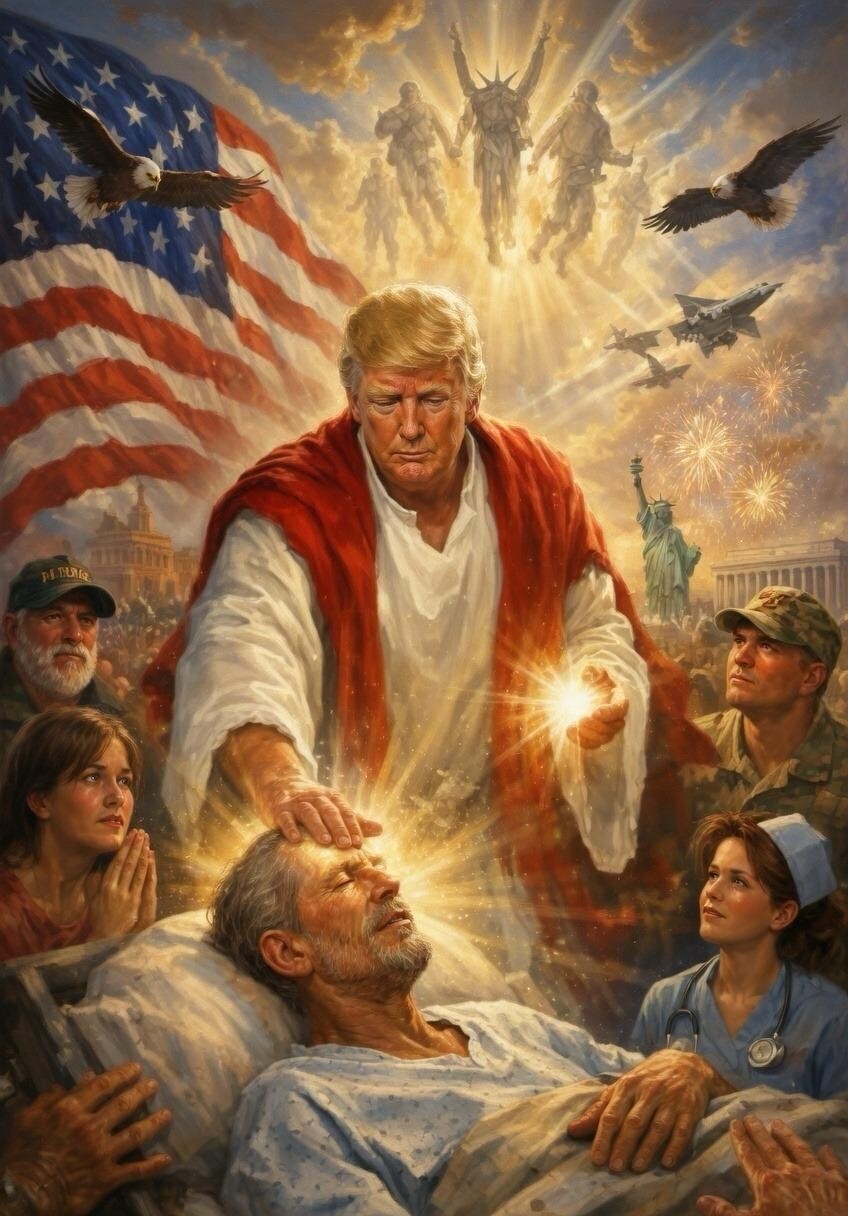
Politics in the United States is no longer just about debates; it’s about the soul of voters. Donald Trump has broken the internet again, but this time it wasn’t just another social media comment. After a series of direct attacks against Pope Leo XIV, whom he accused of “interfering in matters of national sovereignty,” the former president shared a viral AI-generated image showing himself under the shadow of Jesus Christ as a healer.
- Digital Messianism: When Politics Crosses the Sacred Line
- The Timeline of the Conflict: From the Vatican to Mar-a-Lago
- Visual Analysis: The Semiotics of “Healing”
- The Role of Artificial Intelligence in Emotional Misinformation
- How Should the Hispanic Community React?
- Long-Term Consequences: Toward an American Church?
The truth is, this wasn’t a mistake by his communications team. It’s a calculated move.

What does this image really mean for the average voter? In simple terms, Trump is trying to inherit the moral authority that, in his view, the Vatican has lost. By presenting himself as a figure protected by divinity, he seeks to consolidate the evangelical and conservative Catholic vote that feels alienated by Pope Leo XIV’s more progressive stances.
Quick Response (Snippet Bait): The image of Donald Trump as Jesus Christ the Healer is a political marketing tool designed to mobilize the conservative religious base after his recent clashes with the Catholic Church. This move aims to portray the former president not just as a political leader, but as a spiritual chosen one in direct confrontation with the ecclesiastical hierarchy of Pope Leo XIV.
Credit: ElHispanoParaTodos
The Timeline of the Conflict: From the Vatican to Mar-a-Lago
To understand the photo, you have to understand the feud. It didn’t come out of nowhere. Pope Leo XIV has been vocal on issues that sting Trump: immigration, social justice, and climate change.
Trump’s Criticisms of Pope Leo XIV
- The Trigger: The Pope recently suggested in a homily that “building walls is not the path to salvation.”
- The Reaction: Trump responded by calling the Pontiff “politicized” and suggesting the Vatican should worry more about its own security than foreign borders.
- The Escalation: Hours after these statements, the “Trump the Healer” image flooded the candidate’s social media.
Do we really need politics to become a religion? Probably not, but in today’s polarized climate, these images act as “dog whistles”: coded messages that only his most loyal followers decode as a sign of spiritual resistance.
Visual Analysis: The Semiotics of “Healing”
The image isn’t subtle. We see a serene Trump while a figure of light—clearly identifiable as Jesus—places his hands on his shoulders. It’s a classic representation of “The Chosen One.”

Narrative Comparison: Trump vs. Religious Institution
| Element | Trump’s Narrative | Pope Leo XIV’s Stance |
| Authority | Direct from God (Messianism) | Institutional and Apostolic |
| Focus | Nationalism and “America First” | Universalism and Humanism |
| Channel | Social Media and AI Images | Encyclicals and Homilies |
| Goal | The “believer but rebel” voter | The traditional and social faithful |
Here’s the interesting part: for many Hispanics, this iconography is powerful but dangerous. The cultural Catholicism in our community tends to be very respectful of the papal figure, so this head-on clash could be a double-edged sword for the Republican campaign. Will Trump attract the Hispanic evangelical vote at the cost of offending traditional Catholics? It’s a high-risk gamble.
The Role of Artificial Intelligence in Emotional Misinformation
Let’s get to the point: the image is fake, but the emotion it generates is real. We’re entering an era where AI isn’t used to inform but to reinforce biases.
- Bias Validation: If you already believe Trump is a savior, the image confirms your faith.
- Opponent Delegitimization: By placing Jesus “on Trump’s side,” the Pope is automatically positioned on the opposing side.
- Organic Virality: The visual shock guarantees millions of shares within minutes.
It’s fascinating—and a little terrifying—to see how an algorithm can synthesize centuries of Christian iconography to serve a presidential campaign. This isn’t just a meme; it’s a real-time rewriting of faith.

How Should the Hispanic Community React?
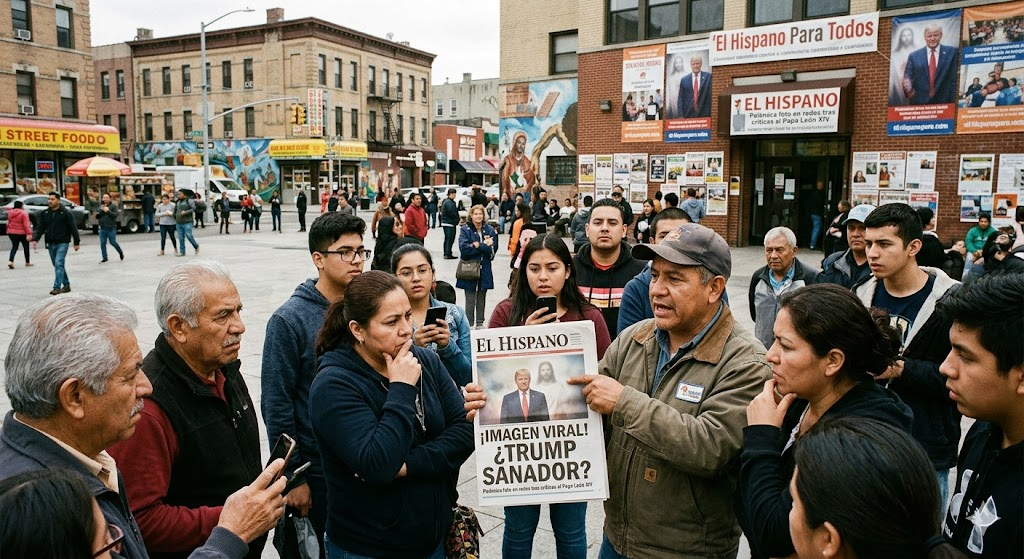
The truth is, there’s no single answer. However, there are three key points every reader of El Hispano Para Todos should consider before sharing this image:
- Source Verification: Always remember these images are digital creations. They’re not real photos or documented visions.
- Separation of Powers: One thing is political management (economy, jobs, borders), and another is personal faith. Mixing them usually ends badly for the average citizen.
- Respect for the Institution: Criticizing the Pope is a right, but using the image of Jesus Christ to attack him is, for many theologians, a line that shouldn’t be crossed.
“Politics feeds on hope, but religion feeds on faith. When the two are confused, critical thinking is usually the first victim.” — El Hispano Editorial.
Long-Term Consequences: Toward an American Church?
This event sets a precedent. If Trump successfully distances his base from Pope Leo XIV’s leadership, we could be witnessing the birth of a much more pronounced “nationalist Christianity.” This wouldn’t just affect elections but the social structure of communities in Florida, Texas, and Arizona, where the church is the center of community life.
The important thing here isn’t whether the photo is attractive or not. What matters is that we’re seeing the Uberization of religion: everyone chooses their own “messiah” based on their Facebook algorithm.
Image: ElHispanoparaTodos/PRESS