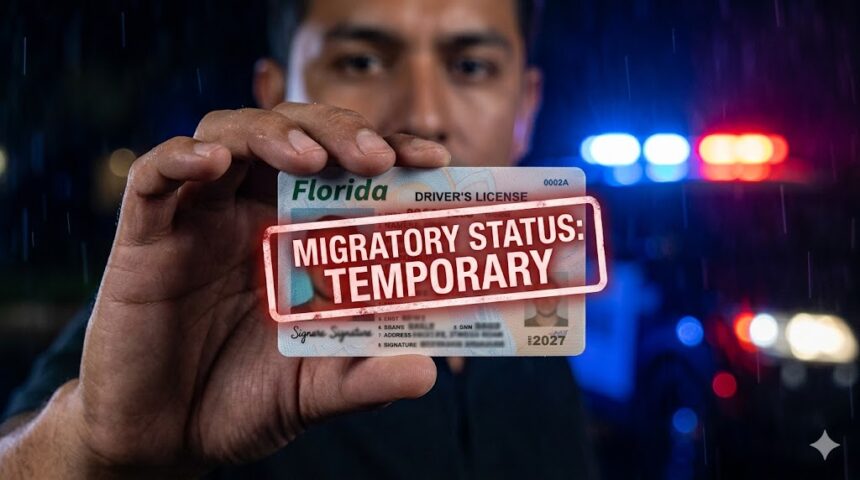
The End of Immigration Privacy on Florida Roads
Ron DeSantis’ administration has done it again. In a move many analysts describe as the “final step” toward total state-level immigration control, Florida is preparing for a radical transformation of its identification system. Starting in 2027, your driver’s license won’t just say who you are and where you live—it will shout your legal status in the country to any authority—or even a supermarket cashier.
This change isn’t just an administrative tweak; it’s a declaration of psychological warfare for thousands of families. Do we really need a transit ID to become a status passport? For Tallahassee’s government, the answer is a resounding “yes” in the name of public safety. For our community, it’s a maximum alert signal.

What You Need to Know Today
Starting January 1, 2027, all driver’s licenses issued in Florida must include a distinct visual identifier indicating whether the holder is a U.S. citizen, permanent resident, or has temporary/undefined legal status. This measure aims to facilitate the immediate identification of immigrants by police and state agencies, eliminating the ambiguity allowed by the current REAL ID license system.
The Anatomy of the Change: What Will Appear on Your Card?
The law is specific but leaves room for technical interpretation by transportation authorities (FLHSMV). What we know so far is that it won’t be a subtle mention.
The Codes of Contention
The new cards are expected to use a system of codes or colors in the upper-right corner of the license:
- Citizenship Indicator: A specific seal or color for native-born or naturalized citizens.
- Limited Legal Status: A clear mark for DACA recipients, TPS holders, or temporary work visa holders.
- Privacy Restriction: A differentiated design for those who cannot prove legal presence, which would technically invalidate the card for federal purposes and could automatically draw ICE’s attention.
Why Wait Until 2027?
The truth is Florida’s technological system needs a massive overhaul. Real-time interconnection with the Department of Homeland Security (DHS) and U.S. Citizenship and Immigration Services (USCIS) databases is required. Three years may seem like a long time, but it’s the deadline they’ve set to ensure there are no “mistakes” in marking someone.

Comparison: Current License vs. 2027 License
| Feature | Current Model (REAL ID) | New Model (2027 Law) |
| Gold Star | Indicates federal compliance. | Remains, but status is added. |
| Status Visibility | Hidden in the chip/database. | Explicit on the front design. |
| Use in Police Checks | Requires secondary verification. | Instant status identification. |
| Privacy Impact | Moderate. | None; total exposure. |
The Danger of Racial Profiling
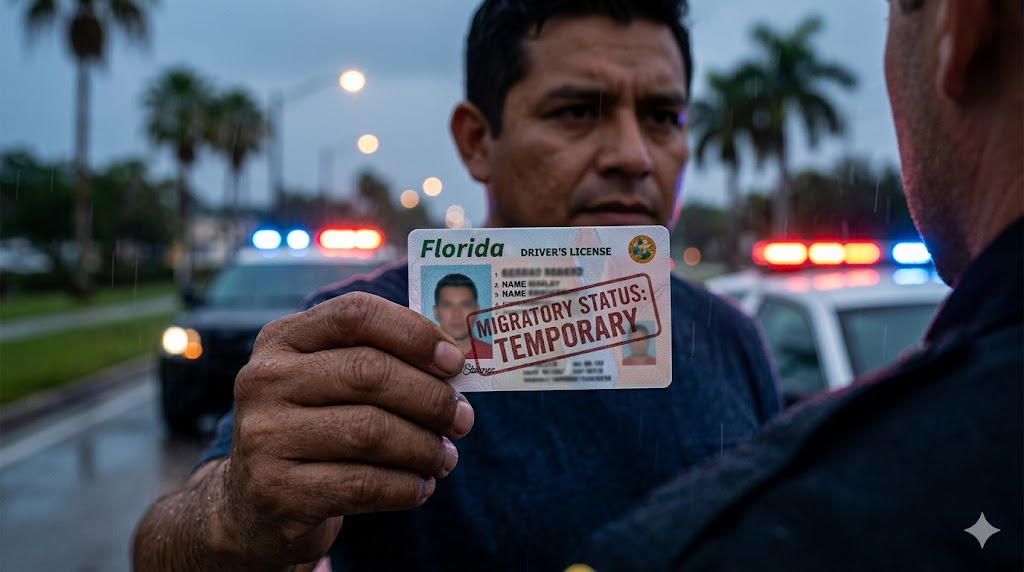
Let’s cut to the chase: this is an open invitation to profiling. If a police officer stops two people for a minor traffic violation, and one license bears the seal of “Unverified Status” or “Temporary,” do we really believe the treatment will be the same?
Uncomfortable truth: This law turns local police into de facto immigration agents. A simple failure to signal could end in a processing center if the status revealed on the license isn’t the “ideal” one.
The Effect on Daily Life
It’s not just about the police. Consider:
- Car rentals: Companies could deny service based on the immigration marker.
- Entry to government buildings: Greater scrutiny for those with the “temporary” marker.
- Employment contracts: Though the I-9 is the federal standard, a biased employer could use the license as an illegal pre-screening filter.
What Can You Do to Prepare?
It’s not time to panic, but it is time to be strategic. If you live in Florida, the clock is already ticking.

- Regularize what you can now: If you have a pending case, this is the time to push it forward with your attorney. Don’t wait for your license to expire in 2027.
- Know Your Rights: Regardless of what your license says, in the U.S. you have the right to remain silent and to refuse searches without a warrant. The license states who you are, but it doesn’t require you to disclose your immigration history.
- Alternative Documentation: Always keep a copy of your original immigration documents (TPS, DACA, residency) in a safe place. Don’t rely solely on your driver’s license as proof of your legal status.
Do we really need another law that divides us? Probably not, but this is what’s on Florida’s horizon. The Sunshine State is becoming a place of shadows for those without definitive paperwork.
Image: ElHispanoParaTodos/PRESS