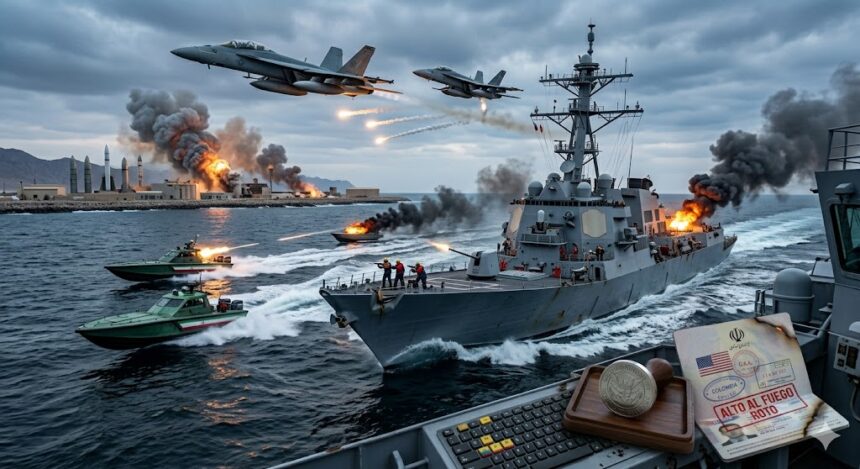
The fragile peace the world had been breathing after weeks of intense secret negotiations in the Middle East has alarmingly cracked. Just as the international community began to believe the diplomatic path pushed by mediators in Qatar and Pakistan would bring a definitive respite to the global crisis, crossfire has returned to the Persian Gulf. The United States Central Command (CENTCOM) has officially confirmed the execution of new strikes against Iran, destroying strategic military infrastructure in the south of the Persian country. Tehran’s response was swift: the Iranian government has formally denounced a “flagrant breach” of the indefinite ceasefire both sides had agreed to just last month.
- Anatomy of the Bandar Abbas Attack: What Exactly Happened in the Strait of Hormuz?
- Tehran’s Stance: “A Smokescreen to Maintain Pressure”
- X-Ray of a Fragile Armistice: Timeline of the Iran-U.S. Crisis
- The $24 Trillion Labyrinth: What’s Really Being Negotiated Behind the Scenes
- Collateral Effects: How Does This Crisis Impact the Hispanic Community in the U.S.?
- Does This Mean the Peace Agreement Is Dead?
The truth is that the promises of President Donald Trump’s administration not to “rush” a definitive agreement seem to have collided with the harsh operational reality of a region hyperventilating after months of open conflict. As oil prices and global inflation indicators react with panic to this new clash, the question on everyone’s lips is whether we are witnessing the prelude to an irreversible regional escalation.

Breaking Summary (Snippet Bait): U.S. military forces carried out “self-defense” operations against missile launch platforms at the strategic Bandar Abbas base and against Iranian vessels in the Strait of Hormuz. The attack, which left at least four Iranian sailors dead, has been labeled by Tehran as a direct violation of the existing armistice. The Pentagon insists the ceasefire remains formally in place, justifying the incursion as a reactive measure to imminent threats against its combat aircraft.
Anatomy of the Bandar Abbas Attack: What Exactly Happened in the Strait of Hormuz?
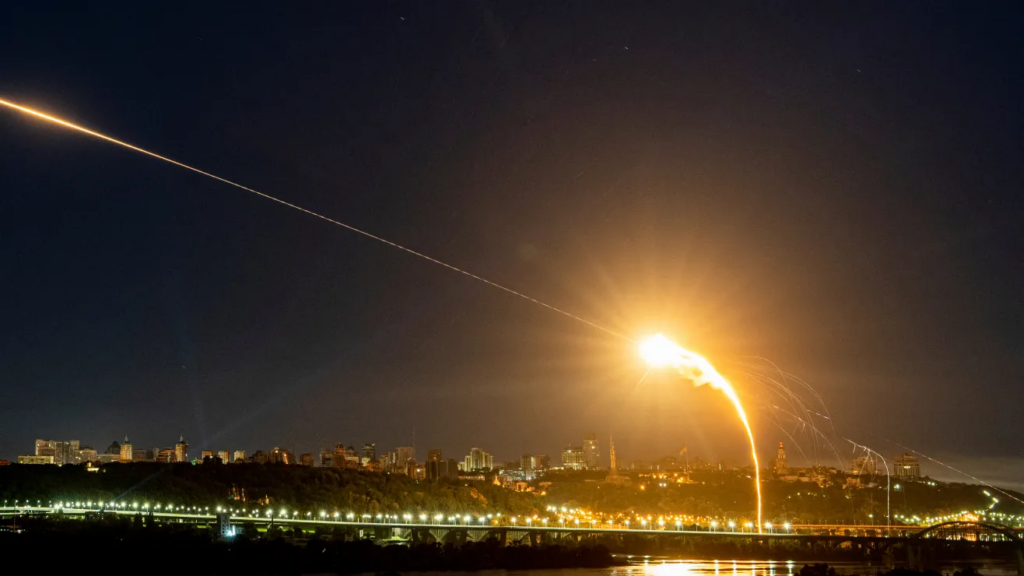
On Monday, May 25, 2026, the tense calm dominating the waters of the Strait of Hormuz was shattered. According to reports validated by the U.S. command, combat aircraft deployed in the area detected suspicious activity at missile sites of the Islamic Revolutionary Guard Corps (IRGC) in Bandar Abbas, a logistical and military hub critical for controlling global maritime trade.
A high-ranking source in the Donald Trump administration told allied broadcasters that U.S. operational forces responded to “radar lock-ons” by Iranian batteries targeting U.S. patrol aircraft. The president’s prior authorization to repel any threat in the waterways was immediately activated. The result: two Iranian navy vessels disabled at sea and a ground-based launch platform completely destroyed.
Tehran’s Stance: “A Smokescreen to Maintain Pressure”
For Iran’s leadership, headed by Supreme Leader Mojtaba Khamenei (direct successor following the lethal events that sparked the conflict in late February 2026), the U.S. narrative of “self-defense” is unsustainable. Iran’s Foreign Ministry accused the White House of using the dialogue tables in Islamabad and Doha merely as diplomatic cover while continuing to militarily and economically suffocate the nation.
Here’s the twist: in immediate retaliation for Washington’s incursions, the IRGC Navy launched attacks with fast boats and suicide drones against U.S. warships stationed in the Strait of Hormuz and the Gulf of Oman. Spokesmen for the Islamic Republic’s military assured that any formal attempt to resume large-scale warfare would provoke a response “devastating and far more painful for Washington.”

X-Ray of a Fragile Armistice: Timeline of the Iran-U.S. Crisis
The current conflict did not begin yesterday. To understand how we reached this point of negotiation collapse, let’s analyze the timeline that has kept the global economy and stability on edge throughout 2026:
| Time Period (2026) | Key Military/Diplomatic Event | Direct Impact on the Global Stage |
| February 28 | U.S. and Israel launch surprise bombings on Iran. Previous Supreme Leader dies. | Immediate closure of the Strait of Hormuz; extreme volatility in energy markets. |
| April 8 | Pakistan mediation secures an initial two-week ceasefire. | Channels open to negotiate the release of frozen financial assets. |
| April 21 | President Donald Trump extends the ceasefire indefinitely. | Discussions begin in Doha on the nuclear program and sanctions. |
| May 25-26 | New strikes against Iran in Bandar Abbas. Tehran accuses breach of agreement. | Oil prices spike; diplomatic peace talks stall. |
The $24 Trillion Labyrinth: What’s Really Being Negotiated Behind the Scenes
Behind the smoke of explosions and fiery television speeches, the real battle of this war is being waged in international bank accounts. Sources close to the negotiating team in Doha revealed that delegations from both countries are discussing a highly complex economic memorandum of understanding.
The absolute breaking point keeping diplomats’ pens at a standstill includes the following demands from both sides:

- Frozen Funds: Iran is demanding the immediate release of $24 billion in sovereign funds frozen abroad due to the Western sanctions regime. In fact, Iran’s chief negotiator, Mohammad Baqer Qalibaf, traveled urgently to Qatar to try to secure a viable financial delivery mechanism.
- The Navigation Clause: Washington is conditioning any economic relief on Iran’s written guarantee of the total, free, and safe opening of the Strait of Hormuz under a new regional maritime supervision scheme.
- The Extended Regional Pact: The White House is pressuring Iran to halt funding for its allies in Lebanon, Yemen, and Iraq, further demanding a non-proliferation commitment on nuclear weapons as the cornerstone of any final agreement.
“The Pentagon’s rhetoric that they are ‘exercising restraint’ while bombing coastal targets is a contradiction that endangers months of quiet diplomacy. No one signs a peace agreement with a gun pointed directly at their temple,” commented a European diplomat stationed in the Gulf under strict anonymity.
Collateral Effects: How Does This Crisis Impact the Hispanic Community in the U.S.?
It’s common to think that a missile exchange thousands of miles away doesn’t affect the daily lives of Latino families in Texas, California, or Florida. This is a monumental miscalculation. The average citizen’s wallet is the first to suffer the shrapnel of this conflict’s resurgence.
1. The Gasoline and Inflation Effect on Households: Daily Financial Impact.
The Strait of Hormuz is the artery through which nearly 20% of the world’s oil flows. Every time CENTCOM confirms strikes against Iran, international crude markets react upward. This translates into a direct increase in the price of a gallon of gasoline at U.S. service stations within 72 hours, automatically raising the cost of the food distribution chain and basic household goods.
2. Market Instability and Remittances: Currency Strategy.
The financial volatility caused by war alerts disrupts fiscal year economic projections. For the migrant community, a sharp fluctuation in the dollar against Latin American currencies (such as the Mexican peso or Colombian peso) alters the real value of remittances sent monthly to support parents and children in their countries of origin.
3. Enhanced Counterterrorism Surveillance: Domestic Security.
Domestically, the Department of Homeland Security (DHS) typically raises alert levels at key U.S. infrastructures (airports, ports, and government centers). Cargo transit controls and inspections at border crossings tend to become much stricter and slower as a preventive measure against potential cyberattacks or asymmetric retaliation actions.
Does This Mean the Peace Agreement Is Dead?
Not necessarily. CENTCOM spokesman Captain Timothy Hawkins emphasized that commanders on the ground remain aligned with the ceasefire framework, as long as Iranian forces do not cross operational “red lines” that directly endanger the lives of U.S. troops stationed at regional bases. The next 48 hours will be decisive in determining whether negotiators in the Gulf can extinguish this new fire or if the drums of total war will sound with definitive force in this complex year of 2026.
Image: ElHispanoParaTodos/PRESS