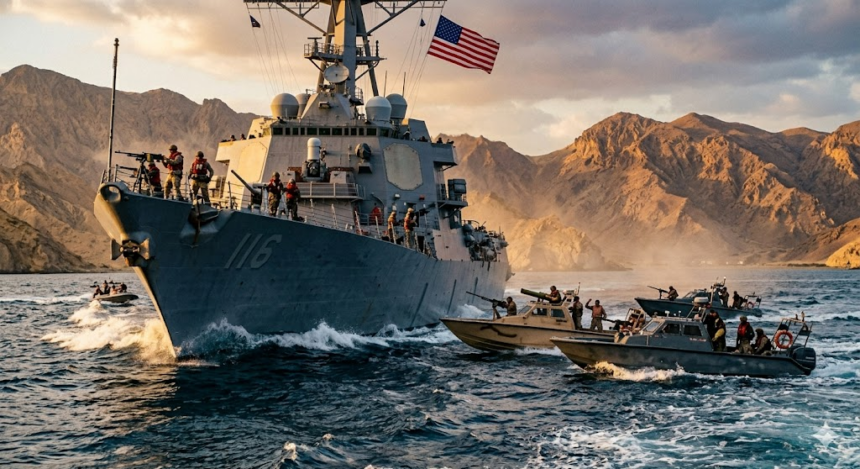
Tensions in the Persian Gulf have just escalated from “uncomfortable” to “explosive”—war could break out in seconds. This isn’t just Twitter (or Truth Social) rhetoric; it’s a direct order to the United States Navy that could reshape the geopolitical landscape before the day is over.
The short answer is blunt: Donald Trump has given precise instructions to the U.S. Navy to “shoot down and destroy” any Iranian vessel that harasses or endangers American ships in international waters. This measure aims to curb the constant harassment by Iran’s Revolutionary Guard fast boats in the crucial Strait of Hormuz, through which nearly 20% of the world’s oil passes.

The Chessboard: Why Now and What Exactly Was Ordered?
The order didn’t come out of nowhere. After weeks of “unprofessional” encounters—according to the Pentagon—between Iranian vessels and U.S. destroyers, the administration has decided to draw a red line in the water.
Is this a political bluff or a real military rule of engagement? The truth is, in defense terms, a presidential order of this magnitude eliminates the “gray zones.” Commanders at sea no longer need to ask for permission to respond; the order to fire is pre-authorized if they feel threatened.
The Strait of Hormuz: The World’s “Bottleneck”
To understand why this affects you—whether you’re reading this from Florida or Texas—you need to look at the map. The Strait of Hormuz is a narrow passage connecting the Persian Gulf to the Gulf of Oman.
- Minimum width: Just 20 miles.
- Importance: It’s the main artery for crude oil leaving Saudi Arabia, Iraq, and Kuwait.
- The Risk: A single armed incident here could instantly spike oil barrel prices.
Critical Note: If Iran decides to close the strait in retaliation, we wouldn’t just be talking about a military conflict but an energy crisis that could make today’s inflation look like child’s play.
Implications for the Hispanic Community and the Global Economy
Many are asking: “What does a ship in the Middle East have to do with me?” The answer is in your wallet.

- Gasoline Prices: The U.S. is a major producer, but the oil market is global. A conflict in the Strait of Hormuz means filling up your car’s tank could cost 30% to 40% more within weeks.
- Market Instability: If stock markets panic, the retirement funds (401k) of thousands of Hispanic workers in the U.S. are directly affected.
- National Security: Increased military presence usually comes with higher defense spending, which shifts the country’s budget priorities.
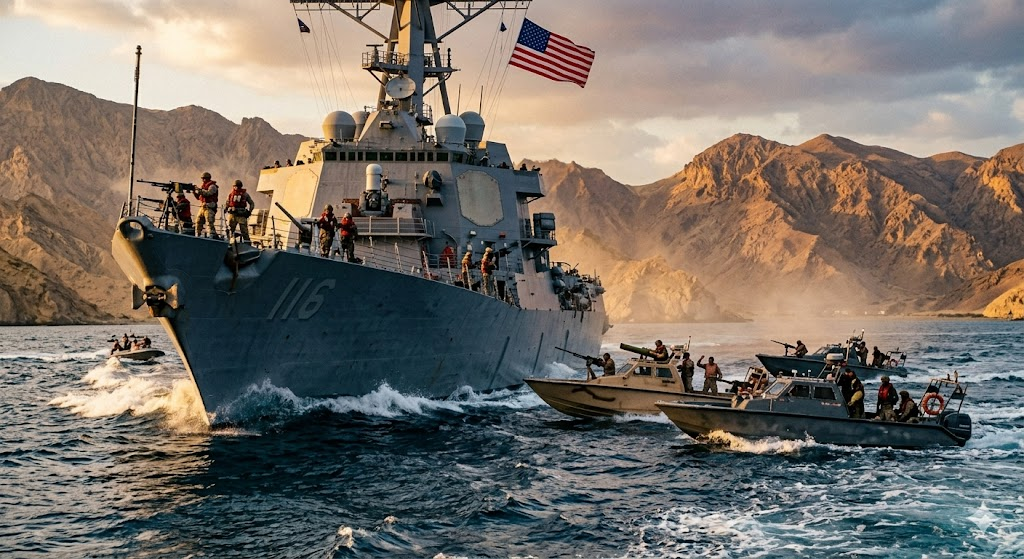
Naval Capabilities in the Region: A Comparison
| Force | Type of Vessel | Main Tactic |
| U.S. (5th Fleet) | Arleigh Burke-class destroyers | Aegis technology, guided missiles, long-range defense. |
| Iran (Revolutionary Guard) | Armed fast boats | “Swarming,” naval mines, hit-and-run attacks. |
What Does Iran Say? Tehran’s Response to the Threat
As expected, the Iranian regime hasn’t stayed silent. They’ve dismissed Trump’s order as “propaganda” and warned that their forces are prepared to defend their territorial waters. This is where the danger of a “miscalculation” becomes real.
What if an Iranian boat drifts too close due to mechanical failure and a U.S. ship captain interprets that as an imminent attack under Trump’s order? The line between defense and provocation has never been thinner.
- Flashpoint 1: The use of surveillance drones by both sides.
- Flashpoint 2: Harassment of commercial ships from U.S. allies (like the United Kingdom).
- Flashpoint 3: The nuclear rhetoric that always looms in the background of negotiations with Iran.
Are We Really Close to Open War?
Probably not… yet. In Trump’s foreign policy, “maximum pressure” is often a negotiation tool. By threatening to fire, Trump aims to force Iran to the table or, at least, to back down from its maritime guerrilla tactics.

However, playing with fire near a powder keg (literally, because of the oil) is an extremely high-risk strategy. The international community, especially Europe, is watching this escalation nervously, fearing that a minor incident could trigger a chain reaction no one can stop.
Image: ElHispanoParaTodos/PRESS