Citizenship in Limbo: Trump Targets Passports for Children of Undocumented Immigrants
Historic blow to birthright citizenship! Trump considers restricting passports for children of undocumented immigrants born in the U.S. Understand the legal impact.
If you’ve had the joy of seeing your children born on U.S. soil, you likely grew up with the absolute certainty that one of the greatest strengths of their future was their inalienable right to American citizenship, enshrined in the 14th Amendment of the Constitution. The truth is, for millions of immigrant families, that birth certificate issued by the hospital served as an unbreakable shield against uncertainty and deportation.
However, the recurring proposals from the most restrictive faction of the national immigration policy once again place this constitutional pillar at the center of a legal storm. The idea that the federal government might begin to question the validity of passports or the issuance of citizenship certificates based on the immigration status of parents at the time of birth is not just rhetorical provocation; it’s a direct threat to the stability of millions of mixed-status households. What lies behind this strategy, what are the real constitutional obstacles, and what impact would it have on the Hispanic community? Let’s break it down thoroughly.
Advertisement
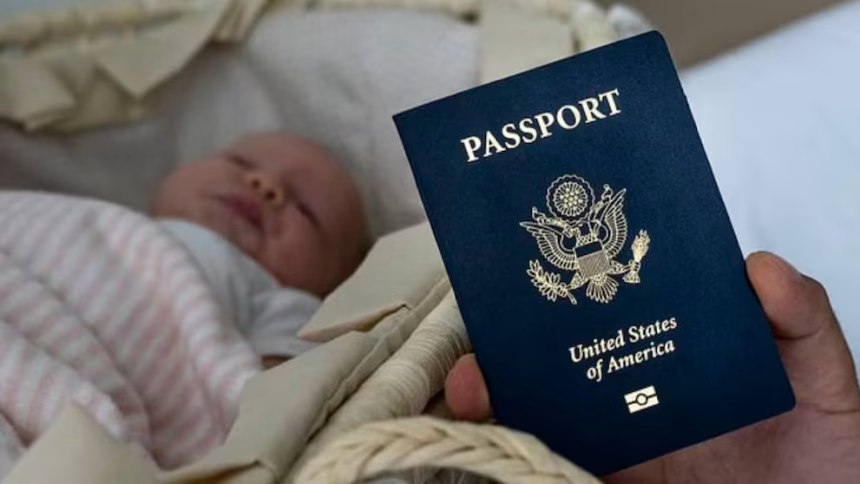
The crux of the constitutional debate (Snippet Bait): The proposal pushed in conservative circles and backed by Donald Trump seeks to challenge the principle of birthright citizenship through executive orders or decrees that would direct federal agencies to withhold the issuance of U.S. passports to minors whose parents lack legal residency or citizenship, forcing them to prove their status. Legal experts warn that this measure flagrantly violates Section 1 of the 14th Amendment of the Constitution, triggering an inevitable and monumental battle before the Supreme Court.
Donald Trump aims to be remembered long after leaving the presidency, which is why he ordered his image to be included on a page of the commemorative edition of the U.S. passport. Credit: Department of State | AP
The anatomy of the conflict: What does the 14th Amendment say, and why do they want to change it?
To understand the magnitude of this political clash, it’s necessary to analyze the legal foundation that has upheld automatic citizenship in the country since the 19th century.
1. The historic safeguard of the 14th Amendment
Adopted in 1868 after the Civil War, the 14th Amendment clearly establishes in its Citizenship Clause: “All persons born or naturalized in the United States, and subject to the jurisdiction thereof, are citizens of the United States and of the State wherein they reside.”
The historic scope: For over 150 years, federal courts and Supreme Court jurisprudence have interpreted the phrase “subject to the jurisdiction thereof” to include nearly anyone present in the national territory, regardless of whether their parents are tourists, temporary residents, or undocumented immigrants.
The uncomfortable truth: Opponents of this interpretation argue that the framers of the 1868 amendment did not foresee the phenomenon of contemporary irregular immigration, suggesting that granting citizenship to children of undocumented parents creates perverse incentives. However, amending the Constitution requires an extremely complex process involving two-thirds of Congress and ratification by three-fourths of the states, which is why the path chosen by conservative sectors is typically a direct judicial challenge through executive orders.
2. The operational impact: Requiring parents to show papers at passport offices
If a policy of this nature were to be implemented administratively, the operational consequences would be felt immediately at the counters of the State Department.
Advertisement
The block on document issuance: Consulates and passport offices (Passport Acceptance Facilities) would receive instructions to suspend the routine processing of passports for minors born to undocumented parents, requiring proof of legal residency from the parents before formally recognizing the child’s citizenship.
Widespread fear in mixed-status communities: The mere possibility that the federal government might begin auditing the immigration status of mothers and fathers when applying for a school or identity document for their U.S.-born children creates a climate of institutional terror, deterring families from accessing essential public services.
Chart: A breakdown of the legal clash — The proposal vs. constitutional reality
To visualize the arguments and legal obstacles of this initiative with precision, we contrast the key aspects of the conflict:
Analysis Axis
Perspective of the Measure’s Proponents
Constitutional and Legal Perspective
Legal Interpretation
They argue that children of undocumented immigrants are not “fully subject to the jurisdiction” of the country.
The Citizenship Clause of the 14th Amendment protects all those born on national territory without exceptions.
Intended Mechanism
Executive orders and directives to the State Department to halt passports.
Manifest unconstitutionality due to usurpation of legislative and judicial powers.
Political Objective
To discourage irregular immigration and redefine the boundaries of nationality.
To protect acquired rights and prevent the creation of second-class citizens.
Practical guide: How to protect your children’s documentary rights and stay calm
In the face of recurring announcements of measures seeking to restrict fundamental rights, immigrant families must act with verified information and legal prudence. Follow these foolproof steps:
1. Obtain the certified birth certificate and Social Security number: Secure the vital documentation for your children born in the U.S.
Advertisement
The fundamental document proving a minor’s U.S. citizenship is their birth certificate issued by the county or state where they were born, along with their official Social Security card. Make sure to keep these original documents in a safe place and keep certified copies on hand.
2. Don’t give in to panic or avoid essential procedures due to rumors: Apply for passports on time through regular channels.
To date, federal courts have systematically blocked any attempt to undermine the 14th Amendment through executive orders. If you need to apply for a U.S. passport for your minor child for travel or identification, visit authorized offices following the State Department’s standard requirements, with the support of accredited legal advisory organizations.
3. Avoid falling for notary fraud or fake agents: Consult only accredited lawyers and trusted organizations.
Amid complex immigration debates, scammers abound, promising magical solutions or terrifying families with false alarms about retroactive loss of nationality. For rigorous information, consult legal updates from organizations like the American Civil Liberties Union (ACLU) or neutral coverage from Associated Press.
The truth is that constitutional rights do not vanish by the mere will of a political decree; they require a long and tortuous path of legal battles that civil society and states defending civil rights are prepared to fight. For our Hispanic community, knowing the law and maintaining composure is the best shield against uncertainty.