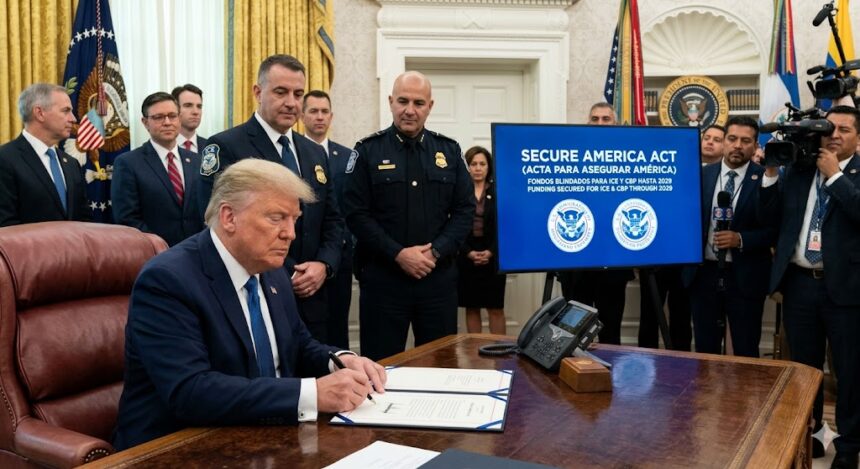
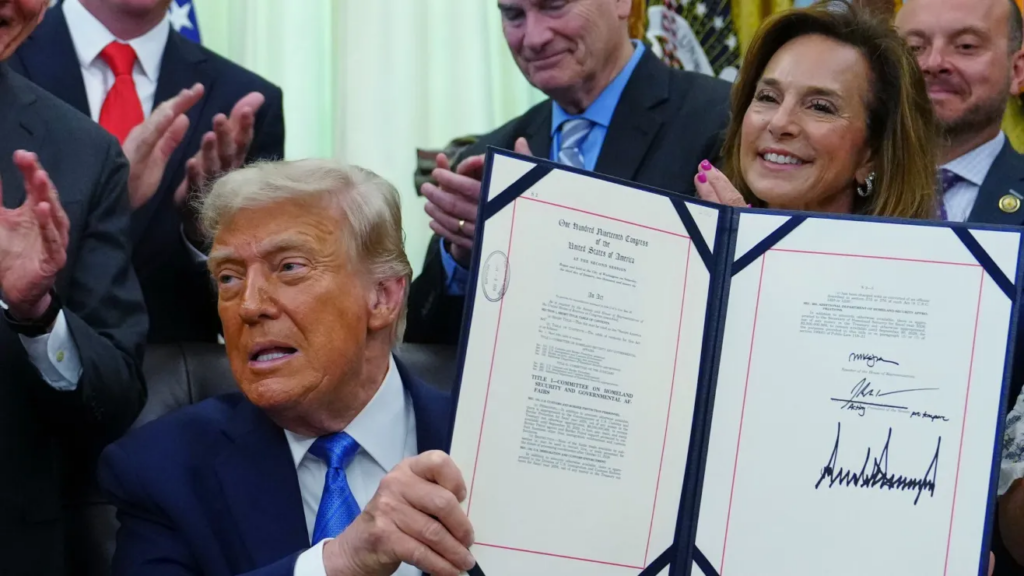
Uncertainty has ended in the halls of the West Wing, but it is just beginning on the streets of our Hispanic communities. If you have a family member with a pending immigration case, run a business that depends on foreign labor, or simply monitor the pulse of laws in this country, be prepared. In a ceremony laden with political symbolism at the White House, President Donald Trump signed the Secure America Act. This is not a routine budget extension; it is a multibillion-dollar blank check of nearly $70 billion that shields the deportation and border patrol machinery until the end of his term in 2029.
- The Reconciliation Route: How Was This Law Passed Without Democratic Support?
- Anatomy of the Secure America Act Budget
- Comparative Table: The New Era of Immigration Enforcement
- The Real Impact in the Southeast: The Shadow Over Florida Cities
- Family Contingency Guide: How to Act in the New Enforcement Environment
The truth is that the White House strategy has been surgical. By using the complex legislative mechanism of “budget reconciliation,” Republicans managed to bypass the Democratic opposition’s blockade in Congress, ending months of fiscal paralysis that kept the Department of Homeland Security (DHS) in limbo.

Immediate Operational Impact (Snippet Bait): With the signing of the Secure America Act, the Donald Trump administration secures massive funding of $38.9 billion for U.S. Immigration and Customs Enforcement (ICE) and $22.6 billion for U.S. Customs and Border Protection (CBP), extended through September 30, 2029. This law directly authorizes the mass hiring of border agents, the expansion of private detention centers, the implementation of biometric surveillance technology, and full funding for 287(g) agreements that allow local police to act as immigration agents, accelerating the plan to carry out up to one million deportations annually.
The Reconciliation Route: How Was This Law Passed Without Democratic Support?
To understand the significance of what just happened, you need to grasp the parliamentary “trick” that was used. Normally, a law of this magnitude requires 60 votes in the Senate to overcome a filibuster. Democrats had conditioned national security funds on greater civilian oversight and accountability following fatal incidents earlier this year involving federal agents.
Here’s the interesting part: by packaging the funds under a budget reconciliation bill (linked to resolution S.Con.Res. 33), Congress only needed a simple majority. The Senate approved the measure with a 52-47 vote, and the House of Representatives followed with a razor-thin margin of 214-212. No Democrat voted in favor.
The result? An absolute budget shield that protects ICE and CBP from any future attempts at “financial asphyxiation” or budget disputes on Capitol Hill for the next three years. The money is already secured and untouchable.
Anatomy of the Secure America Act Budget
Where exactly will these nearly $70 billion go? It’s not just about patrols and physical walls. The distribution of funds reveals a strategy focused on high technology and the decentralization of arrests:

- ICE Removal Infrastructure ($38.9 billion): Allocated for hiring personnel, repatriation flights, contracts with private prisons, and the modernization of computerized tracking systems.
- CBP Frontline Missions ($22.6 billion): Secured funds for deploying personnel along the southern border, tactical support operations, and maintenance of perimeter infrastructure.
- Technological Surveillance and Interdiction ($3.45 billion): Modernized inspection equipment at ports of entry, biometrics, surveillance drones, and technology for detecting substances like fentanyl.
- Emergency Contingency Fund ($5 billion): Reserved exclusively for unexpected expenses or “spikes” in border detentions, avoiding the need to seek additional approval from Congress.
- Activation of 287(g) Agreements: A substantial financial injection to expand partnerships with local police departments and county sheriffs (especially in southeastern states like Florida and Texas), providing them with resources to assist in the identification and custody of undocumented individuals.
Comparative Table: The New Era of Immigration Enforcement
To understand the paradigm shift introduced by the Secure America Act compared to traditional budgets from past administrations, let’s analyze this table of fiscal priorities:
| Operational Focus | Traditional Budget Pre-2026 | Secure America Act Era (Through 2029) |
| Funding Duration | Annual (Subject to constant government shutdowns) | Multi-agency and multi-year through the end of FY2029. |
| Role of Local Police | Voluntary and limited cooperation | Aggressive funding of 287(g) agreements and local partnerships. |
| Border Technology | Focus on fixed cameras and infrastructure | Advanced biometrics, predictive analytics, and modernized inspection. |
| Human Rights Safeguards | Integrated civilian oversight clauses | Eliminated. Zero new restrictions on the use of force. |
The Real Impact in the Southeast: The Shadow Over Florida Cities
Wondering how a signature in the Oval Office affects a resident in Port St. Lucie, Fort Pierce, or Stuart ignores the interconnected nature of immigration law. The rhetoric of “national security” translates on the ground into a direct increase in visible control operations.
With secured funding for 287(g) agreements, local sheriffs in Florida’s Treasure Coast will have more resources—and, above all, greater political pressure—to activate legal status verification protocols during routine traffic stops or commercial license reviews.

“We’re not seeing a change in substantive asylum or residency laws, but rather a super acceleration of enforcement capacity. Money is no longer a limitation for ICE. If a deportation officer previously had to prioritize cases due to lack of space in detention centers or flights, this law eliminates that bottleneck overnight,” explains a senior immigration attorney based in Florida.
Family Contingency Guide: How to Act in the New Enforcement Environment
With the fiscal tightening brought by the Secure America Act, improvisation in mixed-status households is a luxury no one can afford. If you or a loved one is in a vulnerable situation, follow this civil preparedness protocol:
1. Carry Proper and Secure Documentation: Legal Prevention.
Avoid carrying foreign passports or birth certificates from your country of origin in your daily life unless you are en route to a specific procedure. If you live in a state that issues driver’s licenses regardless of legal status, or have a municipal ID or consular ID, carry them with you at all times. These documents verify your identity without immediately revealing your immigration status.
2. Know and Exercise Your Constitutional Rights: On-the-Ground Protocol.
Remember that the Fifth Amendment of the U.S. Constitution protects all individuals, regardless of immigration status. If an ICE officer or a local police officer under a 287(g) agreement approaches you or knocks on your door, stay calm. You have the right to remain silent and to not open the door unless the agent presents a judicial search warrant signed by a court judge (not an administrative arrest warrant issued by ICE).
3. Establish a Family Emergency Plan: Support Network.
Prepare a secure file with copies of all immigration documents, birth certificates of your U.S.-born children, property deeds, and lease agreements. Designate a family member with legal status or citizenship as the custodian of this file and grant them a legal power of attorney so they can make financial or custody decisions for your minor children in case of an unexpected detention.
The signing of this law shows that risk containment is a thing of the past; what lies ahead is completely uncharted territory of high operational impact where budget execution is the only constant rule. Tensions will continue to be closely monitored ahead of major international events this year, and our Hispanic community must remain vigilant, informed, and level-headed in the face of the fiscal changes coming to the architecture of border security.
Image: ElHispanoParaTodos/PRESS