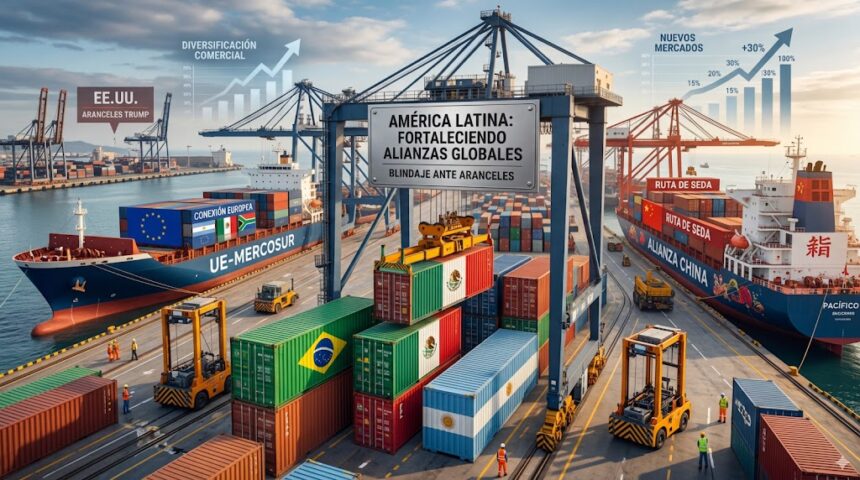
The old saying, “When the U.S. sneezes, Latin America catches a cold,” officially became obsolete in 2026. After a year of tensions, threats of reciprocal tariffs, and legal battles in the U.S. Supreme Court, Latin American countries have stopped waiting for mercy from Washington. Instead, they have activated a global contingency plan that is redrawing the flow of money.
The truth is, while the specter of border taxes still lingers, the region has found in the European Union and the Asian giant the lifelines needed to stay afloat. Are we witnessing a commercial divorce or simply a necessary diversification? Let’s get to the point.

Quick Response (Snippet Bait): By March 2026, Latin America has mitigated the impact of Trump’s tariffs through the signing and ratification of the historic EU-Mercosur Agreement, the modernization of the EU-Mexico deal, and a strengthening of ties with China. While sectors like steel and automobiles face tariffs of up to 25%, key products such as beef, coffee, and critical minerals have secured exemptions or new export routes that keep regional economies afloat.
The 2026 Scoreboard: Who Wins and Who Loses with Protectionism?
A year after the Trump administration launched its global tariff offensive, the landscape is a rhythmic chaos of victories and adjustments. While 2025 saw talk of a universal 10% tariff, the reality in 2026 is far more surgical and complex.
1. The Judicial Breathing Room: The Supreme Court Ruling
Recently, the U.S. Supreme Court dealt a blow to the White House’s economic agenda by striking down much of the global tariffs implemented under the International Emergency Economic Powers Act (IEEPA).
- What it means: Tariffs deemed unconstitutional have been eliminated (collecting nearly $170 billion).
- The fine print: Don’t celebrate just yet. Sector-specific tariffs (steel, aluminum, and automobiles) remain firmly in place.
2. The Mercosur Bloc: Europe’s “Third Way”
Here’s where things get interesting. After 25 years of waiting, the EU-Mercosur agreement has finally begun to take effect (provisionally since May 2026 for countries like Argentina and Uruguay). This deal creates a market of 780 million people and serves as a direct shield against Washington’s volatility.
| Country | Shielding Strategy | 2026 Outcome |
| Mexico | Mexico Plan (Import substitution) | Exempt from general tariffs but faces 25% on steel/autos. |
| Brazil | Pivot toward China and Mercosur | Surplus of $68.3B (the lowest in 3 years, but stable). |
| Argentina | Express ratification with the EU | Opening of 1,600+ tariff lines to Europe. |
| Chile | Modernization with the EU (2024-2025) | Stability in lithium and copper exports. |
Mexico: The USMCA Tightrope Walker
President Claudia Sheinbaum has maintained a stance of “pragmatic sovereignty.” While Mexico managed to stay out of the massive “reciprocal” tariffs, pressure on the manufacturing sector is suffocating. The Mexican strategy has been the “Mexico Plan”: strengthening the domestic market and ensuring that 85% of goods under the USMCA continue to flow unimpeded, despite the war cries from the White House.

Does it really work? The truth is that nearshoring remains the golden goose, but with a twist: companies are no longer looking just north but are also integrating European components to avoid putting all their eggs in the U.S. basket.
China: The Partner That Doesn’t Ask Tough Questions
While Trump uses tariffs as a tool for political interference—particularly visible in his pressure on Brazil—Beijing has seized the opportunity. So far in 2026, Uruguay and Ecuador have deepened their exports of beef and shrimp to China, offsetting the loss of competitiveness in the North American market.
Key Stat: Global trade is estimated to grow by just 0.5% in 2026. In this anemic growth scenario, regional integration is the only real vaccine against imported inflation.
Image: ElHispanoParaTodos/PRESS