If you’ve recently tried to break into the lucrative world of freight transportation in the United States, you’ve likely run into a four-letter roadblock: ELDT. What was once a process of “learning from your uncle in the parking lot” and taking the test has now become a federally regulated odyssey that’s leaving thousands of truck cab seats empty.
The truth is, the transportation sector is desperate for drivers, but the rigor of road safety has created a filter that many fail to pass—not for lack of skill, but for lack of clear information. Let’s break down this tangle.

Quick Answer (Snippet Bait): The ELDT (Entry-Level Driver Training) is a federal standard mandatory since 2022 that requires every first-time applicant for a CDL (Class A or B) to complete a theoretical and practical training program at a school registered with the FMCSA. Without the electronic certificate from this training, the DMV will not allow you to take the driving test, which has increased entry costs by 30% to 50%.
What exactly is the ELDT, and why does it exist?
The Entry-Level Driver Training (ELDT) isn’t a suggestion—it’s a law managed by the Federal Motor Carrier Safety Administration (FMCSA). Its goal is noble: to reduce fatal accidents on the roads by ensuring no one drives an 80,000-pound “monster” without a minimum academic foundation.
Who does this requirement affect?
Not all drivers fall under this scrutiny. You must comply with the ELDT if you’re in any of these situations:
- You want to obtain your Class A or Class B CDL for the first time.
- You’re looking to upgrade your license (e.g., from Class B to Class A).
- You need a specific endorsement: Passenger (P), School Bus (S), or Hazardous Materials (H).
The “Gordian Knot”: Why it complicates getting a CDL
This is where things get tough for our community. Before, preparation was informal and affordable. Today, the ELDT has introduced three major complications to the system:
1. The Training Provider Registry (TPR)
No more YouTube crash courses. The training must be provided by an entity listed in the federal registry (TPR). If the school isn’t registered, your progress is invisible to the DMV.

- The common mistake: Paying an unregistered private instructor. Money down the drain.
2. The Cost and Time Factor
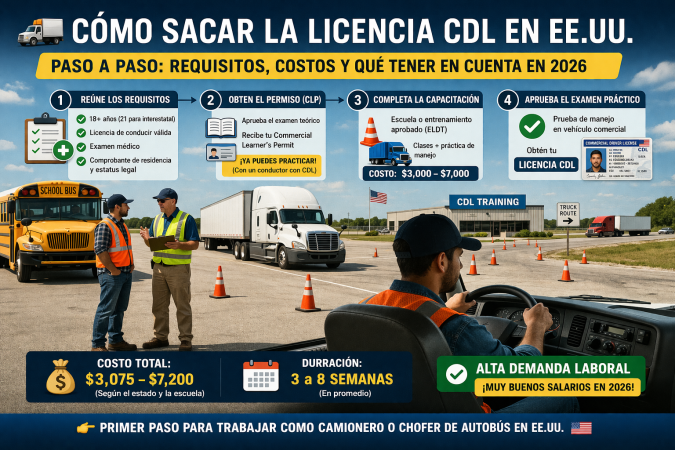
A quality ELDT course can range from $3,000 to $7,000. For an immigrant family seeking a job opportunity, this upfront cost is a class barrier. Additionally, it requires weeks of full-time dedication, making it impossible to work elsewhere while getting certified.
3. Theory vs. Practice
The ELDT divides the world into two:
- Theoretical Knowledge: 30 mandatory topics (inspections, air brakes, fatigue). You must score at least 80% on the assessment.
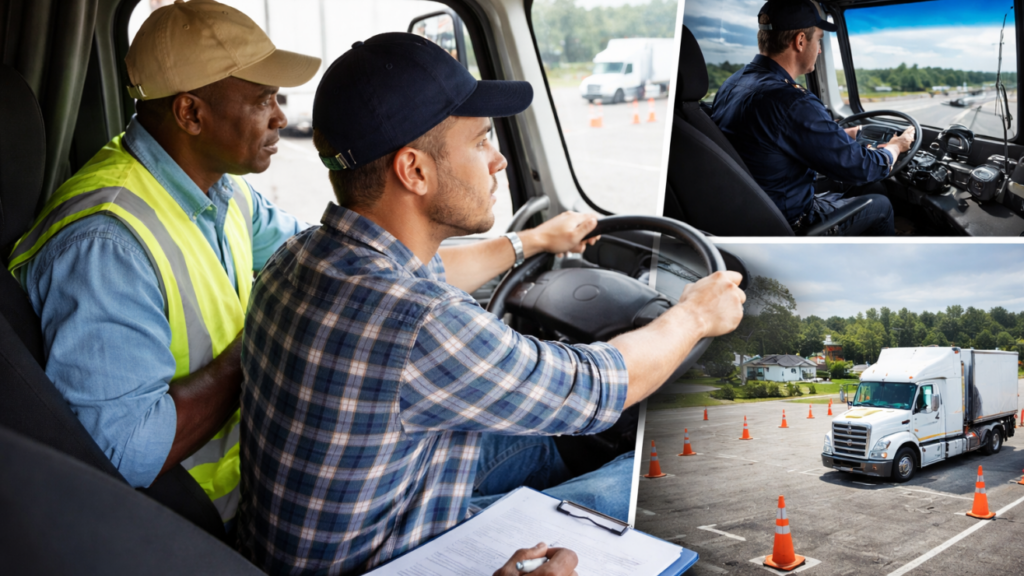
- Behind-the-Wheel Training (BTW): There’s no federal minimum hour requirement (some states do set one), but the instructor must certify you’ve mastered complex maneuvers before giving you the electronic “green light.”
How to navigate the process without failing (Step-by-Step Guide)
Do we really need more bureaucracy? Probably not, but this is the reality, and if you want the $70,000-a-year paycheck the industry promises, you’ll have to play by its rules.

- Get your CLP (Commercial Learner’s Permit): First things first. Pass the general knowledge written tests at the DMV.
- Find a school in the TPR: Visit the FMCSA’s official site and verify the school is legitimate.
- Complete the theory: Many schools allow you to do this part online. It’s tedious, but it’s the easy part.
- Practice in the yard and on the road: This is where you prove you can back up in “offset” and “parallel park.”
- Electronic Verification: The school uploads your results to the federal system. You won’t get a paper diploma to take to the DMV—it’s all digital.
- The final exam: Go to the DMV and take your skills test.
Image: ElHispanoParaTodos/PRESS