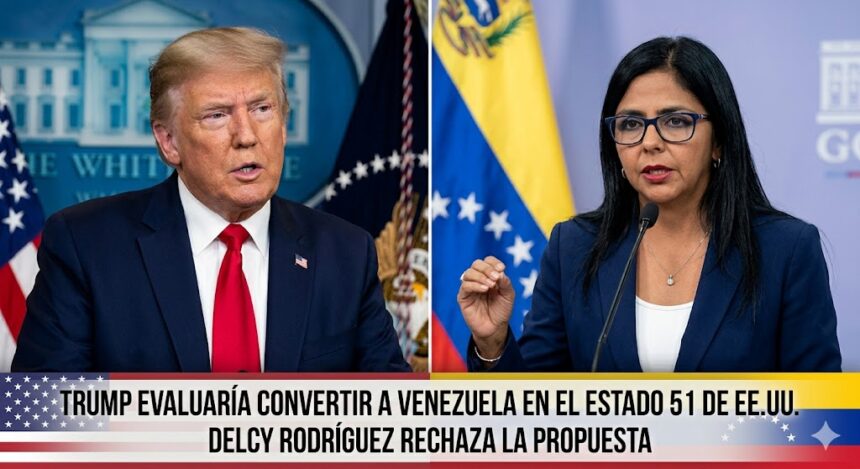
What began as a joke after a baseball game has turned into a diplomatic storm of historic proportions. Donald Trump has put forward an idea that sounds like geopolitical science fiction: making Venezuela the 51st state of the United States.
The response from Caracas (or what remains of its leadership after Nicolás Maduro’s capture) was swift. Delcy Rodríguez, acting as the figure in charge while territorial disputes are settled in The Hague, called the idea “unacceptable.” Are we witnessing a real expansion strategy, or is this simply Trump’s disruptive style at its peak?

“Venezuela becoming the 51st state was never on the table. Venezuelans deeply cherish our independence and our national heroes,” Rodríguez declared outside the International Court of Justice.
The Origin of the Chaos: From a Sports Tweet to the Oval Office
The spark was lit in March 2026, after Venezuela’s victory over the United States in the World Baseball Classic. Trump, true to his style of “rewarding” success, dropped the first hint on social media. However, what many took as a joke has escalated.
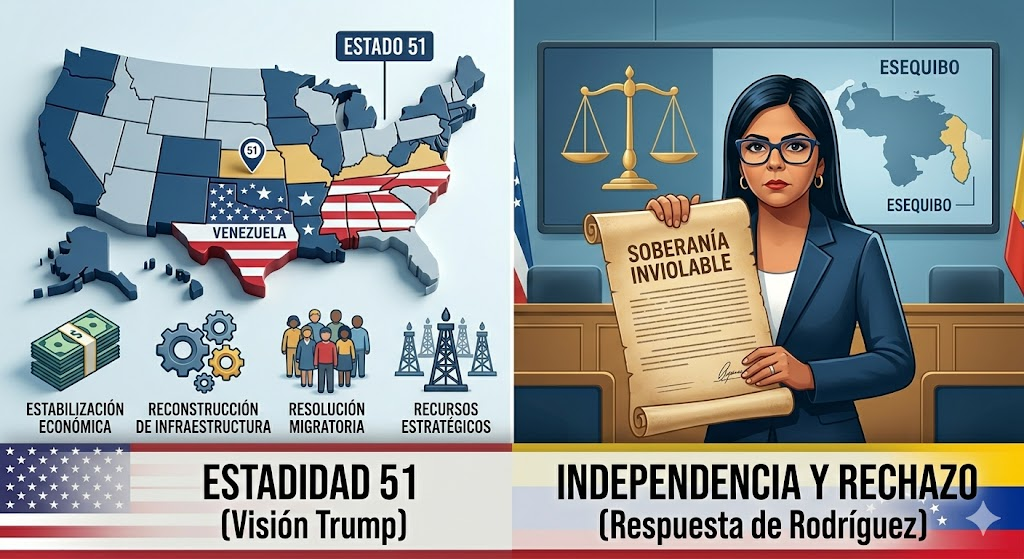
Recently, reports from journalists close to the White House, such as John Roberts of Fox News, suggest that Trump is seriously considering annexation. According to these sources, the president believes Venezuela’s oil infrastructure and geographic proximity make it a “strategic asset” that Venezuelans, in his view, “would love” to see under the U.S. flag.
Credit: ElHispanoParaTodos
The Oil Factor: The Real Engine Behind the Proposal
Let’s not kid ourselves. This isn’t just about baseball or “freedom.” The reality is that Venezuela holds the world’s largest oil reserves. After Maduro’s detention in January 2026, control over Venezuelan crude has been left in a limbo that Washington seems eager to fill.
- Projected Production: By the end of 2026, Venezuela is expected to generate over $22 billion in exports.
- Corporate Interest: Major U.S. oil companies are already landing in Venezuela with massive extraction platforms.
- Regional Stability: Trump argues that under U.S. administration, the migration crisis would be resolved “in one fell swoop.”
Delcy Rodríguez and the Resistance from The Hague
While Trump floats trial balloons in Washington, Delcy Rodríguez is in the Netherlands defending the Essequibo against Guyana. For her, sovereignty is a non-negotiable red line. The truth is, the situation is tense: the country is divided between those who see U.S. intervention as an economic lifeline and those who view any annexation attempt as a “colonial humiliation.”

Is It Legally Feasible?
Here’s where it gets interesting… For a territory to become a state, a complex process is required under the Admissions Clause of the U.S. Constitution (Article IV, Section 3). This isn’t something Trump can decide by decree, but his narrative is already resonating in certain sectors that prefer the stability of the dollar over the chaos of the bolívar.
Comparison: Venezuela or Puerto Rico?
| Aspect | Puerto Rico (Commonwealth) | Venezuela (Trump’s Proposal) |
| Population | ~3.2 Million | ~28 Million |
| Resources | Tourism / Pharmaceuticals | Oil / Gas / Gold |
| Legal Status | Unincorporated territory | Sovereign nation (in crisis) |
| Resistance | Divided between statehood and independence | Strong official rejection |
Trump’s “Expansion Protocol”: Who’s Next?
This isn’t the first time the 47th president has toyed with the world map. He already tried with Greenland (offering $700 billion) and has clashed with Canada over trade issues that ended with suggestions of a “merger.”

The truth is, this proposal regarding Venezuela aims to achieve two things:
- Distraction: Divert attention from domestic issues in Washington.
- Positioning: Send a clear message to China and Russia about who dominates the Western Hemisphere.
What Does This Mean for Everyday Venezuelans?
For the Hispanic community, especially the diaspora in Florida, these statements are an emotional rollercoaster. On one hand, there’s hope for rapid reconstruction; on the other, fear of losing national identity. The reality is that as long as Delcy Rodríguez stands firm in her independence rhetoric, any move toward statehood seems more like a geopolitical dream (or nightmare) than an immediate possibility.
Bottom Line: Venezuela won’t become the 51st state tomorrow, but the fact that it’s being seriously discussed in the halls of the White House marks the beginning of an era where borders, as we know them, seem to be up for grabs.
Image: ElHispanoParaTodos/PRESS