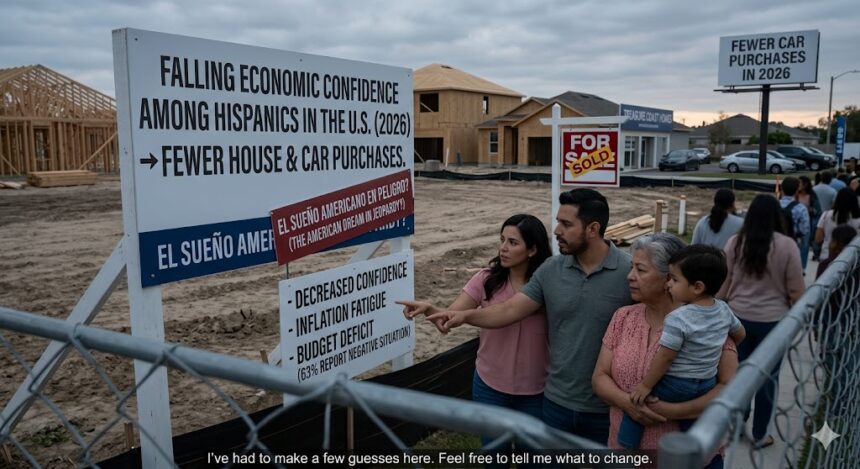
The Latino community’s wallet in the United States is sending a red alert that Washington cannot ignore. What began as cautious spending after post-pandemic inflation has turned into a sudden halt in consumption by mid-2026. It’s no longer just about choosing generic brands at the supermarket; today, Hispanic families are crossing off two cornerstones of progress in this country: homeownership and a new car.
Key Data: According to recent figures from the National Association of Hispanic Real Estate Professionals (NAHREP), only 42% of Hispanics believe 2026 is a good year to buy a home—a sharp drop from the optimism of previous years.

The Collapse of Expectations: What’s Really Happening?
The reality is that optimism is fading. At the start of this year, nearly 70% of our community expected their financial situation to improve; today, that number barely reaches 58%. The reason? A toxic mix of stubbornly high interest rates, gas prices squeezing daily budgets, and a job market that, while stable on paper, feels increasingly precarious on the ground.

The truth is that many Latinos are operating in “survival mode.” If the average salary rises by 5% but rent and basic groceries increase by 8%, the math simply doesn’t add up. It’s not a lack of desire to get ahead—it’s pure realism.
The “Brake Effect” on Homes and Vehicles
Buying a home or a car has become a financial high-risk sport. Here’s how this impact is being felt on the streets:
| Sector | Situation in 2026 | Impact on the Hispanic Community |
| Housing | Mortgage rates stalled and record-high prices. | Sharp decline in mortgage loan applications. |
| Automotive | New car loans above 9% interest. | Only 35% of Latinos plan to buy a car this year. |
| Daily Spending | Inflation in basic services and energy. | 40% of households have cut back on food expenses. |
Why Aren’t We Buying Homes Anymore?
Historically, Hispanics have been the driving force of the real estate market in states like Florida, Texas, and California. However, in 2026, access to credit has become a Great Wall. With an annual income of over $100,000 now required for the average family, the dream of a home with a yard is being replaced by the anxiety of renewing a lease that rises every twelve months.
Can we really blame anyone for not wanting to commit to a 30-year mortgage in this climate? Probably not. Uncertainty is the worst enemy of investment.

Invisible Factors: Geopolitics and “Economic Nostalgia”
Here’s the interesting part: it’s not just about the numbers—it’s about the sentiment. Many Latinos have expressed a kind of “economic nostalgia,” remembering decades when, though work was hard, money stretched enough to save. Today, the fear that a conflict in the Middle East could send gas prices to prohibitive levels—already near $4.23 in several cities—keeps people clinging to their savings under the mattress (or in high-yield savings accounts, if they’re lucky).
- Fear of Unemployment: Despite official rates, in service and construction sectors (where Latino labor is key), hiring is perceived to be slowing down.
- Food Insecurity: It’s painful to admit, but nearly 4 in 10 families have had to postpone medical treatments or buy less food to make ends meet.
Resilience Strategies: What to Do Now?
If you feel the outlook is bleak, you’re not alone. But the Hispanic community has always known how to weather storms. Experts suggest three key moves for the second half of 2026:
- “Ant Expense” Audit: It’s time to cut those unused subscriptions and meals out that drain your account.
- Emergency Fund Priority: Before thinking about a home, make sure you have at least 3 months of basic expenses in cash. Confidence is built on liquidity.
- No to Consumer Credit: With current rates, buying a TV or clothes on credit means paying almost double. If you don’t have the cash, wait.
Image: ElHispanoParaTodos/PRESS