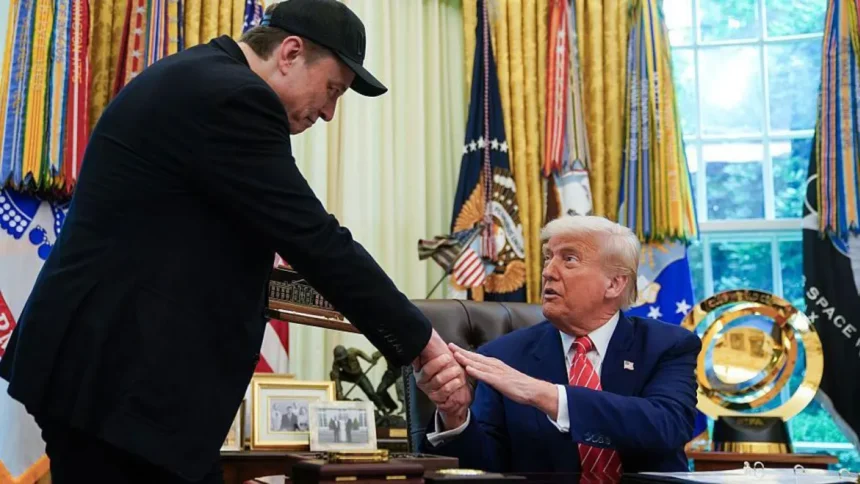
While analysts have long speculated about the possibility of Donald Trump and Elon Musk eventually clashing, few predicted the speed and ferocity with which their dispute erupted on social media.
Since Musk pledged his unconditional support for the president following the assassination attempt against Trump in Pennsylvania less than a year ago, their political and business interests have become increasingly intertwined.

In several key areas—such as political funding, government contracts, and personal relationships—both have come to depend on each other, meaning ending the alliance will likely be difficult.
This complicates their breakup and ensures that, no matter the outcome, they will remain linked and could harm each other in multiple ways.
Campaign Funding
Over the past year, Musk’s donations to Trump and other Republicans have been massive, totaling $290 million, according to Open Secrets, the campaign finance tracking website.
Musk claimed on Thursday that the president won the election thanks to him and accused Trump of “ingratitude.”

There is an obvious counterexample. Earlier this year, Musk invested $20 million in a key judicial election in Wisconsin; however, the Republican candidate he backed lost by 10 percentage points in a state where Trump won last November.
Still, Musk’s donations represent a significant amount of money that Republicans will miss as they try to maintain their advantage in Congress during the 2026 midterm elections.
They may already be facing this issue. Musk has said he will contribute “much less” to campaigns in the future.

But could the feud with the White House lead Musk not only to withdraw but also to invest his money in opposition to Trump?
He hinted as much on Thursday when he posted a poll on X asking: “Is it time to create a new political party in the U.S. that represents the 80% in the middle?”

Government Contracts and Investigations
Musk’s companies, such as SpaceX, its subsidiary Starlink, and Tesla, do a significant amount of business with the U.S. government.
SpaceX alone has received $20.9 billion in U.S. government contracts since 2008, according to a BBC Verify analysis.
Trump is aware that this gives him leverage over the world’s richest man.
On Thursday, he posted on Truth Social: “The easiest way to save money in our budget, billions of dollars, is to cancel Elon’s government subsidies and contracts. I was always surprised Biden didn’t do it!”
Musk threatened retaliation by dismantling SpaceX’s Dragon spacecraft, which transports astronauts and supplies to the International Space Station. But he later walked back the threat.
In practice, canceling or withdrawing from government contracts would be a legally complex and lengthy process, and for now and in the future, the U.S. government is likely to continue doing a significant amount of business with Musk’s companies.
No other company besides SpaceX can manufacture the Dragon and Falcon 9 rockets, and NASA has committed to several missions to the space station and the Moon using SpaceX spacecraft.
Despite these business ties, Musk and his companies also face investigations from multiple government agencies—more than 30, according to a February report by the New York Times—and regulatory challenges, such as the approval of Tesla’s proposed driverless taxis.
Figures in Government and Silicon Valley
When Musk was tasked with establishing the Department of Government Efficiency (Doge), a public spending reduction program and one of Trump’s key drivers of change within the federal government, he was given broad latitude to choose his own staff.
According to leaked lists of Doge employees, many of them previously worked for Musk’s companies. And although Elon left Doge a week ago, many remain in their government positions.
Some Doge employees also have close ties to Trump’s team. Katie Miller, who worked in Trump’s first administration and is married to the current White House deputy chief of staff, Stephen Miller, was Doge’s spokesperson.
However, CNN reported that Miller’s wife also left the government last week and now works full-time for Musk.
There are other members of the Trump administration whose loyalty could be tested by this dispute. David Sacks, whom the president appointed as his top advisor on artificial intelligence and cryptocurrencies, is close to Musk. He worked with the magnate decades ago at PayPal.
On X, many Silicon Valley executives, along with Maga-world influencers, took sides and analyzed every message exchanged between the president and the world’s richest man.
A quick poll by YouGov on Thursday asked people whom they would side with. The results showed that 70% of surveyed Republicans sided with Trump, compared to fewer than 1 in 10 who chose Musk.
Image: Opinion