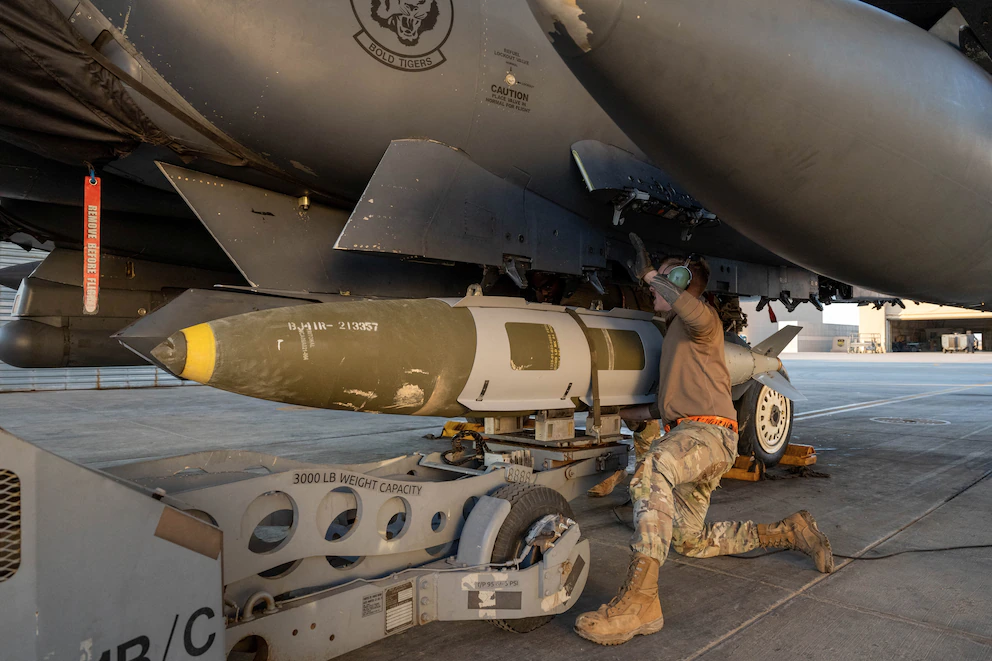
The United States launched airstrikes against Islamic State targets in northwest Nigeria after President Donald Trump warned he would suspend aid and order military intervention if Abuja did not halt killings attributed to Islamist militants, according to official statements released this week.
The US attacks came after Trump warned in early November that Washington would take direct action if the Nigerian government did not curb violence against Christians.

What Did the US Strike?
Trump announced the offensive on his social media platform Truth Social, providing few operational details. “The United States launched a powerful and deadly strike against the terrorist scum of ISIS in northwest Nigeria,” he wrote.
In the same post, he accused the group of “brutally attacking and murdering, primarily, innocent Christians.”
The Department of Defense reported that the operations were carried out in coordination with the Nigerian government but did not specify the scope of the bombings or the number of casualties. US authorities did not release additional information about specific targets or potential collateral damage.
What Was Trump’s Warning?
On November 1, Trump declared that if Nigeria’s government continued “allowing the murder of Christians,” the US would “immediately suspend all aid and assistance to Nigeria, and very possibly enter that dishonored country with guns blazing.”

“I hereby instruct our Department of War to prepare for possible action,” the president wrote. “If we strike, it will be swift, fierce, and decisive.”
Defense Secretary Pete Hegseth responded to the post with a brief message: “Yes, sir,” adding that the Pentagon was “preparing for action.”
A day before those statements, the Trump administration announced it would reinstate Nigeria as a “country of particular concern”, a designation Washington applies to nations deemed responsible for “severe violations of religious freedom.” Trump had taken a similar step in 2020, near the end of his first term, a decision later reversed under the Joe Biden administration.

When asked last month for details about his plan, Trump reiterated his stance. “I foresee many things. They are killing Christians, and killing them in large numbers. We will not allow that to happen,” he said.
In the days leading up to the warnings, several of the president’s political allies made similar accusations. Republican Senator Ted Cruz of Texas accused Nigeria of “facilitating mass murder” of Christians.
Nigeria’s Response
The Nigerian government denied the accusations. President Bola Ahmed Tinubu stated on Saturday that the country remains committed to protecting religious freedom. “Nigeria stands firm as a democracy governed by constitutional guarantees of religious freedom,” he wrote on social media.
In a later statement, Tinubu argued that characterizing Nigeria “as religiously intolerant does not reflect our national reality” and cited what he described as the government’s sustained efforts to safeguard freedom of religion and belief for all citizens.
Violence in Nigeria
Nigeria, with a population of nearly 220 million, is home to large Christian and Muslim communities. Several regions of the country have suffered for years from violence by extremist groups, including Boko Haram, an Islamist organization based in the northeast that attacks both Christians and Muslims it deems insufficiently devout. A splinter group, the Islamic State’s West Africa Province, carries out similar attacks.
In a 2024 report, the US Commission on International Religious Freedom stated that extremist violence in Nigeria “affects a large number of Christians and Muslims in several states.”
In the country’s central region, deadly clashes also occur between herders and farmers, fueled by disputes over scarce resources that exacerbate religious and ethnic tensions. Herders are typically of Fulani ethnicity and Muslim, while farmers are often Christian.
Other episodes of violence are linked to armed groups seizing land. Northwest Nigeria also faces a widespread kidnapping-for-ransom industry, which worsens regional insecurity.
Image: Infobae