Your garden still has hope! Learn when to prune, which fertilizers to avoid, and how to save your plants after Florida’s historic freezes. Don’t write off your investment just yet.
- The “Scorched Effect”: Why Your Florida Garden Suffers More Than Others
- To Prune or Not to Prune? The Shears Dilemma
- Diagnostic Chart: Is It Dead or Just “Sleeping”?
- The Hidden Danger: Fertilizer Is the Enemy (For Now)
- Critical Steps for “Resurrecting” the Soil
- Lessons for Next Season: How to Avoid Repeating the Tragedy
The “Scorched Effect”: Why Your Florida Garden Suffers More Than Others
The scene is devastating: brown leaves, drooping stems, and that sinking feeling that your landscaping investment was ruined in a single 30°F night. But here’s the truth garden centers don’t always tell you: the biggest damage isn’t caused by the frost, but by the impatient gardener. In Florida, our plants are typically tropical or subtropical; they don’t go into deep dormancy. The cold ruptures their cell walls, creating that “boiled” or necrotic appearance. However, many plants have a lifeline underground.

Quick Answer: To recover a garden after a freeze in Florida, the most important step is patience. Don’t prune the brown parts immediately, as they act as thermal shields for the living tissue beneath. Wait until the risk of the last freeze has passed (March in Central/Northern FL) and keep the soil hydrated, but avoid fertilizing until you see consistent new growth.
To Prune or Not to Prune? The Shears Dilemma
Most Florida residents make the mistake of cleaning up the garden as soon as the sun comes out. Big mistake. Those dead, crispy leaves you hate seeing are actually a natural insulating blanket.
The Golden Rule of “Wait and See”
- Herbaceous Plants (Flowers and soft stems): If the plant has turned into a mushy, black mass (like impatiens or begonias), remove that part to prevent fungus.
- Woody Plants (Hibiscus, Bougainvillea): Leave them alone. Scratch the bark lightly with your fingernail; if there’s green underneath, the plant is alive. If you wait, you’ll see recovery sprouting from the lower nodes.
- Palm Trees: Be careful here! Never cut the fronds of a palm tree until they are completely brown. The palm is moving nutrients from the damaged fronds to the heart (meristem) to survive.
Diagnostic Chart: Is It Dead or Just “Sleeping”?
| Plant Type | Frost Symptom | Immediate Action | Recovery Outlook |
| Citrus | Curled leaves, soft fruit | Water deeply, do not prune | High (if the trunk is intact) |
| Succulents | Translucent or watery leaves | Remove rotted parts | Medium (sensitive to rot) |
| Lawn (St. Augustine) | Straw/brown color | Nothing (it’s dormant) | 100% by spring |
| Tropicals (Bananas) | Collapsed leaves | Cut the trunk only if it’s soft | High (regrows from the bulb) |
The Hidden Danger: Fertilizer Is the Enemy (For Now)
This is where many lose the battle. You feel sorry for your plant and decide to give it a “boost” of energy with nitrogen fertilizer. Don’t do it!
Nitrogen stimulates new growth. If you apply fertilizer and another late freeze occurs (very common in Central Florida), that tender young tissue will die instantly, draining the plant’s final energy reserves.
- Wait until late February or March.
- Use a slow-release fertilizer.
- Prioritize watering: water in the soil helps retain residual ground heat.
Critical Steps for “Resurrecting” the Soil
We often focus on what we see above ground, but the magic happens below.

- Emergency Hydration: A dehydrated plant suffers more from the cold. If another cold night is forecast, water the day before. Moist soil absorbs more solar radiation than dry soil.
- Mulching: If the cold destroyed your ground cover, add 2-3 inches of organic mulch. This stabilizes root temperature, which is the only thing that really matters for the plant’s comeback.
- Anti-Fungal Treatment: Plants weakened by cold are magnets for pathogens. If you see white spots or gray mold on damaged areas, apply a light copper-based fungicide.
Lessons for Next Season: How to Avoid Repeating the Tragedy
If you’re going to live in Florida, you must accept that freezes are part of the cycle.
- Choose native plants: They know how to handle these sudden changes.
- Strategic placement: Position the most sensitive plants near south-facing walls; these retain heat from the house overnight.
- Invest in thermal fabrics: Forget plastic (which transmits cold when touching the leaf). Use fabric blankets or frost-specific covers.
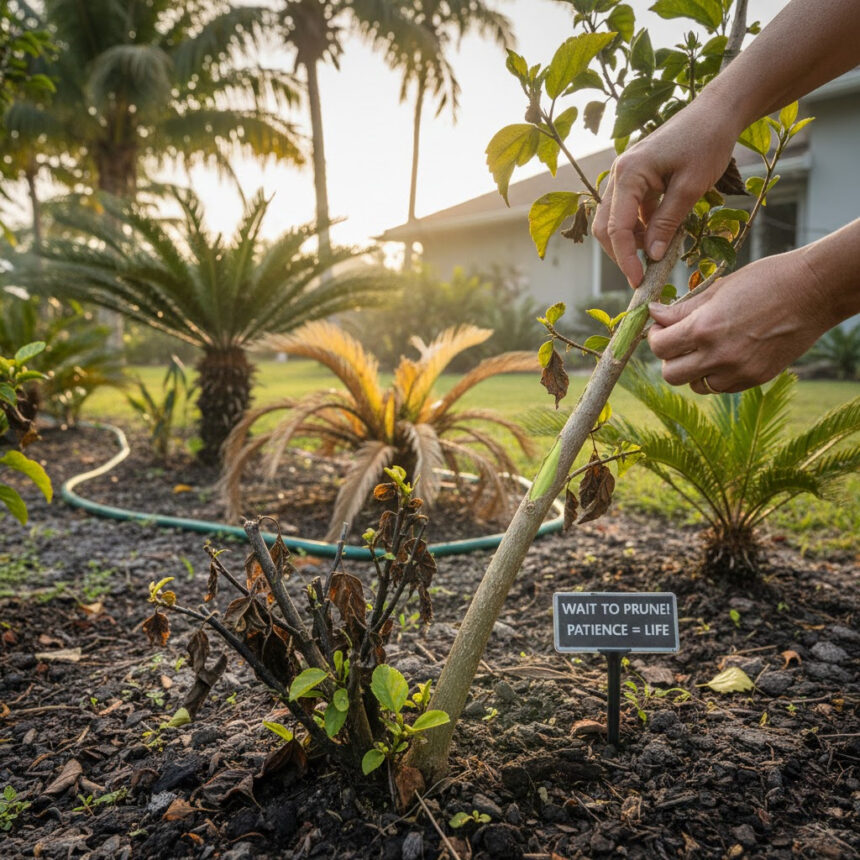
AI-generated image for illustrative purposes