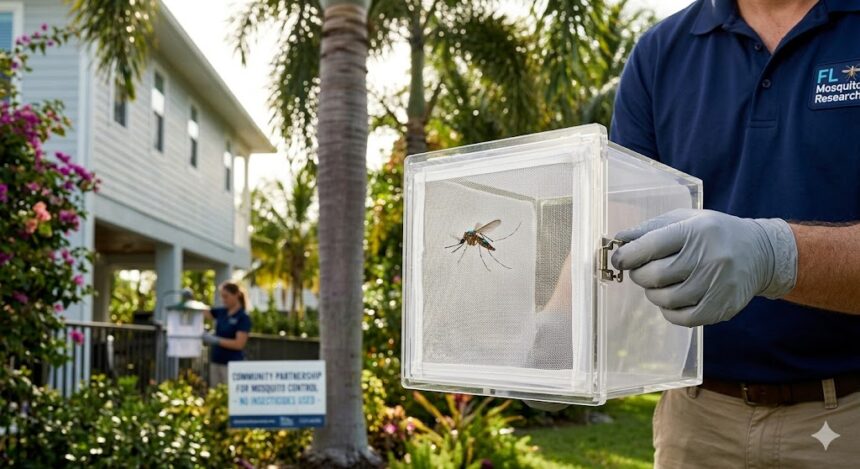
The Buzz That’s No Longer Cured with Poison: Florida’s New Reality
Forget the trucks spraying white clouds through the streets. That image, almost nostalgic of the Florida of decades past, is losing the war. Why? The Aedes aegypti has become an elite survivor; traditional insecticides no longer stop it as they once did.
- The Buzz That’s No Longer Cured with Poison: Florida’s New Reality
- Complementary Methods: Beyond the Lab
- 1. The Wolbachia Bacteria: The “Natural Contraceptive”
- 2. Precision Drones and Thermal Mapping
- 3. “Zero Water” Urban Planning
- Comparison Table: Traditional Methods vs. Biological Methods
- Community Controversy: Should We Be Concerned?
To stop dengue in Florida, the state has had to play God in the lab. It’s no longer about killing mosquitoes with chemicals that end up in our lungs or the water of the Everglades, but about using the insect’s own genetics as a “Trojan horse.” But is this technology safe for your family, or is it an open-air experiment? Let’s look at the facts.

Snippet Bait: Currently, the main strategy to stop dengue in Florida without insecticides is based on the controlled release of genetically modified male mosquitoes (OX5034). These mate with wild females and pass on a gene that prevents female offspring from surviving, reducing the local population by up to 90% without affecting other species.
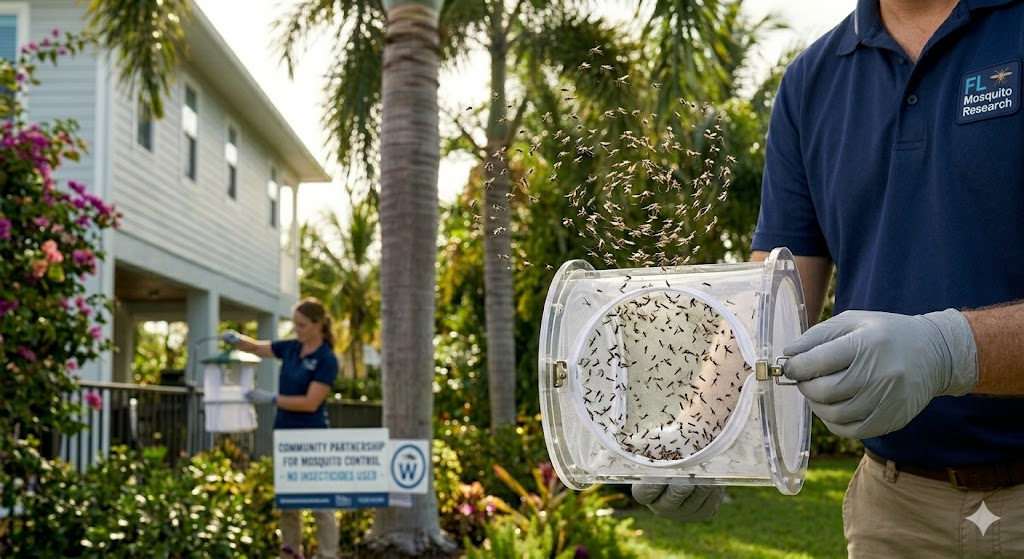
The Oxitec Experiment: Biological Soldiers or Environmental Risk?
The centerpiece of this strategy is the collaboration with biotech company Oxitec. After years of intense debate and protests in the Florida Keys, the release of modified mosquitoes is a reality yielding surprising results.
How Does This Technology Work Exactly?
It’s not magic—it’s precision engineering. The process is divided into three critical stages that the average resident should understand:
- The Limiting Gene: The released mosquitoes carry a “self-limiting” gene. Only males (which do not bite humans, as they feed on nectar) survive to maturity.
- Selective Mating: These males actively seek out Aedes aegypti females in the environment.
- Collapse of the Offspring: The resulting female larvae die before reaching adulthood (the stage that bites and transmits the virus), while males survive to continue spreading the gene.
Why Is This Better Than Insecticide?

The truth is that pesticides are “cluster bombs”: they kill bees, butterflies, and harm the ecosystem. This technique is a “sniper”: it only affects the species that transmits dengue, Zika, and Chikungunya.
Complementary Methods: Beyond the Lab
While the “mutant” mosquitoes grab the headlines, Florida is implementing an ecosystem of passive solutions that don’t require a single drop of malathion or permethrin.
1. The Wolbachia Bacteria: The “Natural Contraceptive”
In some areas, mosquitoes infected with the Wolbachia bacteria are being used. This bacteria is not harmful to humans, but when a male mosquito with Wolbachia mates with a wild female, the eggs do not hatch. It’s literally a massive biological birth control.

2. Precision Drones and Thermal Mapping
Instead of fumigating entire condominiums, Miami-Dade and Broward counties are using drones equipped with thermal and multispectral cameras to identify microscopic breeding sites on rooftops or hard-to-reach areas. Once located, biological larvicides (like BTI, a natural bacteria) are applied, which only affect mosquito larvae.
3. “Zero Water” Urban Planning
Building codes in South Florida are being reviewed to ensure new real estate developments have no rainwater stagnation points, eliminating the problem from the architecture.
Comparison Table: Traditional Methods vs. Biological Methods
| Feature | Insecticides (Traditional) | Modified Mosquitoes (New) |
| Environmental Impact | High (affects pollinators) | Almost none (species-specific) |
| Resistance | Mosquitoes develop immunity | Impossible to develop rapid genetic resistance |
| Long-Term Cost | Recurring and increasing | High initially, decreasing as population stabilizes |
| Human Risk | Possible irritation/toxicity | None (modified males do not bite) |
Community Controversy: Should We Be Concerned?
Here’s the interesting part… Not everyone in Florida is celebrating. Activist groups and some residents feel that releasing millions of modified insects is an experiment with no turning back.
Do we really know what will happen in 20 years? Science says the gene disappears if mosquito releases stop, but doubt lingers at Florida family dinners. What’s undeniable is that dengue is a real and growing threat in the state due to climate change and the constant flow of travelers. Between “a chemical in the air” and “a modified mosquito in the yard,” Florida seems to have chosen the latter as the lesser evil.
Pro Tips to Protect Your Home (Without Chemicals):
- Repellent Plants: They’re not a myth. Citronella, geranium (pelargonium), and lavender on your balcony create a real olfactory barrier.
- The Fan Trick: Mosquitoes are mediocre fliers. A ceiling or pedestal fan on your terrace is more effective than any smoke coil.
- Gutter Maintenance: 80% of breeding sites in Florida homes are in gutters clogged with leaves.
Image: ElHispanoParaTodos/PRESS