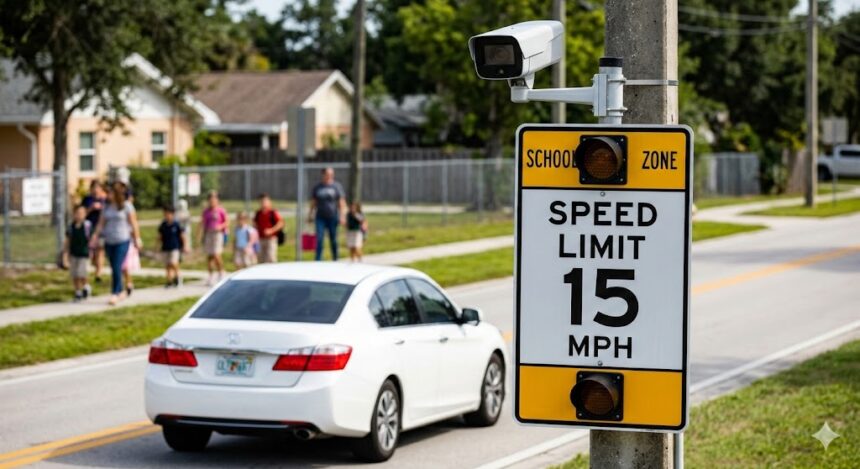
Revenue Trap or Child Safety? The Dilemma of Speed Cameras in Florida
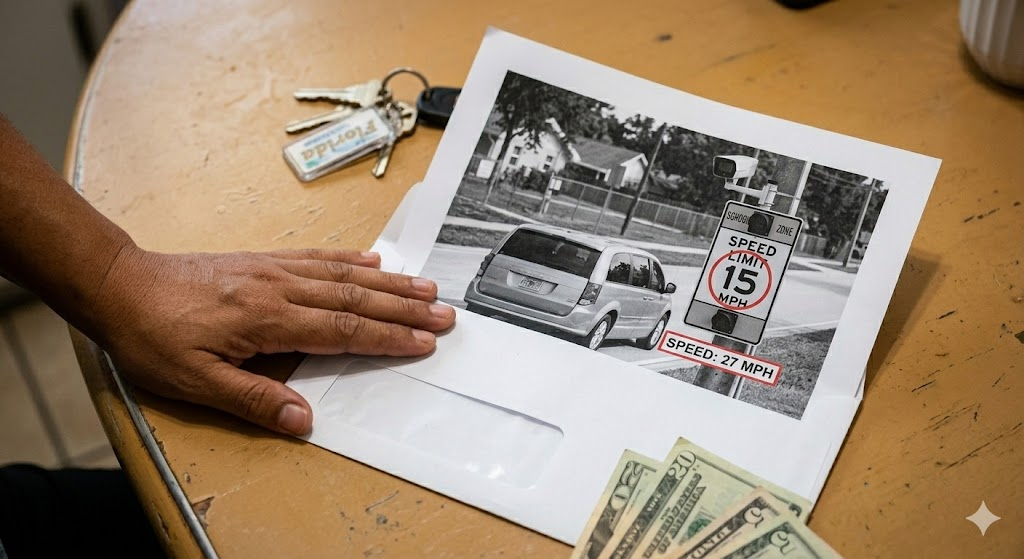
Imagine driving down a familiar avenue in Miami or Tampa. You see the yellow school zone lights are off and maintain your usual speed of 35 or 40 mph. Weeks later, you open your mailbox and find a “surprise”—a $100 fine. There was no patrol car, no sirens, just a cold envelope with a photo of your license plate.
The reality is that, under state law HB 657, cameras in Florida don’t need flashing lights to “catch you.” If the clock shows school hours, the system is ready to issue a fine.

Quick Answer: Yes, in Florida, you can be fined $100 via speed cameras even if the warning lights are not flashing. This is because the law allows photo enforcement during the entire school day (from 30 minutes before classes start until 30 minutes after they end). The violation is automatically triggered when a vehicle exceeds the speed limit by more than 11 mph.
The “Ghost” of HB 657: Why Are You Fined Without Lights?
Many Hispanic drivers grew up with the idea that “if there are no lights, there’s no active school zone.” Fatal mistake in 2026. Current legislation allows counties and municipalities to install Speed Detection Systems (SDS) that operate under an implacable logic.
How the Penalty System Works
- The Fine Threshold: The system only takes a photo if you’re driving 11 mph or more over the posted limit. If the limit is 15 mph and you’re going 26 mph, you’re in trouble.
- Extended Hours: Unlike physical patrols, cameras monitor all day. This includes lunchtime and periods when children are inside the building, not just during drop-off or pick-up.
- Responsibility: The fine is sent to the registered owner of the vehicle, regardless of who was driving (unless you submit an affidavit).
Credit:ElHispanoParaTodos/PRESS
Cost Breakdown and Consequences: Pay or Fight?
To help you navigate the paperwork, here’s what happens when you receive that envelope:
| Concept | Ticket Details | Impact on Your Record |
| Initial Cost | $100 fixed | Does not add points to your license. |
| Payment Deadline | 30 calendar days. | If paid on time, your insurance won’t increase. |
| Escalation | If you ignore the notice (NOV). | It becomes a Uniform Traffic Citation (UTC). |
| Final Impact | Civil infraction. | Possible license suspension if the UTC is not resolved. |
The Legal Loophole: Can These Fines Be Appealed?
This is where things get interesting (and a bit infuriating). Many drivers argue that the lack of active flashing lights is an “ambush.”

- Static Signage: The law requires physical signs indicating operating hours, but it does not mandate flashing LED lights all day.
- System Errors: Traffic attorneys are already winning cases based on improper sensor calibration or software errors in identifying license plates.
- The “Driver’s Defense”: You have the right to request an administrative hearing. If you can prove the system failed or the signage did not meet Florida Department of Transportation (FDOT) standards, you might avoid the fine.
Key Fact: Approximately 20% of the revenue from these fines goes directly to the private companies operating the cameras. Safety or business? You decide what to think.
3 Critical Steps If You Receive a Notice of Violation (NOV)
- Don’t ignore it: Thinking it’s a “scam” because it looks like junk mail is the costliest mistake. A $100 fine can jump to $250 plus court costs if it becomes a UTC.
- Verify the evidence: You have the right to view the video or photo on the official portal mentioned in the letter. Check if the vehicle is really yours and if the detected speed makes sense.
- Weigh the cost-benefit: Since it doesn’t add points, many choose to pay the $100 to avoid losing a day of work in court. However, if the fine is wrong, fighting it helps make the system more transparent for everyone.
Image: ElHispanoParaTodos/PRESS