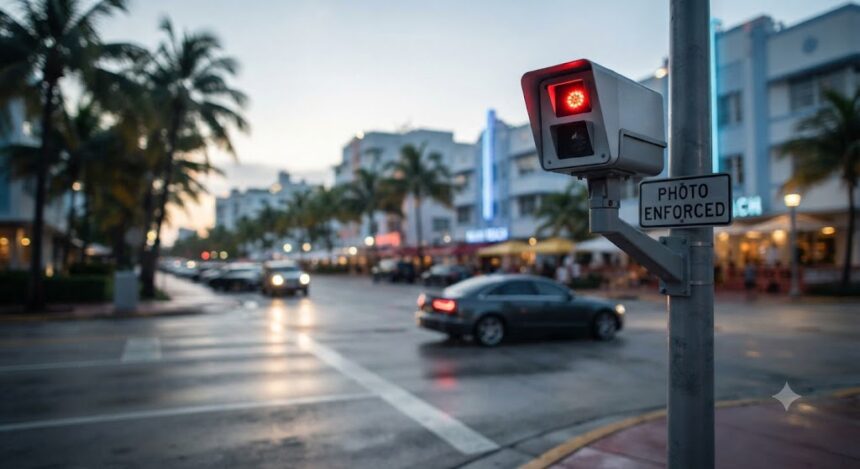
If you regularly drive through Miami Beach streets, the adrenaline rush of trying to beat the yellow light or the usual hesitation when turning right on red has just undergone a major rule change. The city has accelerated its traffic safety program, and what was once a friendly warning or a legal loophole now directly results in a fine notice in your mailbox.
The truth is, zero tolerance has arrived at the beach’s busiest intersections.

The Pulse of the News (Snippet Bait): The key change is that Miami Beach has drastically toughened red-light camera rules, eliminating the grace period for illegal right turns and increasing scrutiny on direct violations. This means that, from now on, any vehicle that does not come to a complete stop before the stop line before turning right on a red light will be automatically fined, with no prior warning, by the camera system.
The Perfect Storm: Why Were the Rules Changed Now?
This is not a whim of urban planners. The measure responds to a worrying increase in traffic accidents and pedestrian strikes in high-tourism areas. The city argues that “education” has had enough time and that it’s time to strictly enforce the law to save lives.
Here’s the interesting part: the real goal of the camera isn’t just to catch those who run red lights at full speed, but to change the behavior of local drivers who have grown accustomed to the “rolling stop” when turning right.
- Pedestrian safety as a priority: With millions of tourists walking along Collins and Washington Avenues, Miami Beach police report that right turns without a complete stop are the leading cause of pedestrian incidents at crosswalks.
- The technology behind the change: The new cameras are smarter and higher resolution. They use motion-detection algorithms that can differentiate between a sudden stop, an incomplete stop, and a full regulatory stop of three seconds.
Do these cameras really make the streets safer, or are they just a revenue machine for the city’s coffers? (The answer depends on whether you ask the family of a victim or someone who just received a $158 fine for turning too quickly at 2 a.m. on an empty street. It’s likely an uncomfortable combination of both.)
Comparison Table: Violations and Costs Under the New System
To help you understand the impact on your wallet, here’s a breakdown of the actual penalties:

| Type of Violation | Previous Rule (Educational Approach) | Current Rule (Automatic Fine) | Estimated Fine Cost (2024) |
| Running a red light | Direct fine | Direct fine | ~$158 – $262+ (depends on court costs) |
| Right turn on red without a complete stop | Warning (often, once a year) | Automatic direct fine | ~$158 |
| Intersection obstruction (“Box Blocking”) | Warning or fine | Increased camera enforcement | ~$175 |
Practical Guide to Avoiding the $158 Fine in Miami Beach
If you don’t want to fund Miami Beach’s new camera system, follow these essential steps. The old habit of “half-stopping and continuing” no longer works.
1. Mandatory Full Stop: The Three-Second Rule.
Forget *Miami Vice*. You must bring your tires to a complete stop for a count of three seconds before the white stop line, not on top of it. If the camera’s algorithm doesn’t detect that your vehicle has come to a full stop, a violation will be issued.
2. Proceed with Caution: The Myth of the Yellow Light.
The yellow light in Miami Beach seems to last shorter than an ice cream in the sun. If the light turns yellow and you have space to brake safely, do it. If you try to speed up to beat the yellow and the light turns red before your rear tires cross the line, the camera will catch you.

3. Look for Specific Signs: Right Turn on Red Prohibited.
While right turns on red are legal by default in Florida (after a complete stop), Miami Beach has many tourist-heavy intersections (especially on main avenues like Collins Ave) where right turns are explicitly prohibited at certain times or always. Look for the red-background signs.
What you should know is that the mailed notice is not the final fine. It’s a “Uniform Traffic Citation.” If you pay it, you admit guilt, pay the civil fine, and receive no points on your license. If you choose to fight it in court, costs could increase significantly if you lose.
The situation is clear: the city has raised its compliance and tolerance standards at intersections. Staying informed and changing your driving habits is the only real defense against financial surprises. We will continue to monitor the statistics from these cameras to inform our community about the real impact of this measure on beach traffic safety.
Image: ElHispanoParaTodos/PRESS