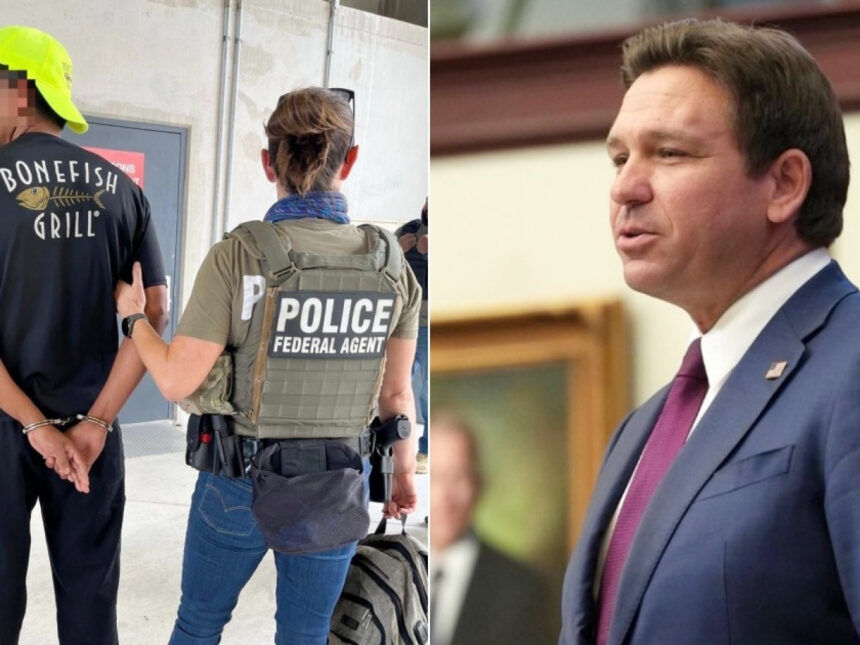
The calm on the streets of the ‘Sunshine State’ has just received a direct financial impact from the legislative offices in Tallahassee. If you drive to work every day, have a family member awaiting an immigration resolution, or run a local business that depends on our community’s workforce, pay close attention. The state Congress has ratified a measure in which Florida approves $90 million for local police to purchase equipment and collaborate with ICE. This is not just a simple budget adjustment for routine patrols or a common fund to combat organized crime. The state administration has decided to go full throttle on internal border enforcement, handing a multimillion-dollar check to local law enforcement with a very specific goal: full integration into the federal machinery of detention and deportation.
The truth is that the division between the roles of local police and immigration agents has completely blurred in Florida.

The immediate operational impact (Snippet Bait): The state Congress has ratified the measure in which Florida approves $90 million for local police to purchase equipment and collaborate with ICE. This historic fund will be primarily allocated to the acquisition of mobile biometric scanning technology, automatic license plate readers (ALPR), and integrated computer systems linked to the criminal and immigration databases of the Department of Homeland Security (DHS). The central purpose is to subsidize and massively expand the controversial cooperation agreements under the program for the rapid detention and transfer of undocumented immigrants to federal detention centers.

The Money Trail: How Will This $90 Million Fund Be Distributed?
To understand the weight of what’s coming, we must dismantle the official narrative and analyze the cold data of the budget allocation. The money will not be blindly distributed among all the state’s counties. The resources are designed to reward cooperation and pressure those jurisdictions that have been reluctant to use their local funds for federal tasks.
Here’s the interesting part: the distribution of capital is structured into three operational blocks aimed at securing Florida’s urban perimeter control:
- Technology Equipment Subsidies (USD 42 million): Intended for the purchase of high-speed fingerprint scanners so that patrols can verify the identity of any driver in real time on the road, connecting directly to ICE servers.
- Emergency Custody Compensation Fund (USD 33 million): Direct money to reimburse county jails for operational expenses incurred by holding an individual under an “administrative detention order” (ICE detainer) beyond the legal time allowed for the original local criminal offense.
- Training and Intelligence Links (USD 15 million): Funding for mandatory training courses and the hiring of data analysts dedicated exclusively to cross-referencing license records, utility reports, and commercial payrolls with immigration alerts.
Can the spending of Florida residents’ taxes on functions that belong to the federal government really be justified? The legislature insists it is a matter of state public safety, but the real backdrop is a strategy of direct economic pressure on immigrant neighborhoods.
Comparative Table: The Transformation of Police Control in Florida
To gauge how quickly the legal environment is changing in our state, let’s analyze how local police operated before this financial injection and how the operational landscape on the streets is shifting:

| Police Operational Area | Traditional Protocol in Florida | Current Scenario with the $90 Million Fund |
| Common Traffic Stops | Verification of license and insurance; immigration status was rarely checked unless a serious crime was involved. | Systematic use of mobile biometrics. Officers are equipped to cross-check identities with ICE databases from the patrol car. |
| Administrative Detention Orders | Subject to the discretion of the county sheriff due to lack of reimbursement funds. | Mandatory and prioritized retention. Local jails receive direct financial compensation for each day they hold an immigrant for ICE. |
| Surveillance in Commercial Zones | General public safety patrols without intervention in work permit verification. | Monitoring with license plate readers (ALPR) funded by the state to track vehicles in high labor concentration areas. |
County Impact: The Treasure Coast and Port St. Lucie Dilemma
Wondering how a budget approved in the state capital affects the daily life of a family living in areas like Port St. Lucie, Fort Pierce, or the agricultural regions of surrounding counties ignores how police pressure operates. In these regions, where the economy heavily depends on agriculture, tourism, and construction, the injection of these resources alters the priorities of local police departments.
“We are not facing a new criminal law that changes penalties, but a financial supercomputer that gives local police the means to do the work ICE cannot do due to lack of personnel. When a police department receives millions for tracking technology, it has to justify that money by showing high detention numbers,” says a senior civil policy analyst based in the state’s southeast.
Civil Protection Guide: Fatal Mistakes During a Police Stop
With the new state-funded biometric equipment ready to hit the streets, improvisation or panic during a routine traffic check can destroy your immigration case in minutes. If you find yourself in a police control situation in Florida, avoid these three critical mistakes:
1. NEVER Provide Fake Documents or Fantasy IDs: Documentation Error.
The most serious mistake people make out of desperation is showing fake driver’s licenses or altered international IDs. With the new digital readers purchased with the $90 million fund, police will detect the forgery instantly. This turns a simple traffic violation into a serious federal crime for identity fraud, eliminating any possibility of subsequent immigration bail. If you don’t have valid documents, it’s better to give your real name and remain silent.

2. DO NOT Answer Questions About Your Country of Origin or Legal Status: Statement Error.
Officers trained under the new state funds will use casual questions like “Where are you originally from?” or “How long have you been living in Florida?” to build a basis for reasonable suspicion. You have the constitutional right under the Fifth Amendment to remain silent. Respond politely: “I will not discuss my immigration status or place of origin without my attorney present.”
3. DO NOT Allow a Search of Your Vehicle or Property Without a Judge-Signed Warrant: Consent Error.
A local police officer may ask for permission to search your car’s trunk or enter your home. Saying “yes” out of fear gives them the legal right to search every corner and seize any documentation that could harm you. Demand to see a judicial warrant signed by a district court judge (Judicial Warrant). Remember this detail: administrative orders issued and signed only by ICE officers are not valid to force entry into your private property without your explicit consent.
This massive budget injection shows that immigration enforcement no longer occurs only at international borders; it has moved to the daily patrols of our urban communities. Keeping a cool head, knowing the limits of police authority, and acting in strict adherence to constitutional civil rights are the indispensable resistance tools for our Hispanic community to navigate this new and complex fiscal landscape in Florida.
Image: ElHispanoParaTodos/PRESS