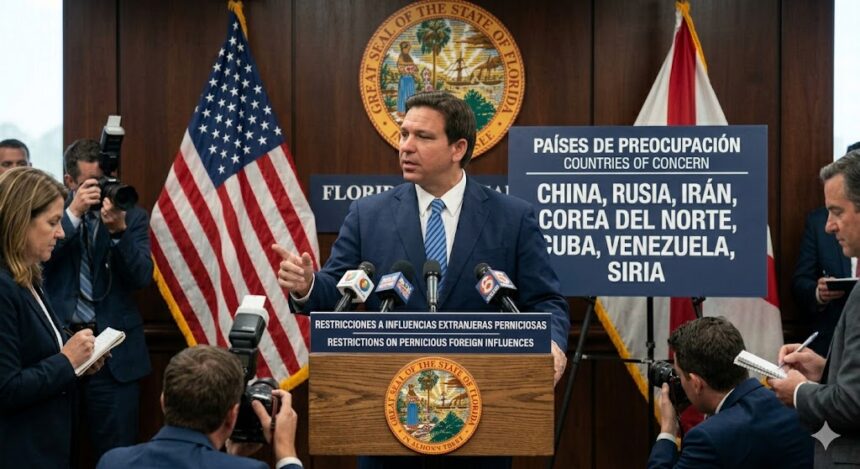
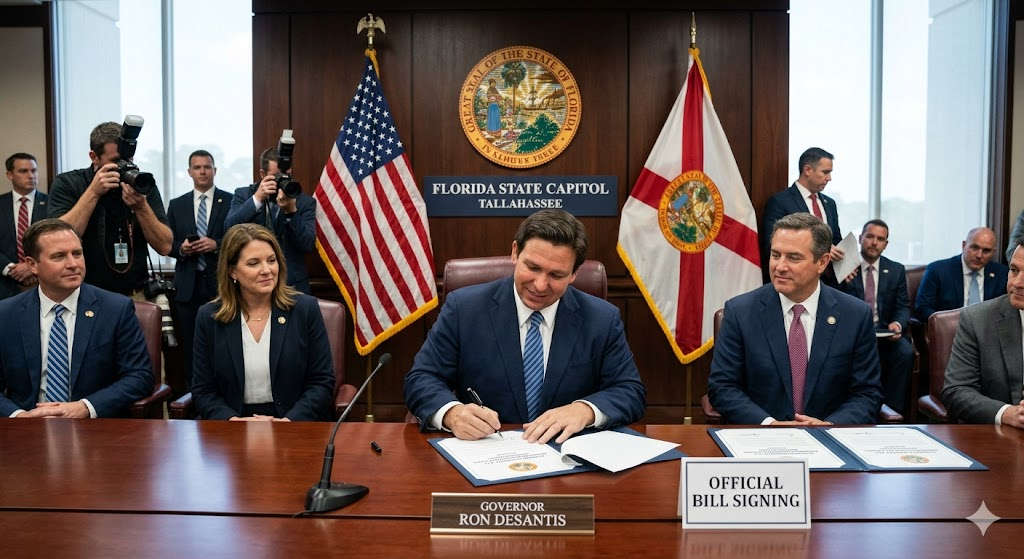
If you live in Florida or plan to invest even a single dollar in this state, the rules of the game have just changed dramatically with this new law. It’s not just headline politics; it’s a reconfiguration of who can own what. Governor Ron DeSantis has put in place a legal lock targeting nations the state considers “threats,” but in the crossfire, thousands of investors and residents are asking: Does this affect me?
- 1. The Conflict Map: Which Countries Are on the “Blacklist”?
- 2. Real Estate Restrictions: The End of Free Purchases
- 3. The Technological Blow: TikTok and Beyond
- 4. The Impact on the Hispanic Community: The Cases of Cuba and Venezuela
- 5. Is This Constitutional? The Upcoming Legal Debate
- 6. Practical Advice for Property Owners and Investors
The reality is that this legislation is not just a press release. It’s a bureaucratic wall that impacts everything from buying a home near a military base to the software used in public schools.

Quick Answer (Snippet Bait): The law enacted by Ron DeSantis in Florida severely restricts the purchase of real estate and agricultural land by citizens and entities from seven “countries of concern” (China, Russia, Iran, North Korea, Cuba, Venezuela, and Syria). Additionally, it prohibits the use of applications and technologies linked to these countries on government and educational devices, citing critical risks to national security and data privacy.
1. The Conflict Map: Which Countries Are on the “Blacklist”?
The law is unambiguous. It specifically identifies nations that, according to the Florida government, have interests adverse to those of the United States. If you have business ties, citizenship, or financing from these places, scrutiny of your assets in Florida will be total.
The seven countries under the microscope are:
- China (The primary target and subject to the most severe restrictions).
- Cuba (Direct impact on Miami’s diaspora).
- Venezuela (Affects thousands of recent investors).
- Russia.
- Iran.
- North Korea.
- Syria.
Why does this matter? Because Florida has historically been a refuge for Latin American capital. Including Cuba and Venezuela on this list creates an earthquake in South Florida’s real estate market that many have yet to fully process.
2. Real Estate Restrictions: The End of Free Purchases
This is the section keeping realtors up at night. The law establishes exclusion perimeters that are, at the very least, extensive.

Prohibition of Agricultural Land and Near Critical Infrastructure
No one linked to the aforementioned countries can buy agricultural land in Florida. But there’s more: the purchase of any property within a 10-mile (16-kilometer) radius of military installations or critical infrastructure (airports, refineries, ports, power plants) is prohibited.
What is considered “Critical Infrastructure”?
The definition is so broad that, in practice, it covers much of the state’s urban and logistical zones. If there’s a power substation or a small regional airport nearby, the restriction applies.

| Type of Investor | Main Restriction | Possible Exception |
| Chinese Government/Entities | Total prohibition on purchases statewide. | None. |
| Citizens of the 7 countries | Prohibition near critical infrastructure (10 miles). | A single residential property of up to 2 acres if they have a non-tourist visa. |
| Companies with foreign capital | Obligation to register and declare the origin of funds. | If foreign capital is minority (<5%). |
3. The Technological Blow: TikTok and Beyond
DeSantis isn’t just looking at land; he’s also looking at data. The law mandates that any software or platform developed in these countries be removed from state servers and public school networks.
- In Education: Public universities are prohibited from accepting funds or participating in partnerships with institutions from these countries unless they comply with strict transparency protocols.
- In the Digital Wallet: Access to apps like TikTok is blocked on official devices, a measure aimed at curbing “data mining” by the Chinese Communist Party.
The truth is, while it sounds like high-level cybersecurity, the implementation will affect academic researchers and international students who rely on global collaborations.
4. The Impact on the Hispanic Community: The Cases of Cuba and Venezuela
This is where things get personal. Florida is home to the largest concentration of Cubans and Venezuelans outside their countries. Many of them send money, buy properties for relatives, or maintain legitimate businesses.
The gray area of compliance:
While the law aims to punish the regimes of Díaz-Canel or Maduro, the wording could ensnare ordinary citizens fleeing those systems. The obligation to register properties acquired before the law with the Department of Economic Opportunity (DEO) is a bureaucratic step that many fear could become a “watchlist.”
- Fines for non-compliance: If you are a citizen of these countries and do not register your property within the legal deadlines, you could face fines of $1,000 per day of delay.
- Seizure: In extreme cases, the state has the authority to initiate confiscation proceedings for land obtained illegally under this new regulation.
5. Is This Constitutional? The Upcoming Legal Debate
Let’s be clear: this law is already being challenged. Civil rights organizations argue that it violates the Fair Housing Act and the Fourteenth Amendment by discriminating based on national origin.
The question we’re all asking is: Can you punish a person for the actions of their government? DeSantis says yes, that it’s a matter of sovereign survival. The courts will have the final word, but in the meantime, the real estate market is already feeling the “chilling effect.”
6. Practical Advice for Property Owners and Investors
If you think you might be affected, don’t wait for a notice in the mail.
- Check the location: Use mapping tools to measure the distance from your property to the nearest military base or critical infrastructure.
- Consult a real estate attorney: Not all sales closings are the same now. Affidavits about the origin of funds are now mandatory and more rigorous.
- Mandatory Registration: If you already own land and are a citizen of one of the 7 countries, make sure to comply with state registration deadlines to avoid draconian fines.
Image: ElHispanoParaTodos/PRESS