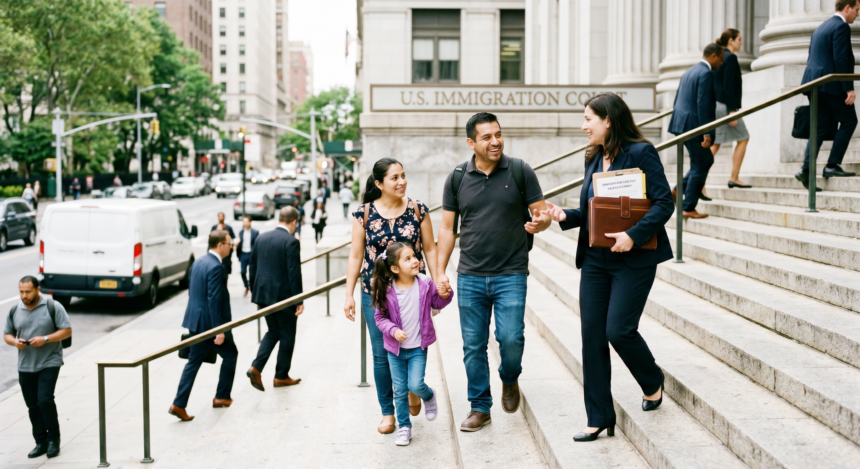
A federal judge has banned ICE from carrying out immigrant arrests inside courthouses across the U.S. What does this temporary relief mean for your upcoming case? Find out here.
Attending your own immigration hearing had become a trap.

You put on your best suit, prepare your documents with your lawyer, walk through the courthouse doors to defend your case, and suddenly, the nightmare: agents waiting in the hallways to detain you, regardless of the judge’s ruling. These arrests have become a tactic that, let’s be honest, has sown pure terror in our community.
But the rules of the game have just changed dramatically.
What You Need to Know Now
A federal judge in California has issued a nationwide order strictly prohibiting ICE agents and Department of Justice personnel from arresting immigrants inside and in the hallways of immigration courts. This measure represents the strongest legal check to date against the mass deportation policy that the Donald Trump administration had reactivated in sensitive locations.
Here’s the interesting part… this ruling isn’t just a victory on paper; it’s a lifeline for thousands of families who were willing to lose their cases out of sheer fear of showing up. Let’s get straight to the point and break down how this decision affects you.

The End of the “Hunt” in Courthouses: How We Got Here
Judge P. Casey Pitts of the Northern District Court of California didn’t mince words. In a historic expansion of an order he had already issued last December (which only covered the San Francisco area), Pitts extended the protective shield to the entire territory of the United States.
The legal reasoning? A direct violation of federal regulations.
According to the magistrate (appointed during the Joe Biden administration), both ICE and the Executive Office for Immigration Review (EOIR) acted in an “arbitrary and capricious” manner. We’re not just using adjectives for effect; that’s the exact legal language detailing how both agencies trampled the Administrative Procedure Act (APA) by failing to provide a valid justification for conducting arrest operations in places that, historically, were sanctuaries of justice.

“The court concludes that each of the challenged policies lacks reasoned explanations… in clear contravention of the law,” ruled Judge Pitts.
Additionally, the ruling includes an extra safeguard: ICE is strictly prohibited from holding immigrants in prolonged, unjustified registration facilities. No more being held in “the little room” at the courthouse to buy time.
The Disaster of “In Absentia” Deportations
To grasp the magnitude of this news, we need to look at the damage that had already been done. When the Trump administration removed protections for so-called ‘sensitive locations’ (hospitals, churches, and courthouses), the message was clear: nowhere is safe.
The images went viral and were heartbreaking. Mothers crying in the hallways, lawyers struggling with plainclothes agents, and families separated just meters from the courtroom.
What was the direct result of this psychological terror?
- Drastic drop in appearances: People simply stopped going to fight their cases.
- The Domino Effect (In Absentia Deportation Order): In the immigration system, if the judge calls your name and you’re not there, you sign your own sentence. You receive an automatic deportation order for failure to appear.
ICE knew full well that fear would keep immigrants away from the courts, making deportation easier. This judicial order aims to heal that deep wound in due process.
Before and After the Ruling: What Changes in Practice?
To clear up any doubts, here’s how the system operated last week compared to how it must operate under this federal order:
| Courthouse Situation | Under the Zero-Tolerance Policy (Trump) | With the New Federal Order (Judge Pitts) |
| Courthouse Hallways | Plainclothes agents monitoring hearing lists. | ICE is prohibited from stalking or waiting for immigrants. |
| Losing the Case | Immediate arrest and handcuffing upon leaving the courtroom. | Free to leave the courthouse to plan appeals with your lawyer. |
| EOIR Collaboration | Court guards facilitated ICE access. | EOIR cannot assist ICE in ambushes inside the building. |
| Scope | Nationwide (no safe places). | Temporary protection guaranteed in all 50 states. |
The Political Storm: DeSantis and the Looming Supreme Court Showdown
Don’t think for a second this will end here. The hardline conservative reaction was swift, and it gives us a clear map of what’s to come.
Florida Governor Ron DeSantis was one of the first to fire back at the decision via his X account (formerly Twitter): “This is another example of biased judges obstructing the enforcement of immigration laws,” he wrote, reflecting the White House’s frustration.
What Will the Trump Administration Do?
The current administration’s legal team is already preparing a counteroffensive. The path is predictable but dangerous for immigrant advocates:
- Immediate Appeal: They will seek to have a circuit court freeze Judge Pitts’ order.
- Final Destination: The Supreme Court: This is the real battleground. With a solid 6-3 conservative majority, the Trump administration knows that if it can take the case to the highest court, it has a strong chance of winning and permanently reinstating courthouse arrests.
(Yes, this is a victory, but it’s a victory with an hourglass. We can’t let our guard down.)
Action Guide: What to Do If You Have a Court Date in the Coming Weeks
Information is power, and given the volatility of immigration laws, you need to be prepared. If you or a family member have an immigration hearing scheduled in the near future, follow these steps:
- Do not miss your hearing. Today, the risk of being arrested in court has been blocked nationwide. The risk of not showing up is a guaranteed automatic deportation order.
- Talk to your lawyer about the ruling. Specifically, ask how the climate is at the local courthouse you’re attending. Lawyers have real-time information networks.
- Keep a low but firm profile. Go directly to your courtroom, don’t give information to plainclothes individuals in the hallways who don’t identify themselves, and always stay with your legal representation.
- Prepare a contingency plan. Since this order could be appealed and suspended at any time by a higher court, make sure a trusted family member has copies of your documents, knows your lawyer’s name, and knows who will take care of your children in the worst-case scenario.
The scales of justice tipped today in favor of dignity and due process. Courthouses must be places where justice is sought, not traps designed to ambush and arrest those trying to do things the legal way. At El Hispano Para Todos, we will continue monitoring every appeal in this case to keep you informed before anyone else.
Image created for illustrative purposes for EL HISPANO PARA TODOS