Having a job and a degree is no longer enough. Discover why 25 million young adults still live with their parents and the brutal cost of renting in South Florida.
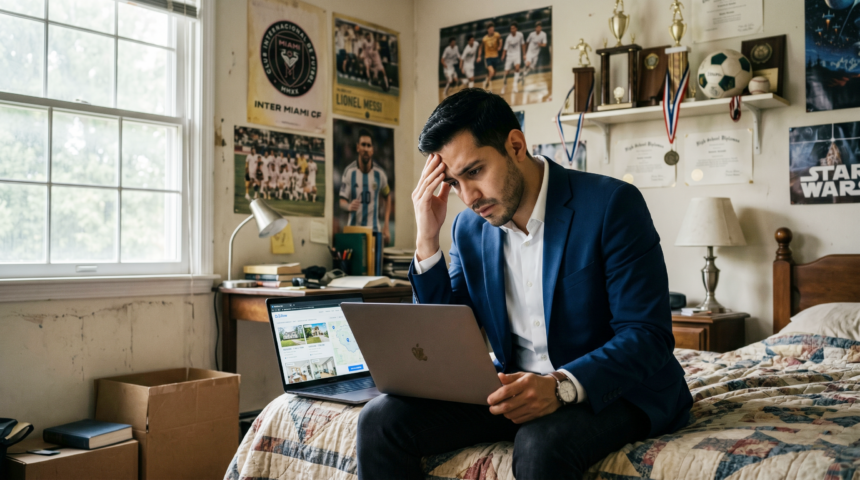
A stable, full-time job. A college degree hanging on the wall (along with the student debt that comes with it). A paid-off car. And yet, every night, you’re still sleeping in the same bedroom where you spent your teenage years.

If this is your reality, take a deep breath: you’re not doing anything wrong.
The U.S. housing market has become an impenetrable fortress for first-time buyers, and South Florida is the moat of alligators surrounding the castle. This isn’t about laziness or lack of ambition—it’s about cold, cruel math that has left an entire generation with no way out.
According to a revealing study by Realtor.com, a record 25.2 million adults under 35 (one in three) currently live with their parents in the U.S. Seventy percent of them are employed, but a chronic housing shortage and rents exceeding $2,600 in cities like Miami or Fort Lauderdale have shattered the dream of independence.
Let’s get to the point. What’s really happening, and why can’t wages even cover a basic “efficiency” apartment?

The Under-35 Trap: Anatomy of a Generational Crisis
For years, we were sold the narrative of the “lazy Millennial and Gen Z” who prefer to spend their money on expensive coffee instead of saving for a home. Recent data, fortunately, completely debunks that myth.
What we’re experiencing is a massive systemic failure.
The real estate report is clear: the 33% rate of young adults living with their parents surpasses even the worst peaks of the pandemic. In fact, if affordability conditions had remained the same as in the early 2000s, there would be nearly 5 million fewer young adults living in their parents’ homes today.

(Think about that for a second. Five million rental contracts that were never signed and five million “starter” homes that were never bought.)
Why the Numbers Just Don’t Add Up
- Wild Real Estate Inflation: Nationally, the median listing price of a home has climbed to an unattainable $430,000 (a 34% jump from pre-pandemic levels).
- Extortionate Rents: The national median rent has risen 18% in recent years.
- The Phantom Shortage: The U.S. is short about 4 million homes. After the 2008 crisis, builders simply stopped constructing “entry-level” homes (small, affordable houses), focusing instead on luxury properties that offer higher profit margins.
“The adults living with their parents today are mostly employed, and many have college degrees,” says Hannah Jones, senior economist at Realtor.com. “What’s holding them back isn’t a lack of qualifications but a lack of housing they can actually afford.”
Ground Zero: South Florida and Its Prohibitive Prices
If the situation is bleak nationally, in South Florida, it borders on pure drama. The Miami-Dade, Broward, and Palm Beach housing market has become a playground for international investors and high-earning remote workers, leaving locals out of the equation.
Here’s the interesting—and painful—part. If you wanted to live independently in this region today, here’s what it would cost you monthly:
Reality Check: Average Rental Costs in South Florida (2026)
| City / Area | Average Rent (Overall) | Studio Apartment Rent (Approx.) | Recommended Monthly Income (30% Rule) |
| South Miami | $3,195 | $2,400+ | $10,650 ($127,800 per year) |
| Miami (City) | $2,770 – $2,833 | $2,100 | $9,333 ($112,000 per year) |
| Fort Lauderdale | $2,671 | $2,189 | $8,903 ($106,800 per year) |
| West Palm Beach | $2,455 | $1,900 | $8,183 ($98,200 per year) |
Note: The golden rule of finance says you shouldn’t spend more than 30% of your gross income on rent. As you can see, a young adult in Miami needs to earn over $100,000 a year just to live alone “comfortably.” How many recent graduates make that? Exactly.
Latent demand in this region is enormous. Thousands of young professionals are stuck in borrowed rooms, waiting for the bubble to burst, but prices have only stabilized marginally (Fort Lauderdale saw a slight year-over-year drop, which is barely a scratch compared to the accumulated increase).
The Domino Effect: The Hidden Cost for Parents
The truth is, this crisis doesn’t just affect young adults—it’s eroding the peace of mind of the older generation.
“Empty nests” are becoming an endangered species. When children return (or never leave), the family’s financial burden readjusts. The direct result? Parents are forced to delay their retirement age.
Plans like downsizing, selling the family home, or using that money for medical expenses are put on indefinite hold. It’s a cycle of stagnation where the economies of two generations collide under one roof.
What Options Remain in the Face of This Stagnant Demand?
I won’t sugarcoat the situation. The first-time homebuyer market isn’t going to magically become more affordable overnight. However, faced with the 25 million young adults representing a massive accumulated demand, there are some raw strategies many are adopting in Florida:
- Radical “House Hacking”: Having one roommate isn’t enough anymore. Many young adults are renting 3- or 4-bedroom houses with four or five working professionals, splitting costs to the limit to avoid the absurd prices of individual studios.
- The Exodus North or Inland: If your job allows it, areas like Port St. Lucie, Ocala, or even outside Florida are welcoming the housing refugees from Miami and Broward.
- Strategic Patience (and Capital Accumulation): If you’re living with your parents and not paying rent (or paying a symbolic amount), your only priority should be saving aggressively. Don’t fall into the trap of consumerism out of frustration (“since I can’t buy a house, I’ll buy an expensive car”). Build capital. When interest rates or supply adjust, those 25 million young adults will flood the market, and only those with real liquidity will be able to compete.
The scene of thousands of Hispanic households where three generations share the same Wi-Fi is the new American standard. This isn’t a personal failure—it’s the symptom of a country that forgot to build homes for its own people.