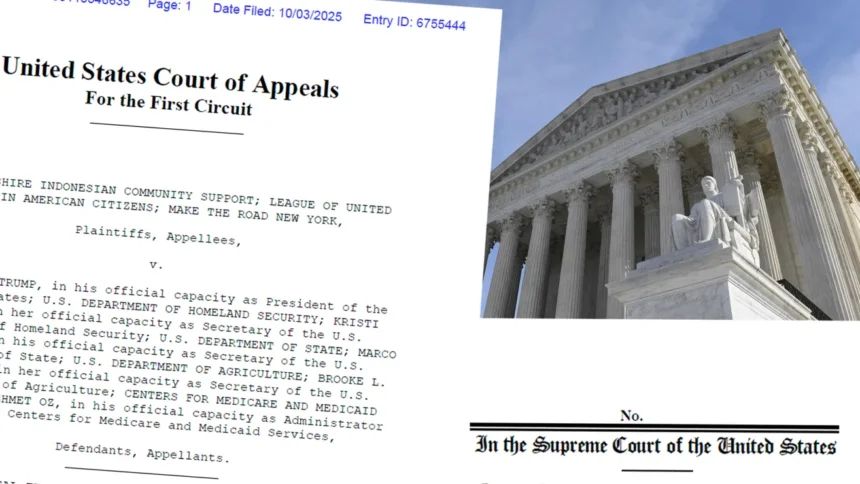
Birthright citizenship for children of undocumented immigrants faces multiple legal challenges, but its biggest test lies before the Supreme Court after the administration of President Donald Trump asked the justices to block this benefit for certain foreigners.
In late September, through Solicitor General D. John Sauer, the Trump Administration asked the Supreme Court to review the ruling by the Ninth Circuit Court of Appeals, which ruled in July that President Trump’s executive order was unconstitutional for violating the Fourteenth Amendment.

The appeals court, however, adhered to a prior Supreme Court determination limiting the decisions of District and Appeals Courts to their respective jurisdictions.
In this case, the Ninth Circuit ruled on a nationwide injunction, asserting it was necessary to provide complete relief for the plaintiff states.
On February 19, Trump’s executive order—signed on January 20—sought to block U.S. citizenship for children of undocumented immigrants and those foreigners with non-immigrant visas (tourists, students, and workers).
Several lawsuits were filed across the country, both by states governed by Democrats and by civil rights organizations, immigrant advocates, and pregnant women fearing immediate harm.

In June, the Supreme Court responded to an “emergency petition” from the Trump Administration but did not resolve the core issue—whether it is constitutional to block birthright citizenship for children of certain foreigners.

In its new petition before the Supreme Court, the Trump Administration also challenges the decision by Judge Joseph Laplante in New Hampshire, who blocked Trump’s order after a lawsuit by individuals warning of direct harm.
Solicitor General Sauer did not request an emergency petition this time, so the Supreme Court justices must now decide whether to take the case—for which four votes are needed—and if they do, the central debate will likely occur in 2026.

Trump’s Core Argument
President Trump argues that prior Supreme Court decisions focused on the children of slaves, not on anyone born in the U.S., and he seeks to have the current justices follow that reasoning.
“The right to U.S. citizenship enshrined in the 14th Amendment was never about modern intruders, illegal immigrants who break the law by being in our country; it was entirely about granting citizenship to former slaves,” Trump wrote on Truth Social.
Another Appeals Court Ruling
Judge Laplante’s decision, challenged by the Trump Administration, was upheld by the First Circuit Court of Appeals, adding to the complexity facing the Supreme Court justices.
In the case *New Hampshire Indonesian Community Support v. Donald J. Trump*, the appeals court affirmed Judge Laplante’s ruling after a lawsuit filed by the American Civil Liberties Union (ACLU), the ACLU of New Hampshire, the ACLU of Maine, the ACLU of Massachusetts, Asian Law Caucus, Democracy Forward, and the Legal Defense Fund on behalf of New Hampshire Indonesian Community Support, the League of United Latin American Citizens (LULAC), and Make the Road New York.
“This ruling is the latest rebuke to the blatantly unconstitutional efforts by President Trump to eliminate birthright citizenship,” said Cody Wofsy, deputy director of the ACLU’s Immigrants’ Rights Project, who presented arguments before the court. “In fact, no judge has accepted the administration’s flawed arguments.”
Wofsy acknowledged that the Trump Administration has again brought the case before the Supreme Court but insisted that “the Constitution is clear” in granting citizenship to those born in the U.S.
In addition to the victory in the First Circuit, the attorneys in this lawsuit filed a second related case, *Barbara v. Donald J. Trump*, a class-action suit seeking to preempt the Supreme Court’s decision to limit District Court rulings. This latter case is the one presented by the Trump Administration to the Supreme Court.
Other attorneys in the *New Hampshire Indonesian Community Support v. Donald J. Trump* case reiterated the clarity of the Fourteenth Amendment.
“The Constitution has always been clear: if you’re born here, you’re a citizen,” said Aarti Kohli, executive director of the Asian Law Caucus. “For generations, immigrant families have built their lives and contributed to this country because birthright citizenship means they belong here.”
Immigrant advocates insist this legal battle seeks to protect the constitutional rights of migrant families and, primarily, of children.
“Every child born on U.S. soil is a citizen of the United States,” said Tianna Mays, legal director of Democracy Forward.
Harold Solis, co-legal director of Make the Road New York, warned that this campaign to block birthright citizenship is another effort by the Trump Administration against immigrants, whose mixed-status families face a policy of mass deportations.
“While the Trump administration continues its crusade against immigrants, once again, this ruling affirms a constitutional right: children born in the United States cannot be stripped of their U.S. citizenship,” Solis added. “In recent months, we have witnessed this administration’s repeated attempts to circumvent the Constitution, disenfranchise people, and undermine the foundations of our democracy.”
Image: DiarioNY