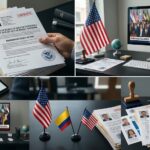
Imagine arriving at your local polling place on a Tuesday morning, before heading to work, ready to exercise this nation’s most fundamental civic right: voting. You approach the table, give your name, and instead of being asked for your usual driver’s license, the poll worker demands a valid passport or an original, sealed birth certificate. If you don’t have it on hand, you don’t vote. This sounds like a scenario from another era, right? Yet, we were just a handful of Senate votes away from this becoming the new normal nationwide.
- The Core of the Matter: What Was This Proposal Really Trying to Achieve?
- The Power Play: Why the Senate Put the Brakes on It for Good
- Reality Check: Current Law vs. the Rejected Proposal
- The Psychological Impact: A Breath of Relief for the Hispanic Community
- Action Guide: How to Protect Your Right to Vote Right Now
The political tension is sky-high. In a legislative maneuver that has sparked furious debates on radio shows and at kitchen tables across our community, the federal Senate has decided to slam the brakes on one of the most aggressive election proposals in recent years.

The truth is, the narrative of “massive voter fraud committed by immigrants” has been the perfect fuel to attempt rewriting the rules of the game before November. But legislative math and civil rights advocacy prevailed. At least for now.
The Legislative Verdict (Snippet Bait): The United States Senate formally blocked the advancement of a Donald Trump-backed initiative that required proof of citizenship to vote through physical documents (such as passports or birth certificates) at the time of registering for federal elections. The measure was halted on the grounds that it would impose unconstitutional bureaucratic barriers on millions of eligible citizens, while also reaffirming that voting by non-citizens is already a serious federal crime under current laws.

The Core of the Matter: What Was This Proposal Really Trying to Achieve?
To understand the significance of what just happened in Washington, we need to break down the text of this initiative (often associated with legislation like the so-called SAVE Act in the House). Those who support it argue it’s simply a matter of “electoral integrity.” The public premise is basic: only citizens should vote, so let’s prove we’re citizens.
But here’s the catch: as always, the devil is in the implementation details. The law would have required states to demand strict documentary proof from anyone wishing to register or update their voter registration.
What’s the real problem with this?

- The Financial Barrier (The Hidden Tax): Obtaining a passport costs over $130. Requesting a certified copy of a birth certificate from another state can take weeks and incur additional fees. For a single mother working two shifts or a college student, this amounts to a hidden tax just to vote.
- The State Logistical Chaos: State election administrators, both Democrats and Republicans, warned that current systems at the Departments of Motor Vehicles (DMV) are not equipped to digitize and verify millions of birth certificates instantly.
- The Marriage Factor: Millions of married women have a last name on their driver’s license that doesn’t match their original birth certificate, which under this law would have required them to also present certified marriage certificates. A paperwork nightmare.
(Does anyone really carry their original birth certificate in their car’s glove compartment when they go to vote? Clearly not, and legislators knew it.)
The Power Play: Why the Senate Put the Brakes on It for Good
Passing legislation of this magnitude required overcoming the dreaded filibuster hurdle in the Senate, meaning securing 60 votes. The measure ran into a wall of Democratic opposition but also caused deep discomfort among some moderate sectors concerned about the legal impact.
The central argument that unified the opposition was blunt: voter fraud by non-citizens is a statistical myth.

“We’re trying to cure a disease that doesn’t exist with medicine that will kill the patient. Voting without being a citizen is already a federal crime punishable by up to five years in prison and immediate deportation. No one crosses a border risking their life just to commit a serious crime to vote for a city council member,” declared a leader of a national civil rights coalition during committee debates.
Several independent audits and state investigations (including those driven by conservative governments in Texas or Florida) have shown that cases of undocumented immigrants voting are isolated incidents that occur due to DMV bureaucratic errors, not mass conspiracies.
Reality Check: Current Law vs. the Rejected Proposal
To dispel the misinformation flooding our family WhatsApp groups, let’s break down exactly how the law works today and how the landscape would have changed if Trump and his allies had succeeded in passing the initiative:
| Electoral Aspect | Current Federal Law (In Effect) | Rejected Initiative (The Proposal) | Real Impact Avoided for Citizens |
| Citizenship Requirement | It is mandatory to be a U.S. citizen to vote in federal elections. | It is mandatory to be a U.S. citizen to vote in federal elections. | None. The prohibition on non-citizens remains intact and severely penalized. |
| Proof at Registration | Sworn affidavit under penalty of perjury when signing the registration form (and verification of Social Security number/driver’s license). | Mandatory physical presentation of U.S. Passport, Birth Certificate, or Certificate of Naturalization. | Prevents U.S.-born citizens without a passport from losing their right to vote due to lack of expensive documents. |
| Fraud Penalties | Federal prison, severe fines, and automatic, irreversible deportation. | Federal prison, severe fines, and automatic deportation. | Maintains the current strict punitive framework that deters any real attempt at fraud. |
| Impact on Naturalized Citizens | The DMV and election agencies cross-reference data with federal databases (SAVE) to verify status. | Possible mass removal of registrations (voter roll purges) requiring re-registration with physical documents. | Prevents hundreds of thousands of naturalized Hispanic citizens from being erroneously purged from voter rolls due to software errors. |
The Psychological Impact: A Breath of Relief for the Hispanic Community
Let’s get to the point. Even though the law didn’t pass, the mere fact that it was debated so intensely serves a secondary purpose: intimidation.
For mixed-status families, the constant rhetoric about “immigrants stealing elections” creates a hostile climate at the polls. A Hispanic citizen, whether born in Texas or naturalized in Florida ten years ago, should not feel anxious when approaching their polling place for fear of being aggressively questioned about their place of birth just because of their accent or skin color.
The Senate’s halt is, therefore, a double victory. On one hand, it stops a bureaucratic machine that would have disenfranchised students, seniors, and low-income individuals. On the other, it sends a clear institutional message: constitutional rights cannot be restricted based on conspiracy theories born on internet forums.
Action Guide: How to Protect Your Right to Vote Right Now
The battle in the Capitol was won temporarily, but conservative state legislatures continue to attempt implementing similar restrictions at the local level. If you are a U.S. citizen, the time to act is not on Election Day; it’s now. Follow this civic protection protocol:
1. Audit Your Voter Registration (Today): Verification Phase.
Don’t assume you’re registered just because you voted four years ago. Many states conduct “purges” of voter rolls looking for inactivity or address changes. Visit Vote.org or your county’s Supervisor of Elections official portal to verify your status is listed as “Active.” If you’ve recently moved, update your address immediately to avoid being turned away at the polls.
2. Know Your State’s ID Law: Documentation Ready.
Although the federal law requiring passports didn’t pass, your state may have strict ID laws (Voter ID Laws). In states like Georgia, Texas, or Florida, you’ll need a state-issued photo ID (driver’s license or non-expired state ID). Check exactly which documents your state accepts before leaving home.
3. Save Civil Protection Numbers: Intimidation Reporting.
If on Election Day a poll worker or an unofficial “poll watcher” aggressively demands additional documents or questions your citizenship without cause, don’t leave quietly. It’s your right to request a “Provisional Ballot.” Save the Election Protection Hotline number: 1-888-VE-Y-VOTA (1-888-839-8682) for immediate legal assistance in Spanish.
Democracy is not a spectator sport. While politicians in Washington continue to use the electoral system as an ideological battleground, our community’s best defense is massive and informed participation. The proposal to require paper proof of citizenship was shelved in the Senate’s halls, but the real test of strength will be the number of Latinos who decide to turn that relief into real votes in the next election.
Image: ElHispanoParaTodos/PRESS