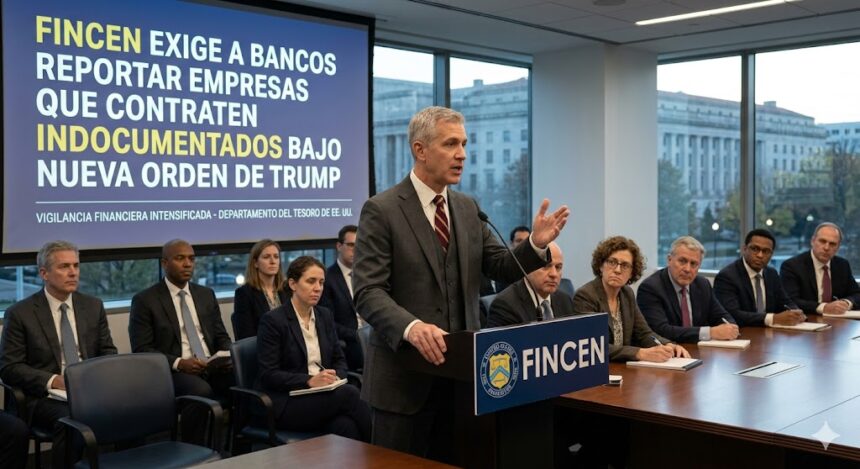
The U.S. Department of the Treasury, through the Financial Crimes Enforcement Network (FinCEN), has issued a formal alert to banks and credit unions to strengthen oversight of financial transactions linked to the irregular hiring of undocumented workers.
This directive is part of Executive Order 14406, titled “Restoring the Integrity of the U.S. Financial System,” pushed by the administration of President Donald Trump. The main goal is to close access to the banking system to discourage informal employment and combat corporate tax evasion schemes.


Key Points of FinCEN’s Alert
The government argues that the use of unauthorized labor creates unfair competition for legitimate businesses and affects tax revenue. Financial institutions will need to pay special attention to the following operational patterns:
- Misuse of Identities and ITINs: Strict monitoring of the use of Individual Taxpayer Identification Numbers (ITIN) and the potential illicit acquisition or duplication of Social Security numbers to open payroll accounts.
- Payment Schemes and Shell Companies: Oversight of intermediaries who withdraw large sums of money to distribute wages via cash, checks, or peer-to-peer (P2P) electronic payment platforms, bypassing federal and state tax withholdings.
- Suspicious Deposits: Detection of patterns in electronic transfers or recurring low-value deposits that point to off-the-books payment schemes.
- Impact Figures: According to the government, last year financial institutions reported over $2.5 billion in suspicious activities linked to payroll fraud and false identities.
- Case Study: FinCEN’s report cites two foreign nationals who operated an illegal payroll scheme that cost the country over $38 million.
- The Modus Operandi Under Scrutiny: Intermediaries who open accounts using ITINs or foreign documents to then distribute wages in cash, checks, or payment apps (P2P), evading tax withholdings.
Mandatory Reporting: FinCEN has instructed banks to specifically tag these Suspicious Activity Reports (SAR) using the internal code FINANCIALINTEGRITY-2026-A002 to centralize investigations into labor fraud and identity theft.
According to official data presented by Treasury authorities, last year financial institutions nationwide had already reported suspicious activities tied to these informal payroll models totaling over $2.5 billion.
Estimated Impact on Economic Sectors
The measures directly pressure the operational structure of many businesses. The impact of stricter financial and banking controls tends to concentrate in industries with historically high dependence on migrant labor:
| Economic Sector | Role of Affected Workforce | Primary Operational Risk |
|---|---|---|
| Agriculture and Harvesting | Crop harvesting and food processing in packing plants. | Supply chain delays due to lack of available labor. |
| Construction | Labor in subcontracting, remodeling, and residential projects. | Increased operational costs and work stoppages due to payroll audits. |
| Hospitality and Services | Housekeeping in hotels, landscaping, and restaurant kitchens. | Reduced profit margins and need to restructure hiring methods. |
Alongside these FinCEN guidelines, the federal administration is evaluating additional mechanisms to broadly restrict formal banking access for individuals without regular immigration status. However, financial sector analysts and legal institutions note that implementing direct banking restrictions or fund withholdings will require, in most scenarios, more detailed specific regulations or intervention by the U.S. Congress.

The Local Angle (Treasure Coast and Florida)
This federal directive will have a direct impact on our state’s economy. Sectors historically dependent on migrant labor—such as commercial agriculture, real estate development in Port St. Lucie, and the hospitality industry in high-growth areas like Fort Pierce and Stuart—could face an immediate increase in operational costs. If subcontractors and financial intermediaries see their banking operations frozen due to suspicious activity, local businesses will suffer logistical delays and frontline labor shortages.
Image: ElHispanoParaTodos/PRESS