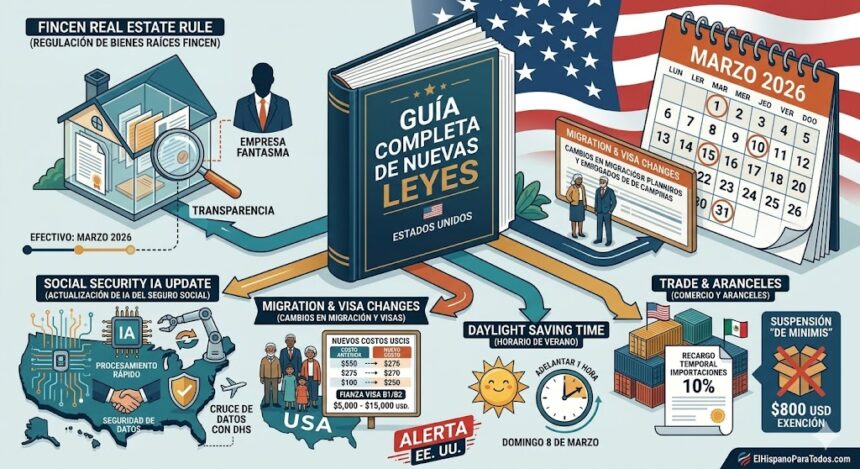
March 2026 is no ordinary month on the U.S. legislative calendar. As the country adapts to the policies of the Donald Trump administration, a series of federal and state regulations have begun to reshape the daily lives of residents, workers, and investors. From near-surgical controls on home purchases to a digital revolution in Social Security, the rules of the game have changed.
If you live in the U.S. or have economic interests in the country, ignoring these updates is not an option. This isn’t about abstract bureaucracy; it’s about your wallet, your time, and your legal status.


Quick Response: The 3 Changes You Can’t Ignore
As of March 1, 2026, the following have taken effect:
- Real Estate Rule (FinCEN): Mandatory identity reporting for all-cash home purchases by companies or trusts.
- Social Security Revolution: Implementation of Artificial Intelligence to process disability claims and cross-referencing data with the Department of Homeland Security (DHS) to verify international travel.
- Immigration Crackdown: Suspension of immigrant visas for citizens of certain countries and new mandatory bonds of up to $15,000 USD for tourist visas in high-risk zones.
1. The End of Anonymity in Real Estate: The FinCEN Rule
The era of “shell companies” for buying luxury properties is over. The Treasury Department, through the Financial Crimes Enforcement Network (FinCEN), has implemented the Residential Real Estate Rule.
- Who is affected? Closing professionals (attorneys, title agents) and buyers using legal entities (LLCs, Trusts) to purchase homes without bank financing (all-cash purchases).
- The goal: To curb money laundering. Now, the real identity of the property’s ultimate beneficial owners must be reported.
- Key date: Transactions occurring on or after March 1, 2026.
Note for investors: If you plan to move capital through an LLC to buy a home, prepare for total transparency. Anonymity is no longer a legal option.
2. Social Security Gets “Smarter” (and Stricter)
The Social Security Administration (SSA) has taken a definitive leap into modernization, but with a sharp edge that concerns many.
- AI in charge: Artificial Intelligence is now being used to approve or deny disability claims. This promises speed but eliminates the human factor in initial evaluations.
- Border control: There is now an automatic data cross-check with DHS. If you receive benefits and travel outside the U.S. for longer than permitted without reporting it, the system will detect it instantly when your departure is recorded at an airport or land border.
- Decentralized processing: Your case may no longer be handled by your local office. An agent in another state may process your application to “balance the workload.”
3. Immigration Earthquake: Fees and Restrictions
Under the new political direction, entry barriers have risen considerably this month.

USCIS New Fee Schedule (March 2026)
| Process / Requirement | Previous Cost (approx.) | New Cost / Condition |
| B1/B2 Visa Bond | Did not exist | $5,000 – $15,000 USD (Selected countries) |
| Work Permit (I-765) | $410 | $550 (Initial) / $275 (Renewal) |
| Annual Asylum Fee | $0 | $100 USD (For pending cases > 1 year) |
| Visa Integrity Fee | $0 | $250 USD (Additional payment at embassies) |
Critical Alert: The issuance of immigrant visas has been temporarily suspended for citizens of 75 countries deemed “high-risk.” If you are from an affected country, your applications are on indefinite hold until further notice.
4. Everyday Changes: Time and Technology
Not everything is macroeconomics; some changes affect your alarm clock and your privacy.
- Daylight Saving Time: On Sunday, March 8, clocks were set forward by one hour. Despite Trump’s promises to eliminate this change, calling it “costly and inconvenient,” the law was not modified in time, and the cycle continues.
- Privacy and AI in the Workplace: In states like California and Illinois, companies must now compensate lactation breaks and cannot use AI to “monitor” or make termination decisions without full transparency about the algorithm used.
5. The Tariff Shield and Consumer Impact
The Supreme Court has dealt a setback to Trump’s massive tariffs, declaring them illegal under the IEEPA. However, the president has responded with a temporary 10% surcharge on imports using other legal authorities.
How does this affect you?

- Imported electronics and cars could see residual price increases this month.
- The suspension of “De Minimis” remains in place, meaning your purchases from sites like Temu or Shein are now taxed from the first dollar, eliminating the previous exemption for packages under $800.
Image: ElHispanoParaTodos/PRESS