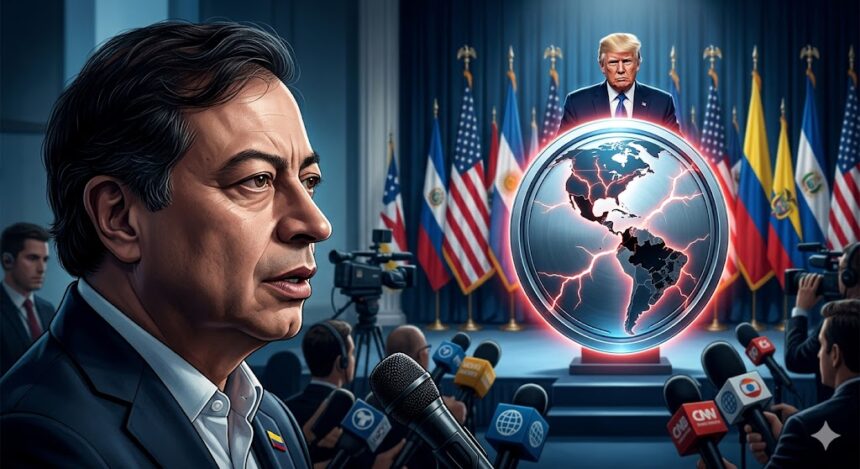
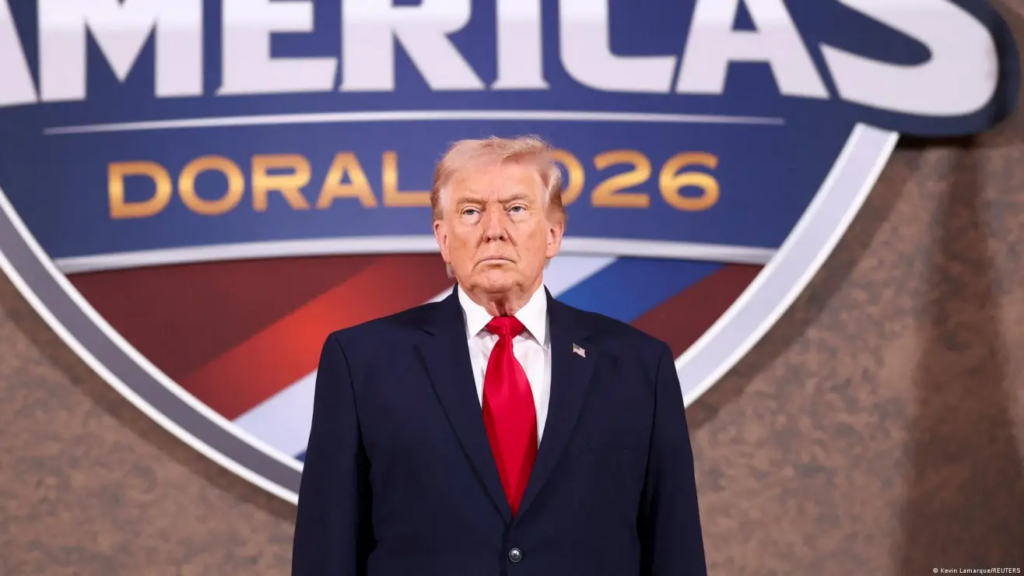
The diplomacy of “hardline tactics” has returned to the continent, and with it, the cracks in hemispheric relations. While in the luxurious facilities of Doral, in Miami, President Donald Trump celebrated with great fanfare the “Shield of the Americas“, a military coalition aimed at annihilating drug cartels, thousands of miles away in Vienna, President Gustavo Petro did not hide his sarcasm.
For Petro, attempting to curb cocaine trafficking on the continent while leaving out Colombia is simply a recipe for disaster. The exclusion is no minor detail; it is a direct political message from the White House that has set off alarms in the Palacio de San Carlos.

“With 17 small, weak countries with no experience in facing cocaine, you can’t create a shield for the south. They’re going to pierce right through it,” Petro declared before the UN Commission on Narcotic Drugs.
Quick Answer: Why Was Colombia Excluded?
The United States government, under the Trump administration, decided not to invite Gustavo Petro (or the leaders of Mexico and Brazil) to the Shield of the Americas due to what Washington calls “insufficient cooperation” and deep ideological differences. The White House questions the effectiveness of the “Total Peace” policy and voluntary crop substitution, preferring to ally with conservative-leaning nations like Argentina, El Salvador, and Ecuador to implement a lethal military strategy.
Trump’s “Shield”: Militarization or Diplomacy?
The Shield of the Americas is neither a trade agreement nor a dialogue forum. It is, in essence, a military and security coalition that seeks to:
- Use of lethal force: Trump has proposed airstrikes and direct operations against labs and speedboats.
- Migration control: Linking drug trafficking to the “migrant invasion” to justify border closures.
- Containing China: Curbing the influence of the Asian giant in Latin American ports.
The event in Florida was attended by ideological allies such as Javier Milei (Argentina), Nayib Bukele (El Salvador), and Chile’s president-elect, José Antonio Kast. However, the absence of the “heavyweights” in production and transit—Colombia, Mexico, and Brazil—leaves a technical gap that Petro was quick to point out.
Comparison: Experience vs. Political Alliance
| Aspect | “Shield” Coalition (Trump) | Excluded Axis (Petro/Lula/Sheinbaum) |
| Approach | Military, punitive, lethal interception. | Social, intelligence-based, crop substitution. |
| Real Experience | Countries with low seizure volumes (e.g., Paraguay, Uruguay). | Colombia holds the record with 3,300 tons seized. |
| Technology | Total dependence on U.S. radars and equipment. | Intelligence network with 75 police forces worldwide. |
| Ideology | Right-wing, aligned with the “Donroe Doctrine.” | Left-wing, sovereigntist, human rights-focused. |
“They’re Going to Pierce Right Through It”: Petro’s Stark Warning
The Colombian leader did not just complain about the lack of an invitation; he questioned the operational logic of the alliance. According to Petro, Colombia possesses the most sophisticated intelligence in the world on narcotics, built over decades of conflict and international cooperation.

- The data argument: Petro boasted about the 3,300 tons of cocaine seized under his administration, claiming that 80% of the intelligence for those operations was Colombian.
- Criticism of allies: Calling the 17 signatory countries “weak” was no slip. Petro suggests that countries like Costa Rica or the Dominican Republic, while valuable, lack the structure to stop cartels that move budgets larger than those of several Central American defense ministries.
A Punishment for Decertification?
The exclusion comes just weeks after Washington decertified Colombia in its fight against drugs. This move by the Trump administration aims to pressure the Historic Pact government to resume aerial glyphosate spraying and forced eradication, tactics that Petro has systematically rejected.
The Uncomfortable Truths of the Alliance
- Narcoterrorism vs. Peasantry: While Trump calls for treating cartels like the Islamic State (ISIS), Petro insists the problem is social: excluded peasants who only have the coca leaf to survive.
- The money is in the North: Petro insists that Trump’s coalition overlooks the most important thing: following the money. The owners of the business are not in the jungles of Guaviare but in international financial systems.
“You can shoot at a speedboat, but you can’t shoot at a bank account in a tax haven. That’s where the ‘Shield’ fails,” say analysts close to the Casa de Nariño.
Image: ElHispanoParaTodos/PRESS