Goodbye to Voting Without a Passport? [The Truth About the New Citizenship Law for Voting]
The House of Representatives approves requiring proof of citizenship to vote. What does it mean for you? Discover the requirements, risks, and the truth behind this law.
The Coming Electoral Storm: Why Are They Now Requiring Papers to Vote?
Politics in Washington has just thrown a stone that will ripple through every polling place in the nation. The House of Representatives has given the green light to a bill that, if implemented, would change the rules of the game for millions: it will no longer be enough to swear under penalty of perjury that you are a citizen; now you will have to prove it with physical documents in hand to be able to vote.
The truth is this is not just an administrative procedure. It’s a head-on collision between national security and the fundamental right to vote. If you’re worried your voice might be silenced or simply want to know if your driver’s license will still be enough, stay with us. Let’s break down this legislative chaos.
Advertisement
Snippet Bait (Direct Summary): The bill approved by the House of Representatives seeks to amend the National Voter Registration Act to require official documents (such as a passport or birth certificate) when registering to vote in federal elections. Currently, voters typically sign an affidavit; this measure aims to prohibit non-citizens from registering, under the argument of protecting the integrity of the ballot box.
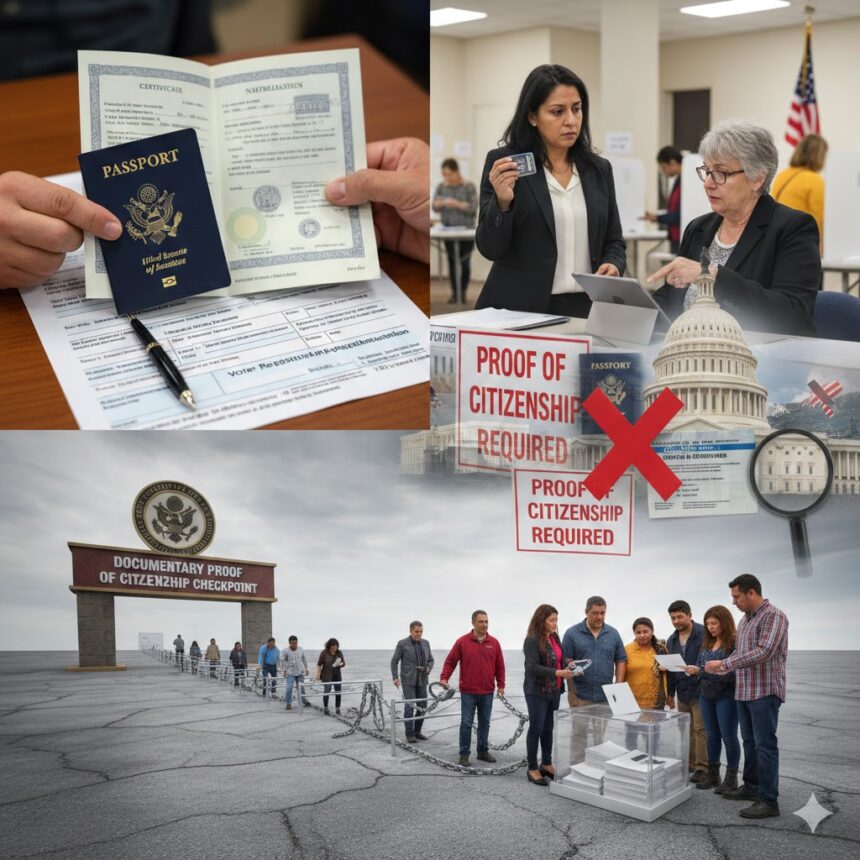
The new legislation seeks to require physical documents for federal voter registration.
Credit: ElHispanoParaTodos/PRESS
What Exactly Does This Bill Require? (The Technical Breakdown)
The core of this proposal is the mandatory presentation of Documentary Proof of Citizenship (DPOC). Until now, the system was based on trust and the threat of deportation or jail if a non-citizen lied on the form. With this law, trust is replaced by paper.
Documents that would be valid:
Valid U.S. passport.
Original birth certificate (with official seal).
Certificate of Naturalization or Citizenship.
Military IDs that certify citizenship.
Here’s the catch: many driver’s licenses, even “Real IDs,” do not specify whether the person is a citizen or legal resident in some states. Under this new rule, a standard driver’s license might not be enough to register for the first time.
The Ideological Divide: Protection or Suppression?
As expected, this issue has split the Capitol into two irreconcilable sides. It’s not just a matter of laws; it’s a matter of narrative.
Advertisement
The Republican Argument (Security): They argue the current system is vulnerable. They claim that with the border crisis, there is a risk that people without legal status could influence election results. For them, this is a “common-sense” measure.
The Democratic Argument (Access): They assert that voter fraud by non-citizens is statistically nonexistent. Their biggest fear is that this law will affect naturalized citizens, students, or low-income individuals who do not have easy access to their original birth certificate, turning it into a “modern barrier” to voting.
Direct Impact on the Hispanic Community
Do we really need another layer of bureaucracy? For our community, this has dangerous nuances.
Naturalized Citizens Under Scrutiny: If you became a citizen 20 years ago and can’t find your certificate, you could face unnecessary obstacles.
Confusion at the Polls: Fear of being questioned or investigated could keep legitimate voters away from the polls. The rhetoric of “investigating citizenship” often feels like a direct attack on those with Latino surnames.
Table: Current Situation vs. Proposed Law
Feature
Current System (Most States)
Under the New Proposed Law
Registration Requirement
Signed affidavit.
Physical presentation of document.
Main Document
Standard federal form.
Passport or Birth Certificate.
Verification
Database cross-checking (in some states).
Mandatory verification prior to registration.
Perceived Risk
Possibility of administrative error.
Exclusion of voters without documents on hand.
What Happens Now? The Path to the Senate
Don’t throw away your voter card just yet. For this to become national law, it must pass the Senate, where Democrats hold the majority and the bill is likely to die before reaching the President’s desk. Additionally, the White House has already signaled it would veto any measure that “makes it harder for eligible citizens to vote.”
However, the message has been sent: citizenship will be the central issue in the next elections.