

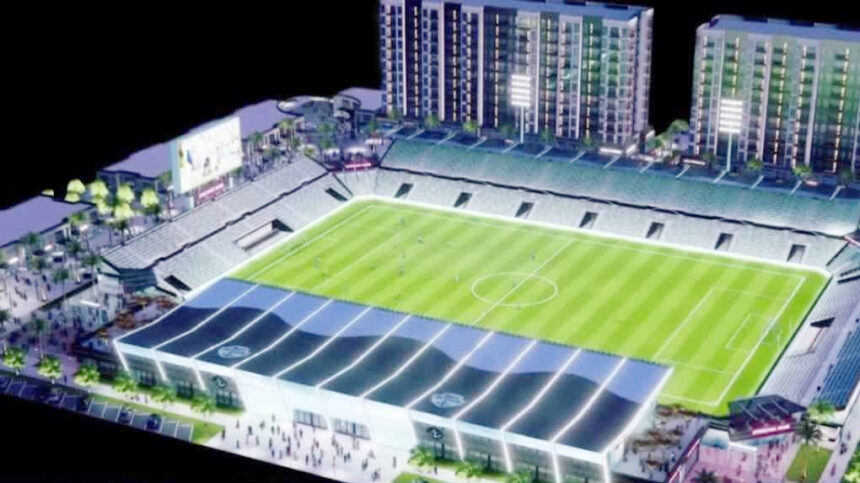
Controversy over the construction of a new 6,000-seat professional soccer stadium in Port St. Lucie has become a recurring topic among residents.
Local Government vs. Residents Controversy: The project, which will house a USL League One men’s team and a women’s team (Port St. Lucie Sports Club) starting in 2027, is seen by the city government as a key piece for development, while a group of residents views it as a threat to their quality of life and poor financial management.

The following are the key points of the controversy:
1. Why are residents collecting signatures, and what’s behind the controversy?
Residents opposing the project have launched petitions and voiced their concerns at city council meetings. Their main arguments are:
- Traffic and Infrastructure: This is the primary concern. Residents argue that the existing road infrastructure, especially in the proposed area (near the MIDFLORIDA Event Center, in the area known as “Walton & One”), already suffers from congestion and deterioration. They fear that a stadium attracting thousands of people on game days will overwhelm local roads and that the city should fix existing traffic problems before adding a project of this magnitude.
- Use of Public Funds: There is strong concern that $27.5 million in taxpayer dollars is being used to finance the stadium. Residents fear this will divert funds from more urgent needs, such as infrastructure, or result in future tax hikes (“heavy taxes”).
- Noise and Construction: Nearby residents are worried about the noise impact during construction and, later, during games and events.
- Suitability of the Project: Some residents simply don’t believe a stadium is the “right fit” for the area and would prefer the city focus on creating smaller public spaces, local shops, and restaurants instead of a large entertainment venue.
2. Where is the funding for its construction coming from?
This is one of the most complex and crucial points of the debate. The financing isn’t as straightforward as the city simply “paying” for the stadium.
- Total Investment: The entire project (stadium and surrounding development) is estimated at nearly $80 million in a combination of public and private investment.
- City’s Investment (Up to $27.5 Million): The city has committed up to $27.5 million. However, this money does not come from the city’s general budget (the funds that pay for police, parks, etc.).
- Source of Funds (CRA and TIF):
- The Developer Pays First: The team’s ownership group (Port St. Lucie Sports Club, led by co-founders Gustavo Suárez, Paulo Suárez, and Agostina Galimberti) is fully responsible for financing and paying upfront for all stadium construction costs.
- CRA Funds: The city’s money comes from the Community Redevelopment Agency (CRA), a special district designed to incentivize development in specific areas.
- Tax Increment Financing (TIF): The payment mechanism is called TIF (Tax Increment Financing). Here’s how it works: once the stadium is built and operating (after receiving a certificate of occupancy), the property will generate an increase in property tax revenue (because a developed property is worth more than vacant land).
- Reimbursement (Not a Blank Check): The city will use only that new tax money generated by the project to reimburse the developer for their construction costs, up to a maximum of $27.5 million.
In short: If the developer never builds the stadium, they receive no money from the city. The city only pays its share using the new tax revenue the stadium itself generates, theoretically protecting the general budget of taxpayers.

3. What is the real impact on the community and the economy?
There are two very different views on the stadium’s impact:
Positive Impact (View of Proponents and the City):
- Economic Anchor: The city sees the stadium as an essential “anchor tenant” to finally spur development in the “Walton & One” area (the former “City Center”), which has struggled to take off. The idea is that the stadium will attract restaurants, shops, and housing around it, creating the urban center the city has long desired.
- Job Creation: The project is expected to generate over 200 new jobs, and city officials claim many of them will pay wages up to 124% higher than the average salary in St. Lucie County.
- Boost to Local Business: Local business owners, especially on the east side of the city, anticipate a “tremendous economic impact” and an increase in customer traffic.
- Entertainment and Tourism: It will provide a new entertainment option (something residents often say is lacking) and attract sports tourism to the city.
- Community Use: The agreement guarantees that the city of Port St. Lucie can use the stadium 24 days a year for its own community events, such as concerts or festivals.
Negative Impact (View of Opponents):

- Chronic Congestion: The most cited impact is a drastic worsening of traffic in an already congested area, reducing the quality of life for current residents.
- Financial Risk: Although the TIF financing is designed to be safe, opponents distrust the economic projections. If the stadium doesn’t generate the promised tax revenue, they fear the city could be left financially strapped or that the surrounding development may never materialize.
- Nuisances (Noise/Traffic): A direct and negative impact on the daily lives of nearby neighborhoods due to noise, lights, and traffic on game days.





