Florida has passed a strict law requiring proof of citizenship (such as a passport) to vote. Learn what documents you need and how to protect your vote.
The rules of the democratic game have just changed drastically in the Sunshine State, and the cost of this change may once again fall on the naturalized immigrant community.

Imagine this: You’ve been paying taxes for 15 years, working from sunup to sundown, and proudly became a U.S. citizen a decade ago. You’ve always voted with your Florida driver’s license. It was quick, it was simple. Well, forget that routine. The state legislature has decided your license is no longer sufficient proof of your loyalty or status.
Let’s get straight to the news shaking up civil rights organizations.
The new reality is this: The Florida Legislature has just passed a controversial bill that bans voter registration and voting without the physical, verifiable presentation of documentary proof of U.S. citizenship, with a passport or original naturalization certificate as the primary documents.
This is not just another proposal that will die in committee. It’s now state law. And while supporters of the measure applaud “election security,” hundreds of thousands of Hispanics in Florida are asking the same question: What if I don’t have a passport?

What Does Florida’s New Law Actually Require?
Until now, when you registered to vote, you checked a box swearing under penalty of perjury that you were a U.S. citizen. The system trusted you (and cross-checked internal data). If you lied, you faced jail time and deportation.
The new law eliminates the “presumption of good faith.” Now, the state demands to see the paperwork. Physically.
If you’re a new voter or if the system randomly decides to “audit” your status, you’ll need to present one of the following “Gold Standard” documents:

- U.S. Passport (valid or expired, depending on final amendments).
- Official Certificate of Naturalization (The original document, no blurry copies).
- U.S. Birth Certificate (Issued by the state, not a hospital keepsake).
- Consular Report of Birth Abroad (For children of citizens born outside the country).
“They’re trying to solve a problem of massive fraud that mathematically doesn’t exist in Florida, creating instead a real bureaucratic nightmare for legitimate citizens.” — Consensus opinion of multiple local voter rights organizations.
The Real Impact: Why This Punishes Naturalized Citizens
Here’s where it gets interesting (and frustrating). If you were born in Orlando, your parents likely have your birth certificate stored in a safe. But what about the naturalized Hispanic community in Miami, Tampa, or Jacksonville?
Getting a U.S. passport today isn’t a five-minute process. It costs over $130 and takes weeks, if not months, to process. For many working families, a passport is a luxury reserved for those traveling abroad on vacation, not a daily necessity.
And what about the naturalization certificate? If you lost it in a move or a hurricane, requesting a replacement from U.S. Citizenship and Immigration Services (USCIS) costs hundreds of dollars, and Form N-565 can take up to a year to process.
Are we looking at a “poll tax” in disguise? Many civil rights attorneys believe so. Forcing people to pay for a document to exercise a constitutional right is a dangerously thin red line.
Comparison Table: Before vs. Now at Florida’s Polls
| Your Voting Situation | How It Was Before the Law | How It Is Now (Under the New Law) | Risk Level for Voters |
| New Registration (Native-Born Citizen) | Online form + Driver’s License (Number) | License is NOT enough. Requires uploading/presenting Birth Certificate. | Medium (If the document is lost). |
| New Registration (Naturalized Citizen) | Online form + Driver’s License or SSN. | Requires Certificate of Naturalization or U.S. Passport. | High (Requires costly documents to replace). |
| Longtime Registered Voter | Voted by showing state ID or License. | Subject to audits. Could be purged if citizenship isn’t proven within a deadline. | Medium to High (Risk of silent purges). |
The Political Play: Security or Suppression?
The truth is that Tallahassee’s political machine justifies this law by arguing that “non-citizen foreigners” are trying to infiltrate Florida’s voter rolls. They cite the national border crisis and the need to “fortify” Florida’s polls for the future.
However, historical data from Florida’s own Secretary of State shows that cases of non-citizens voting are statistically microscopic. (We’re talking about a handful of cases in elections where millions participate).
So, if fraud isn’t widespread, why the titanic effort?
The math of elections is cruel: When you add an extra administrative barrier, the most vulnerable sectors (seniors, low-income individuals, minorities who don’t speak English fluently) are statistically the ones who give up on voting.
Step-by-Step: How to Protect Your Right to Vote Today
We can’t change the law passed by the legislature overnight, but we can outsmart the system by being prepared. If you’re part of El Hispano Para Todos, here’s your immediate action plan:
- Audit Your Own Status: Go to the official Florida Department of Elections portal and verify that your registration is “Active.” Don’t assume anything.
- Find Your “Golden Papers”: Look for your U.S. Passport or Certificate of Naturalization today. If they’re in a shoebox in the attic, take them out. Store them in a safe place along with your house deeds.
- Start Replacement Early: If you lost your naturalization certificate, don’t wait until October of an election year. Start the process with USCIS now.
- Involve the Grandparents: Our elders are the most likely to be purged from the system for not understanding mail notifications requesting proof of citizenship. Check their mail.
- Stay Informed About Legal Challenges: It’s almost certain that groups like the ACLU and Hispanic organizations will take this law to federal court, seeking a temporary block. Stay updated on whether the law is suspended or remains in effect.
Democracy shouldn’t require a VIP pass or a fat wallet to get a passport. But while the courts decide the final fate of this law in Florida, the best protest you can make is extreme preparation. Don’t let anyone take away your voice because of a bureaucratic trap.
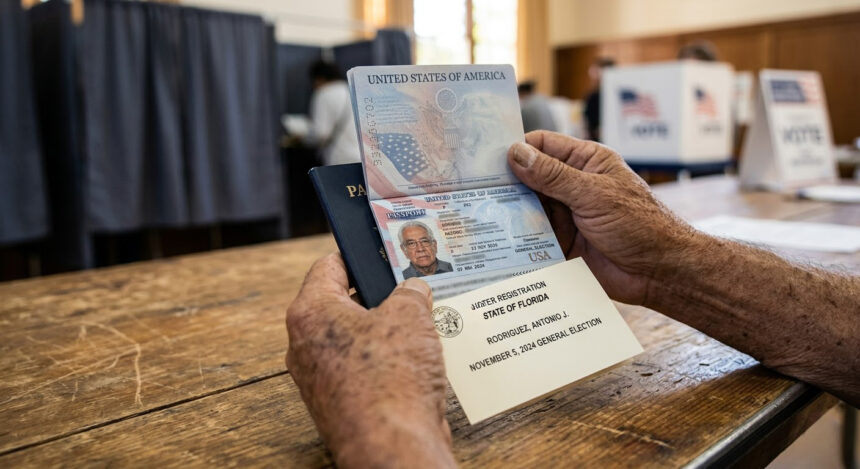
AI-generated image for illustrative purposes.