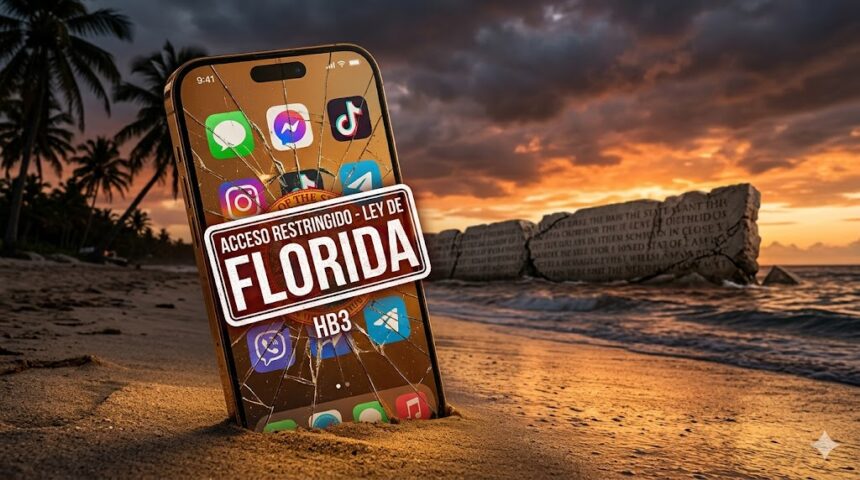
Is Infinite Scroll Over for Kids in Florida? What You Need to Know Today
The battle for children’s mental health has reached a point of no return in U.S. courts. If you live in the Sunshine State and have teenage children, the peace of mind of their digital browsing is about to change drastically. This is not a hallway rumor: Florida’s HB3 Law is now an active legal reality that the state has begun aggressively enforcing this March 2026.
As you read this, major tech companies like Snap Inc. and Meta are under the microscope of the Attorney General’s Office, facing compliance ultimatums that could erase thousands of minors’ accounts within weeks.

Quick Response (Snippet Bait): Florida’s HB3 Law prohibits children under 14 from opening or maintaining accounts on social media platforms with “addictive features.” For teens aged 14 and 15, explicit parental consent is mandatory. Following the 11th Circuit Court of Appeals’ decision in March 2026, the state has the green light to fine companies that fail to remove accounts of young children.
Credit: ElHispanoparaTodos/PRESS
The 2026 Ultimatum: Why Is This Serious Now?
Unlike previous attempts that stalled in bureaucracy, 2026 has brought a game changer. Florida Attorney General James Uthmeier has been clear: companies have 30 days to comply with regulations for minors under 14 and 60 days for those under 16.
Can the government really decide what our children do on their phones? For Governor Ron DeSantis and his allies, the answer is a resounding “yes” when it comes to protecting them from what they consider predatory algorithms. But for groups like NetChoice, this is a direct violation of the First Amendment.
The truth is, while lawyers argue over technicalities of “free speech,” Hispanic families are the ones who will have to deal with identity verification and the potential loss of their children’s digital contact with friends and family.
Which Platforms Does HB3 Law Affect Exactly?
The law does not mention names like “Facebook” or “TikTok” in writing to avoid easy invalidation, but it establishes four technical criteria that act as a net for the most popular apps:

- Analysis Algorithms: Apps that use user data to retain their attention.
- Addictive Features: The infamous “infinite scroll,” constant push notifications, and reaction metrics (likes).
- Upload Capability: Allowing users to upload their own content.
- Mass Usage: Platforms where at least 10% of users are minors who spend more than two hours a day connected.
Impact Table: What Changes for Your Family
| Minor’s Age | Current Status (March 2026) | Required Action |
| Under 14 | Total Ban | The platform MUST delete the account and personal data. |
| 14 and 15 | Restricted Access | Requires notified permission from a parent or legal guardian. |
| 16 and older | Free Access | No changes under this specific law. |
The “Purge Protocol”: What Will Happen to Existing Accounts?
Here’s what concerns many parents (and terrifies teenagers). If the court fully upholds enforcement, social media platforms are required to:
- Terminate Accounts: Automatically close any profile suspected of belonging to a minor under 14.
- Delete Data: It’s not enough to close the account; they must erase all personal information collected for advertising.
- Age Verification: Implement systems (often third-party) to confirm that the person creating an account is who they claim to be.
Here’s a detail no one tells you: The state can fine platforms up to $50,000 per violation. With those numbers, it’s likely that networks will prefer to “err on the side of caution” and close accounts at the slightest doubt.
What Can Hispanic Parents in Florida Do?
Don’t wait for your child’s account to disappear without notice. Here are three strategic steps:

- Check Age Settings: Make sure the birth date on your 14- and 15-year-old children’s accounts is correct so you can receive the official consent request.
- Back Up Content: If your child has important photos or videos on their account (and is under 14), download them now. The “purge” won’t give you time to recover files once it starts.
- Talk About Privacy: This law will force many platforms to request IDs or facial scans to verify age. Explain to your children why they shouldn’t share official documents without your supervision.
“Parental freedom does not end where the internet begins, but the state of Florida believes the harm of algorithms is a public health issue, not just a private parenting matter.” — Editorial reflection by El Hispano.
Image: ElHispanoParaTodos/PRESS