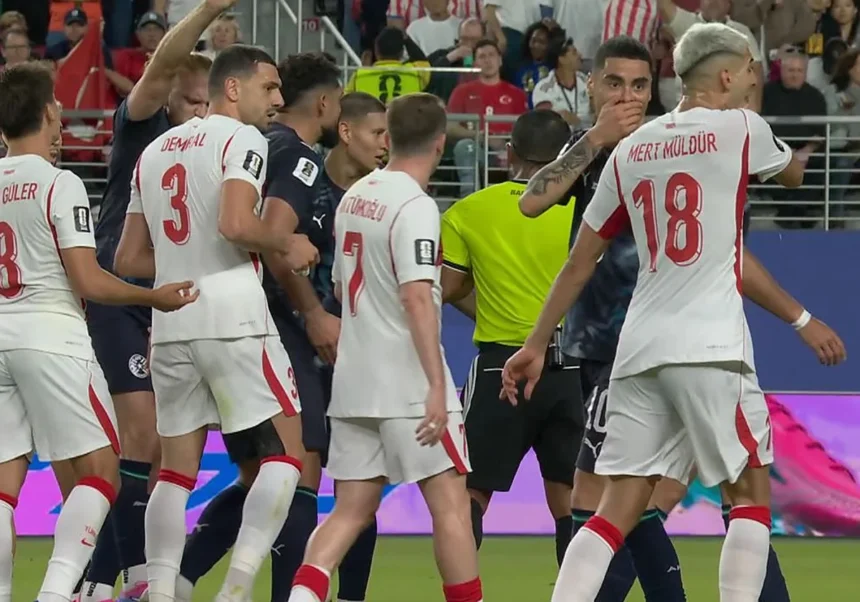
For years, soccer has been a game of shadows. Players covering their mouths with their hands to give instructions, insult referees, or coordinate deceit—without TV cameras being able to read their lips—was part of the sport’s “folklore.” But FIFA has decided that this unwritten code must disappear. The new disciplinary rule, born from the fallout of the regrettable incidents of racism and discrimination in the Prestianni-Vinicius cases, has arrived on the pitches of the 2026 World Cup to draw a red line that no one can cross.
The truth is that technology and sports ethics have joined forces to remove the mask from soccer players.

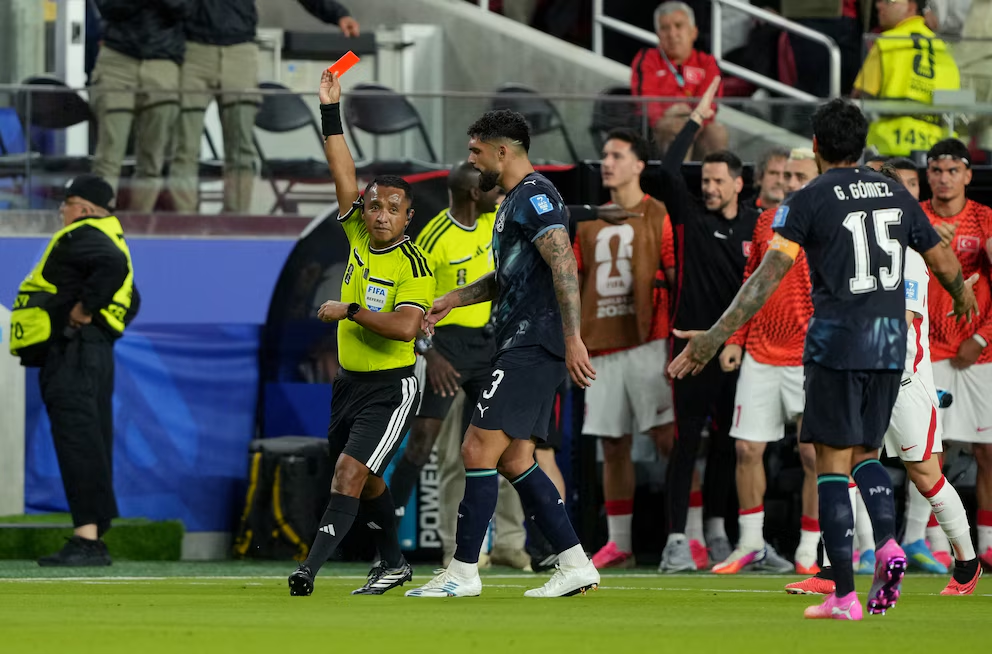
The Verdict from the Pitch (Snippet Bait): In a historic day, FIFA debuted at the World Cup the new rule inspired by the Prestianni-Vinicius case, which penalizes with a direct red card the deliberate obstruction of the mouth to hide messages to referees or opponents. The first victim of this strict regulation was Paraguayan star Miguel Almirón, who was sent off mid-game after being detected by high-fidelity sensors covering his mouth while protesting an officiating decision, triggering the “Communicative Integrity” protocol implemented this summer.
The DNA of the Rule: Why Did FIFA Decide to End the “Locker Room Secret”?
This is not the whim of a bureaucrat sitting in Zurich. The Prestianni-Vinicius case was the last straw. In that incident, the cross-accusations of racist insults were impossible to prove conclusively because the players shielded themselves with their hands, preventing VAR and lip-reading experts from confirming what happened. FIFA found itself facing a global reputation crisis with no solid evidence.
Here’s the interesting part: the new rule does not penalize the content of what is said, but the act of hiding it. It is a preventive measure based on the principle of “absolute transparency on the field.”
- Detection Technology: The World Cup stadiums now feature directional ambient microphones and 4K cameras that, upon detecting a player blocking their face with their hand during a confrontation, send an immediate alert to the central referee via earpiece.
- Warning Protocol: The player receives a mandatory verbal warning (unless the act is aggressive). If they repeat the action of hiding their communication while addressing an authority, the ejection is automatic under the category of “obstruction of the disciplinary process.”
Is this an excess of control that kills soccer’s natural cunning? (Probably. Many purists will say body language is part of the game, but in a world where racism and corruption tarnish the spectacle, who can defend the right to whisper hatred on the field?).
Anatomy of Almirón’s Ejection: The Miscalculation
The game wasn’t decided until the unthinkable happened. Almirón, a player with a fiery temperament, felt a foul went uncalled. In a reflexive act, he put his hand to his mouth and addressed the referee. The system triggered the “hidden conduct” alert.

- Detection: VAR confirmed through an artificial vision algorithm that Almirón blocked his lower lip for more than 3 seconds while gesturing toward the official.
- Review: Under the new protocol, the central referee has the authority to pause the game to request clarification: “Mr. Almirón, uncover your face.”
- Sentencing: Faced with refusal or repeated attempts to hide his mouth, the red card was shown. It was the end of his participation in the match and the start of a media storm over whether the rule is fair or disproportionate.
Comparative Table: The Evolution of Non-Verbal Language on the Pitch
To understand how the behavior of soccer professionals has changed in front of cameras, let’s look at the difference between the “old style” and today’s reality:
| Action | Pre-2026 Era (The “Cunning” Style) | 2026 World Cup Era (The “Transparent” Style) |
| Tactical Instruction | Covering the mouth with a jersey or hand. | Allowed, as long as it’s not in front of referees or opponents. |
| Complaint to Referee | Using hands to cover lips. | PROHIBITED. If done, it’s a yellow or red card. |
| Insults or Provocations | Shielding behind the hand; impunity. | High-fidelity monitoring. Sound and gesture are recorded as evidence. |
| Legal Consequence | Difficult to penalize without evidence. | Immediate technical sanction (card). |
Impact on the Community: A Cleaner or More Sterile Soccer?
This rule opens a deep debate in our community. Many Hispanic fans, who enjoy soccer with passion and see the player’s “cleverness” as something positive, feel that FIFA is “cleaning up” the spectacle too much. But on the other side, those who suffer discrimination see this as a necessary tool for justice.
“It’s not about silencing the player; it’s about ensuring that what is said on the field is responsible. If you have something to say to a referee or an opponent, say it to their face, without hiding. If you have to hide, it’s because you know what you’re about to say isn’t ethical,” says a former international referee analyzing the tournament for ElHispanoParaTodos.
A Fan’s Guide: Understanding FIFA’s New Cards
If you’re attending a stadium at this World Cup or planning to watch the games with friends, it’s vital to understand that the rulebook has changed. Don’t be surprised if you see referees ejecting players for what seem like “minor gestures.”

1. Identify the ‘Concealment’ Signal: Observation Protocol.
Pay attention to TV replays when there’s a confrontation. If you see the referee touch their earpiece after a player covers their mouth, expect a card. No shove or audible insult is needed anymore; the act of covering the mouth is, by itself, a technical foul in this tournament.
2. The Penalty Is Cumulative: Direct Consequences.
A sending-off under this rule isn’t just a red card for the match; under the new law, it triggers an automatic review by FIFA’s Ethics Committee. If it’s proven that the player was hiding a racist or discriminatory insult, the suspension in games increases exponentially.
3. Evidence Is King: The VAR Factor.
VAR is no longer just for reviewing goals or penalties; it’s now a linguistic and gestural forensics unit. Technology has made any attempt to “hide” from the public eye a failed and costly strategy.
The implementation of this regulation is, without a doubt, the most radical change in soccer’s disciplinary behavior in the last 50 years. While the world debates whether Almirón’s ejection was fair, FIFA has made its stance clear: the soccer of the future has no room for secrets. We’ll keep our finger on the pulse of the tournament and updates on this rule that is defining the 2026 World Cup.
Image: ElHispanoParaTodos/PRESS