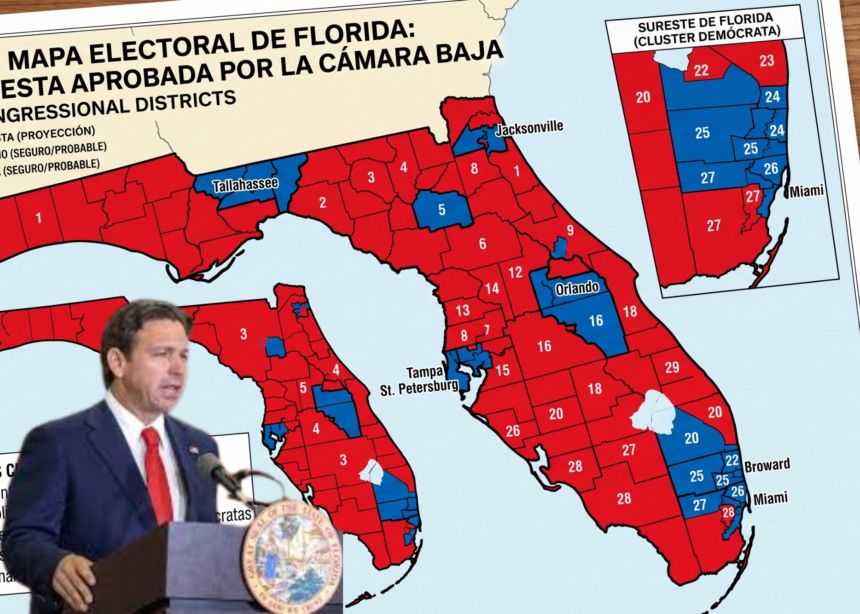
The governor has just signed off on the state’s new voting districts. Find out why this electoral map redraws power in Florida and what it means for Hispanic community representation.
Think about it for a second. You go to vote, cast your ballot with the hope that your voice will help improve your children’s schools, fix your neighborhood streets, or curb inflation. But what if I told you the outcome of that election was mathematically tilted months before you even stepped into the polling place?

This isn’t science fiction. It’s math, geography, and a lot of political strategy.
The news of the day is straightforward: Florida’s governor has officially signed the state’s new electoral map. According to expert and civic organization analyses, this new territorial distribution is designed to secure and expand the Republican Party’s advantage in upcoming congressional and state elections, significantly altering the voting power of minorities, including the Hispanic community in South and Central Florida.
If this sounds like boring bureaucracy, think again. The way these lines are drawn decides who controls your city’s budget and what laws are passed in Tallahassee. Let’s break down how this move works.
The Chessboard: What Exactly Is “Redistricting”?
Every ten years (or when courts or legislatures mandate it), states must redraw the lines dividing electoral districts. The original idea is noble: adjust the zones so each political representative has a similar number of citizens to serve, based on population changes.

Florida has grown tremendously. Thousands of new residents have arrived from other states and Latin America.
Here’s where it gets interesting… Whoever holds the pencil to draw those lines holds the power. And in Florida, the legislature and governorship are under Republican control. The new map consolidates a design that, statistically, turns districts that were once competitive (where either party could win) into safe strongholds for a single party.
How Does This Affect the Hispanic Community?
Our community is Florida’s sleeping giant. However, the power of that giant depends on whether we are united or divided on the map.

- Dilution of Power (Cracking): Imagine a predominantly Hispanic neighborhood in Orlando or Miami-Dade. If the new map splits that neighborhood in half and spreads its voters across two different, larger districts dominated by other demographic groups, the Hispanic vote is diluted. They are no longer the majority in either.
- Concentration (Packing): Conversely, sometimes they group nearly all voters from a minority into a single district. Yes, they will win that safe seat, but their influence in neighboring districts (and in Congress overall) disappears entirely.
“Redistricting isn’t about which party you support. It’s about whether your representative actually needs to listen to you to win. When a district is rigged in advance, politicians stop being accountable to the community.”
Understanding the Machinery: The Infamous Gerrymandering
The truth is, this isn’t unique to one party. Nationally, both Democrats and Republicans use this tactic when they’re in power. It’s called gerrymandering (district manipulation).
To help you visualize this without needing to be a political science expert, see how these tactics work on the ground:
| Tactic | How It Works | The Result in Your Community |
| Hijacking | Combines two districts where opposing party representatives live, forcing them to compete against each other. | You lose an experienced local leader because the math forced them out. |
| Cracking | Splits densely populated minority areas (like Hialeah or Kissimmee) into multiple portions. | Your neighborhood no longer has enough votes to elect a representative who understands your specific issues. |
| Packing | Stuffs all voters of a specific profile into one hyper-concentrated district. | Limits your community’s voice to a single seat, ceding control of the rest of the state. |
Supporters of the new map argue that the lines are “race-neutral” and simply reflect the state’s geography and constitutional rules, eliminating districts they claim were artificially created in the past.
Critics, however, including multiple Hispanic and African American civil rights organizations, have announced lawsuits, arguing that the map violates minority protections enshrined in Florida’s Constitution.
Why You Should Care (Even If You Hate Politics)
It’s easy to tune out. Politics can be toxic. But this map doesn’t just decide who sits in a leather chair in Washington or Tallahassee. It decides your daily life:
- Your Taxes and Insurance: The representatives elected under this map will decide how to address (or ignore) Florida’s property insurance crisis. If a politician knows their reelection is guaranteed by the map’s design, they have less incentive to fight big insurance companies.
- Your Children’s Schools: Funding for public schools, ESOL (English as a Second Language) programs, and local infrastructure depends on who advocates for your ZIP code.
- Immigration and the Economy: State laws on immigration status, driver’s licenses, and labor protections for essential workers pass through the hands of these majorities.
The Next Step: What No One Tells You
The maps may be signed, but the final word is rarely spoken at the governor’s desk.
- Legal Battles: Get ready to see this in court. Organizations are already preparing emergency lawsuits to block the implementation of these maps before the next primaries.
- Check Your District: The lines have changed. The representative you voted for two years ago may no longer be yours. You should visit the official Florida Elections website and verify your address.
- The Power of Turnout: Gerrymandering works based on historical statistics. It assumes a certain percentage “X” of people won’t turn out to vote. The only way to break the math of a rigged map is with massive, unexpected turnout that shatters computer predictions.
No matter which side of the political spectrum you’re on, a healthy democracy requires your vote to carry weight. Check your status, understand your new electoral boundaries, and get ready to make yourself heard.
Image El Hispano para todos