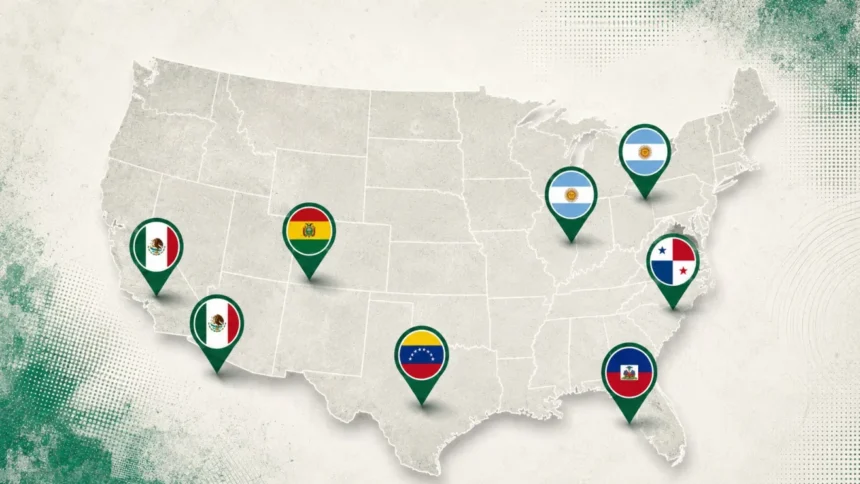
If anyone ever told you the “American dream” was dead, it’s probably because they haven’t checked the Forbes list recently. The reality is that the U.S. business ecosystem is being shaped, in large part, by minds born south of the Rio Grande who arrived with a suitcase full of ambition (and very little cash).
- The DNA of Success: What Do They Have in Common?
- Table: The Latino Success Map in the U.S.
- Practical Guide: What Can We Learn from These Giants?
- 1. Don’t Cling to Yesterday: Constant Reinvention.
- 2. Calculate, Don’t Gamble: Risk Management.
- 3. Strategic Patience: The Value of the Long Term.
- 1. Abel Avellan, Venezuela (position 41)
- 2. Pablo Legorreta, Mexico (position 50)
- 3. Jorge Pérez, Argentina (position 83)
- 4. Daniel Lubetzky, Mexico (position 91)
- 5. Herriot Tabuteau, Haiti (position 94)
- 6. Marcelo Claure, Bolivia (position 97)
- 7. Guillermo Rauch, Argentina (position 97)
- 8. Albert Nahmad, Panama (position 129)
The truth is that behind these eight figures, there aren’t just bank accounts with endless zeros—there are stories of resilience that offer a master class on how to navigate foreign markets without losing your identity.

The Pulse of Wealth (Snippet Bait): According to the most recent Forbes list, eight Latin Americans rank among the wealthiest immigrants, solidifying their presence in sectors ranging from technology and media to construction and retail. These entrepreneurs haven’t just overcome the language barrier; they’ve climbed the ranks to become pillars that drive thousands of jobs in the U.S. economy.
The DNA of Success: What Do They Have in Common?
It’s no coincidence that these eight names appear year after year in Forbes. If we analyze their trajectories, we find patterns that you, the reader, can apply to your own projects (yes, even to your local small business).
1. Smart Diversification
None of them put all their eggs in one basket. While the average immigrant seeks short-term job stability, these leaders bet on highly scalable sectors:
- Technology and digital services: Where the barrier to entry is innovation, not initial capital.
- Real estate and construction: The traditional business that never goes out of style, but managed with a large-scale vision.
2. The Network of Contacts (Networking)
The loneliness of the immigrant is a myth they quickly debunked. These millionaires understood that social capital is as important as financial capital. Joining investment circles wasn’t an option—it was their survival strategy.
Table: The Latino Success Map in the U.S.
To put things in perspective, let’s see which sectors these fortunes have left their mark on:

| Profile | Main Sector | Lesson for the Reader |
| The Innovator | Technology / Software | Scalability is the key to real money. |
| The Builder | Real Estate | Tangible assets protect against inflation. |
| The Visionary | Media / Entertainment | Personal branding is a powerful business asset. |
| The Retailer | Retail | Know your niche and serve it better than anyone else. |
Practical Guide: What Can We Learn from These Giants?
You don’t need an empire to start thinking like them. Wealth begins with a change in mindset (and financial habits).
1. Don’t Cling to Yesterday: Constant Reinvention.
All these immigrants had to abandon their traditional ways of doing business when they arrived in the U.S. Adaptability is their most valuable currency. If your business isn’t growing, ask yourself which processes you’re doing out of inertia rather than efficiency.
2. Calculate, Don’t Gamble: Risk Management.
Many people think these millionaires are gamblers. The truth is, they’re masters of risk management. Before investing, analyze the worst-case scenario. Can you survive it? If the answer is yes, proceed.

3. Strategic Patience: The Value of the Long Term.
None of these names appeared in Forbes overnight. Instant gratification is the enemy of real wealth. If you’re building something, expect to see results in years, not months.
The truth is that the success of these eight Latin Americans is a narrative that benefits us all. Their presence in Forbes tells us that the U.S. market, though competitive, remains fertile ground for those willing to sacrifice comfort to build a legacy. We’ll continue watching how these fortunes evolve and what new doors they open for our community. Because in the end, when a Latino reaches the top, the glass ceiling cracks for everyone else.
1. Abel Avellan, Venezuela (position 41)
Venezuelan entrepreneur Abel Avellan is the highest-ranked Latin American among Forbes’ billionaire immigrants, with an estimated net worth of $5.7 billion. Avellan is the founder and CEO of AST SpaceMobile, a company that builds satellites to provide broadband connections used to give mobile phones signal. This has earned him active contracts with U.S. telecom giants like Verizon, AT&T, and Vodafone.
2. Pablo Legorreta, Mexico (position 50)
With an estimated net worth of $5 billion, Pablo Legorreta is the second Latin American and the first Mexican to appear on Forbes’ ranking. Legorreta is the founder of Royalty Pharma, the world’s largest company in acquiring pharmaceutical royalty streams. The company invests in high-potential drugs and acquires the right to receive a percentage of future sales from the drugs it finances.
3. Jorge Pérez, Argentina (position 83)
The main source of income for Argentine entrepreneur Jorge Pérez comes from real estate investments. He leads Related Group, a Miami-based real estate developer that claims to have built over 100,000 condominiums and apartments since its founding in 1979. His wealth is estimated at around $2.6 billion.
4. Daniel Lubetzky, Mexico (position 91)
Daniel Lubetzky was born in Mexico City in 1968 and is the founder and CEO of Kind Healthy Snacks, a company specializing in energy bars. Although he sold most of the company to Mars for $5 billion in 2020, Lubetzky retains a stake that has earned him an estimated net worth of $2.3 billion.
5. Herriot Tabuteau, Haiti (position 94)
Herriot Tabuteau founded Axsome Therapeutics in 2012 with the goal of developing life-changing treatments for the millions of patients living with brain disorders. He is the inventor of over 200 patents, including potential new drugs for depression, behavioral disorders in Alzheimer’s disease, and narcolepsy. Tabuteau has a net worth of $2.2 billion.
6. Marcelo Claure, Bolivia (position 97)
Marcelo Claure is a Bolivian-American entrepreneur with an estimated net worth of $2.1 billion. He served as chief operating officer of the Japanese company SoftBank, which acquired Claure’s company Brightstar in 2014. Currently, much of his fortune is invested in T-Mobile stock, which merged with Sprint in 2020, where he serves on the board of directors. He also holds stakes in fast-fashion giant SHEIN.
7. Guillermo Rauch, Argentina (position 97)
Sharing the 97th spot with Bolivian Claure, Guillermo Rauch also has a net worth of $2.1 billion. He co-founded Vercel, a company that creates tools for developers focused on website hosting and deployment. The company achieved a $9 billion valuation after raising $300 million in a funding round co-led by venture capital firm Accel and GIC in September 2025. Today, Vercel provides infrastructure for some of the world’s biggest brands, such as Under Armour, Stripe, and Sonos.
8. Albert Nahmad, Panama (position 129)
Albert Nahmad rounds out the group with an estimated net worth of $1.3 billion. Born in Panama, he emigrated to the U.S. to study engineering at the University of New Mexico and later at Purdue. In 1973, he bought a stake in Watsco, then a small publicly traded company, and through acquisitions turned it into North America’s largest distributor of air conditioning, heating, and refrigeration equipment. The company’s market capitalization grew from $22 million in 1989 to over $20 billion today, according to Forbes. Nahmad owns about 7% of the company, which he has led for over five decades, and his son serves as Watsco’s president.
Image: ElHispanoParaTodos/PRESS