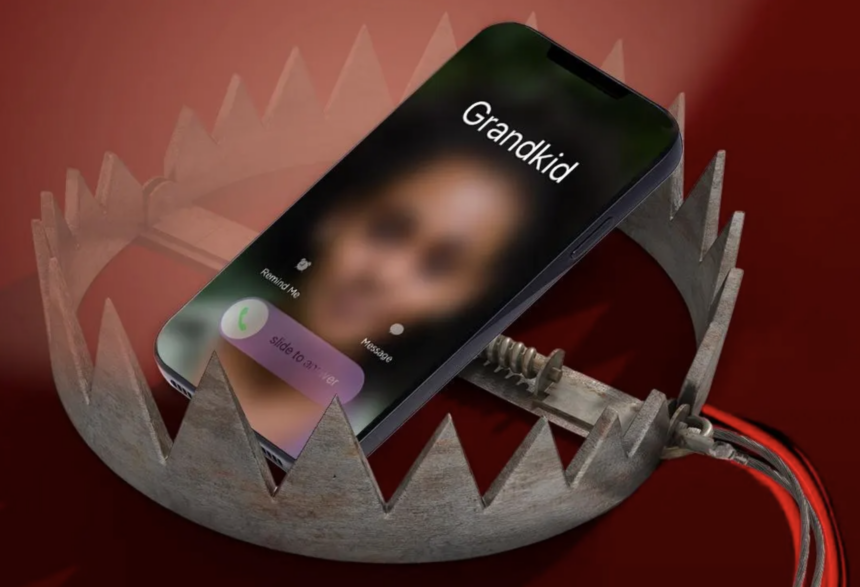
Is your child calling you in tears, begging for urgent money? It could be a clone. Discover how criminal networks are using artificial intelligence in the U.S. and how to protect your family.
Imagine this for a second. You’re making dinner after a long day at work. Your cell phone rings. The caller ID shows your daughter’s number. You answer, and on the other end, you hear her voice, broken with panic, screaming that she’s been in a car accident and needs you to transfer $2,000 immediately to a police officer to avoid jail.

The tone of voice, the way she breathes, how she says “mom” or “dad.” It’s identical.
But it’s not her. Your daughter is safe at home, watching Netflix. You’ve just become the victim of the latest digital nightmare in the United States.
The truth is that artificial intelligence (AI) is no longer the stuff of science fiction movies or Silicon Valley engineers. Today, it’s the primary weapon of phone fraud cartels. With just three seconds of audio stolen from a TikTok or Instagram video, criminals can clone anyone’s voice and generate real-time conversations to drain your bank accounts. And the Hispanic community is their favorite target.
The “Virtual Kidnapping 2.0”: Voice Cloning in Three Seconds
Let’s get to the point. Until a couple of years ago, spotting a phone scam was relatively easy. Someone with a strange accent would call, reading from a poorly written script, threatening you with the IRS (Internal Revenue Service). You’d hang up, and that was that.

Today, technology has erased the line between reality and fraud. Scammers use “deepfake” audio software.
How does this cyber trap work? It’s chillingly simple:
- Tracking the victim: They search public profiles on social media. They find a young Latino who just posted a Reel talking about their new job or a soccer game.
- Extracting the “Vocal DNA”: They download the video and run it through a low-cost voice cloning program. The system needs just a tiny fragment to learn the tone, accent (whether Mexican, Colombian, Caribbean), and cadence of the voice.
- The Attack: They call the young person’s parents or grandparents. The software allows the scammer to type what they want to say, and the machine instantly plays it back in the cloned voice, simulating crying, desperation, or urgency.
“We’re not dealing with small-time thieves. These are highly organized criminal networks operating like tech companies, using databases bought on the dark web to know exactly whom to call and when.”
The 3 Favorite Tactics Against the Hispanic Community in the U.S.
What defines us as Latinos is our strong family bonds and respect (or fear) of U.S. immigration and tax authorities. Criminals know this. They play on our deepest fears.

Here’s a breakdown of their worst tricks:
1. The “Express Deportation” (USCIS or ICE Impersonation)
Using artificial intelligence, criminals spoof the caller ID to make “US Department of Homeland Security” appear on your screen. A voice that sounds professional, sometimes bilingual, informs you of a supposed error in your immigration paperwork or that of a family member. The solution they offer is to pay an “administrative fine” immediately via gift cards or cryptocurrency. (A ridiculous detail, but people fall for it in a panic.)
2. The Grandchild Emergency (The Generational Scam)
This is, by far, the cruelest. They target older adults. They call in the middle of the night. The cloned voice of a grandchild claims to be arrested in another state or stranded in Mexico, begging you not to tell their parents. They demand quick money via Zelle or irreversible bank transfers.
3. The Fake IRS Agent
Tax season arrives, and the phone won’t stop ringing. The automated voice, now with a perfect accent and precise legal terminology generated by ChatGPT, threatens to freeze your bank account or send the police if you don’t resolve a supposed tax debt.
Survival Guide: Traditional Scam vs. AI Scam
To understand the danger, see how the threat has evolved. Here’s what you need to watch for:
| Feature | Traditional Phone Scam (Before) | AI-Powered Fraud (Today) |
| Voice quality | Robotic, suspicious accents, fixed scripts. | Natural, fluid, clones voices of your real loved ones. |
| Prior information | Random calls (Cold Calling). They don’t know who you are. | Highly personalized. They know your name, your children’s names, and where you work. |
| Interactivity | Pre-recorded messages that don’t answer questions. | The bot or scammer responds in real time to your doubts using AI. |
| Emotion | Annoyance. Easy to identify and hang up. | Absolute terror. Hijacks your emotions to prevent you from thinking. |
How to Protect Your Family Right Now (Without Being an Expert)
Here’s the interesting part. You don’t need a degree in cybersecurity to protect your loved ones. Technology advances, but the antidote remains human. Implement this protocol in your home today:
- Establish a Family “Safety Word”: This is the ultimate shield. Gather your family and choose a secret word or phrase (e.g., “Al Pastor Tacos,” “The dog barks blue”). If someone calls asking for money in the middle of a crisis, the golden rule is to ask: What’s the secret word? The AI won’t know how to respond.
- The 3-Second Rule and Hang Up: If you receive an urgent call, take a breath. Listen for 3 seconds. Hang up immediately. Look up your family member’s contact in your own phone and call them directly. 99% of the time, they’ll answer from home, confused but safe.
- Ironclad Social Media Privacy: Go to your children’s (and your own) Instagram, Facebook, and TikTok accounts. Change the settings to “Private.” Don’t hand over high-quality audio to scammers for their machines to train on.
- Beware of “Ghost” Payments: No legitimate U.S. government agency—whether the IRS, USCIS, or local police—will ever ask you to pay fines using Apple or Target gift cards or Zelle transfers. Never.
The game has changed in telecommunications. Artificial intelligence is a wonderful tool, but in the wrong hands, it’s a weapon of financial and psychological destruction. Stay calm, educate the older members of your household, and when in doubt, always press the red button to hang up. Your peace of mind is worth more than any unknown call.
Image Forbes.