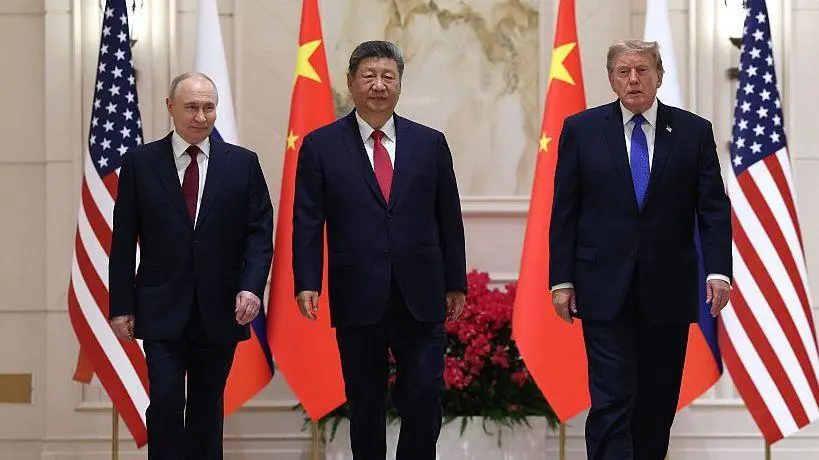
The presidents of the United States, Donald Trump; China, Xi Jinping; and Russia, Vladimir Putin, held their first-ever trilateral summit in history on Thursday, November 19, 2026, in the Chinese city of Shenzhen, on the sidelines of the Asia-Pacific Economic Cooperation (APEC) forum.
The meeting, which lasted about an hour and a half at the Kylin Villa protocol complex, concluded with a joint “Declaration Toward Peace”, though without any immediate binding agreements on active conflicts.

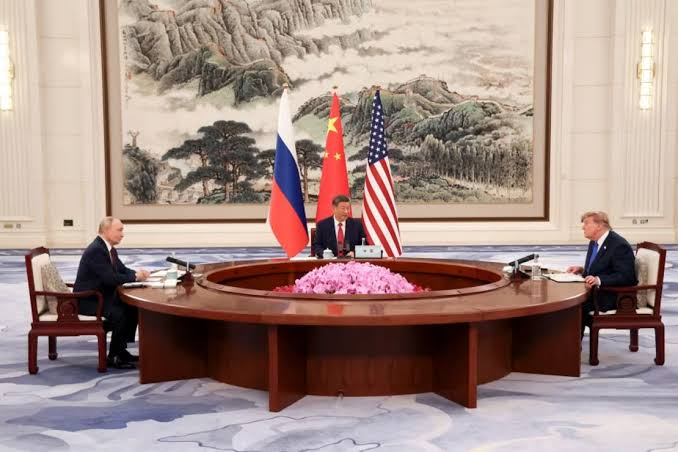
What each leader said
- Xi Jinping (China): Opened the meeting by stating that the three powers “must set an example by cooperating to address global challenges, jointly maintaining peace and stability, and contributing more to humanity’s progress.” He called the positive interaction between Beijing, Washington, and Moscow “an obligation” and described nuclear weapons as “a sword of Damocles hanging over humanity,” urging efforts to prevent any nuclear war. He avoided directly mentioning the wars in Ukraine or Iran, instead urging all conflicting parties to resolve disputes through diplomacy.
- Donald Trump (United States): Said the three leaders were “making history” and emphasized they share a “special responsibility” to maintain dialogue: “Peace has never been achieved by rejecting opportunities for dialogue and conversation.” He stressed that the three countries are in a unique position to negotiate reductions in nuclear arsenals. He expressed his belief that Putin wants to end the war in Ukraine and lashed out at the International Criminal Court (ICC), calling it “out of control.”
- Vladimir Putin (Russia): Argued that cooperation among the three powers strengthens global stability and stated there are “numerous converging interests” in resolving regional conflicts, explicitly mentioning the war in Ukraine. After the meeting, he acknowledged in a press conference that the summit did not produce ambitious immediate goals and clarified that it does not mark the start of a permanent format for three-way summits.
The 4 key points of the joint declaration
| Thematic Focus | Announced Commitment | Context and Notable Omissions |
| Nuclear Risk | Reaffirmed that “a nuclear war cannot be won and must never be fought” and agreed to continue dialogue on non-proliferation. | Comes after the expiration of the New START treaty in February 2026, but without announcing a new arms limitation pact. |
| UN Reform | As permanent members of the Security Council, they committed to advancing United Nations reform to better address global challenges. | Aims to give greater representation to countries in Asia, Africa, and Latin America. |
| International Justice | Defended the immunity of heads of state and state consent, urging the International Criminal Court not to “abuse its jurisdiction.” | Direct support for Putin, who has been under an ICC arrest warrant since 2023. |
| Energy Security | Agreed to preserve the stability of energy flows and increase the production and supply of refined petroleum products. | Comes amid disruptions in the Strait of Hormuz due to the conflict with Iran, though the text omitted any mention of Iran and Ukraine. |

Written by
Federico Rodriguez1,601 stories published
Writes for El Hispano Para Todos, the newspaper of the Latino community of Palm Beach and the Treasure Coast.
See all their stories →