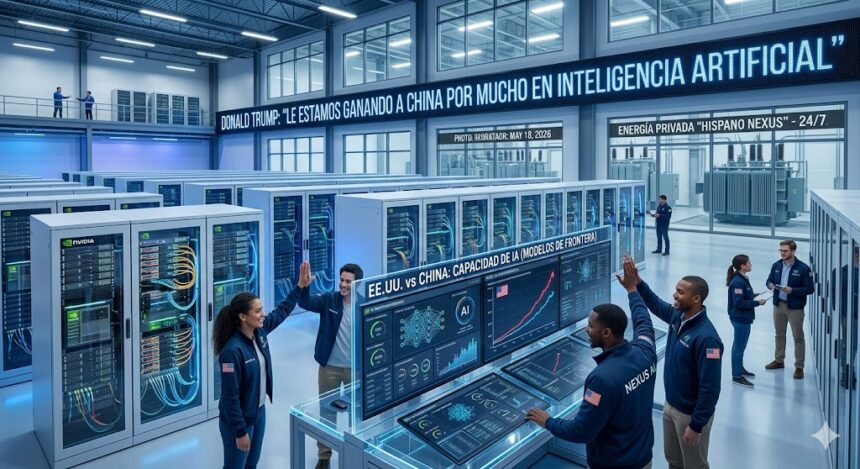
The White House insists the gap is enormous, but Silicon Valley engineers glance nervously toward Beijing with a cold sweat running down their spines. During his recent exclusive interview in the Oval Office with Fortune magazine—granted just hours before boarding Air Force One for his bilateral summit in Beijing with Xi Jinping—President Donald Trump made one of his most striking statements: “We’re beating China by a lot in AI—artificial intelligence.”
The declaration sounds decisive, patriotic, and very much in the president’s style. However, beyond the microphone and far from the electoral rhetoric, the reality of the US-China AI race is measured by far more complex metrics than a simple scoreboard. It’s not just about who programs the best language algorithm, but who has absolute control over hardware, the energy resources to power servers, and, above all, the ability to shield their systems from a large-scale cyberattack.

Are we really as far ahead as the president claims, or are we growing complacent in the face of a giant advancing in silence? Let’s get to the point.
The technical verdict: The United States’ lead over China in developing frontier models (like GPT-5.5 or Anthropic’s controversial Mythos) exists, but industry experts and military intelligence firms estimate the real gap is only 6 to 12 months. A lead that could vanish before the year ends if drastic measures aren’t taken in energy infrastructure.
The Control Panel: Where Is the US’s Real Advantage?
To understand Trump’s confidence, we must look at the foundations of the current technological ecosystem. The United States retains its crown in artificial intelligence due to two very specific factors that Beijing has yet to replicate, despite its reverse-engineering efforts: supremacy in microchip design and the quality of frontier models.
1. The Silicon Monopoly (The Nvidia Factor)
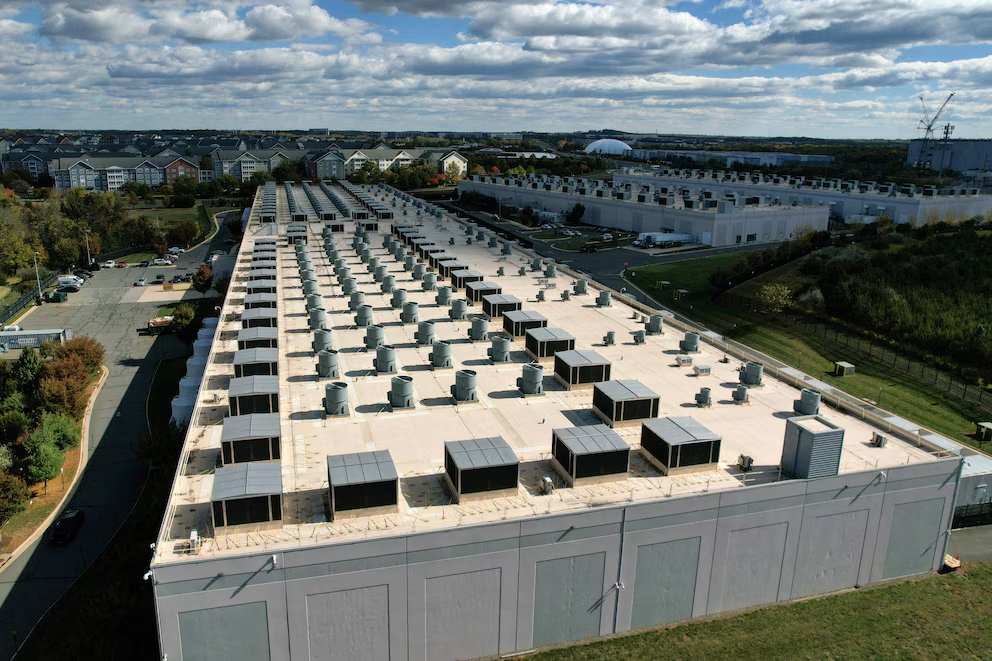
Artificial intelligence doesn’t magically live in the “cloud”; it resides in warehouse-sized facilities the size of the Pentagon, packed with ultra-fast processors. Nvidia, based in California, became the world’s first company to reach a $5 trillion market valuation for a simple reason: they have the best “picks and shovels” in this gold rush.
Under the current Trump administration, export controls have been the primary weapon to slow China down. Federal laws strictly prohibit Nvidia from selling its most advanced chip, the Blackwell, to the Chinese government or companies. Although the Commerce Department recently authorized the controlled sale of the H200 chip (a second-tier processor) with the condition that the volume not exceed 50% of what is sold to U.S. customers, the advantage in raw computing power still lies with America.

2. Closed Models vs. Open-Source Models
The crown jewels of the U.S. (OpenAI, Anthropic, Google DeepMind) operate under a “closed” commercial model. These are extremely powerful systems, expensive to maintain, but with logical reasoning, programming, and cybersecurity capabilities considered the global cutting edge.
Beijing’s Counteroffensive: Why Trump Shouldn’t Declare Victory
Here’s where it gets interesting. While Washington celebrates the quality of its models, China is executing a saturation strategy that tech analysts call “the mid-market advantage.”
To put it simply: it’s like the television market. The U.S. manufactures a $10,000 modular screen that approaches analytical perfection. China, on the other hand, floods the global market with $600 screens that, while not matching the same resolution, are “good enough” for 90% of the population, local businesses, and healthcare services in developing countries.

China’s Three Strong Cards in 2026:
- The democratization of open source: Since the technological earthquake caused by DeepSeek’s software, Chinese developers have perfected models that are offered for free or at a fraction of the cost of American APIs. This is leading companies in Asia, Europe, and Latin America to prefer integrating into the Chinese ecosystem to save costs.
- Physical integration into society: Unlike the U.S., where AI is primarily used to optimize software, marketing, or finance, China has massively integrated it into its physical infrastructure: automated diagnostics in public hospitals, traffic management in megacities, and deep industrial automation.
- The energy crisis on American soil: A critical point raised by former Treasury Secretary Hank Paulson. AI data centers consume industrial amounts of electricity. While in the U.S., Big Tech constantly clashes with the national power grid’s bureaucracy and supply shortages, China is rapidly building transmission infrastructure and power plants (both renewable and nuclear) dedicated exclusively to powering its AI servers.
The Beijing Summit: An Unexpected Pact for Mutual Survival
Despite tariffs exceeding 140% imposed by Washington and Beijing’s blockade of rare minerals, artificial intelligence forced Donald Trump and Xi Jinping to negotiate common ground during their recent summit in China. Why? Because both leaders fear the same thing: a non-state actor gaining access to uncontrolled AI.
The most advanced models this year have set off alarms in the national security sector. U.S. Treasury Secretary Scott Bessent has warned that these tools can detect financial vulnerabilities capable of crashing entire banking systems within minutes. If a terrorist cell or international criminal network gains access to a modified advanced model, both Washington and Beijing would face an existential risk.
The US-China Emergency Agreement (May 2026)
| Area of Cooperation | U.S. Commitment | China’s Commitment | Pact Objective |
| Security Guidelines | Co-design pre-launch commercial evaluation standards. | Adopt the same stress tests in Shenzhen laboratories. | Prevent “security arbitrage” (hackers choosing the least regulated model). |
| Alert Exchange | Share detected dangerous prompts (instructions). | Notify of anomalous behaviors in open-source servers. | Mitigate cyber or biological attacks coordinated by third countries. |
| Hardware and Tariffs | Maintain restrictions on frontier chips (Blackwell), but review quotas for minor components. | Guarantee the supply of critical minerals for the U.S. defense supply chain. | Stabilize the global tech market without ceding military sovereignty. |
What Does This Mean for Our Community?
Beyond geopolitics and the billions of dollars at play between the White House and Beijing, this technological race directly impacts the daily lives of Hispanic professionals and workers in the United States.
The energy deregulation proposed by Trump to facilitate the construction of these mega data centers will generate a massive wave of technical jobs, civil construction, and infrastructure maintenance in key states. On the other hand, the accelerated adoption of these tools forces our workforce to move from simple manual operation to a basic understanding of automated systems. Those who don’t learn to use AI as an assistant in their business—whether in logistics, finance, or services—will be at a disadvantage competing against entire corporations optimized by low-cost algorithms.
The race isn’t won yet, Mr. President. It’s at its most critical point. And in this battle, whoever falls asleep for six months simply disappears from the digital map.
Image: ElHispanoParaTodos/PRESS