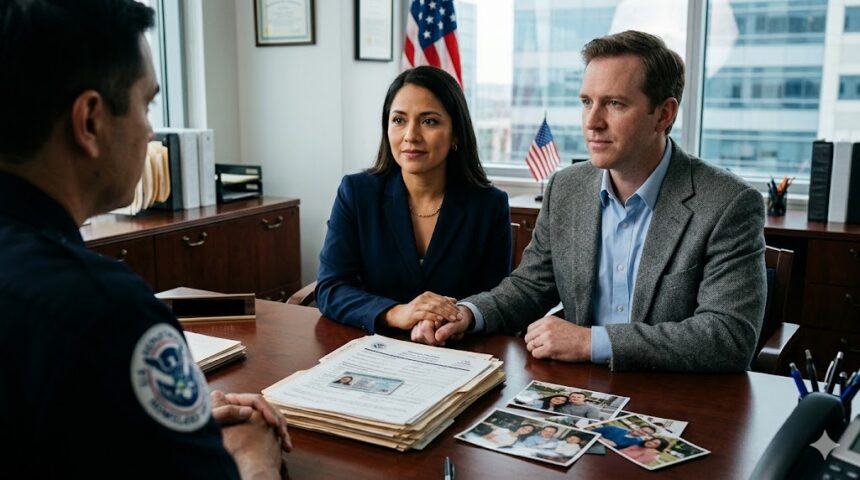
Getting married for love in the United States should mark the start of a dream, but for U.S. Citizenship and Immigration Services (USCIS), your wedding is, above all, a file under suspicion. This isn’t pessimism—it’s the reality of the current system: the scrutiny over marriage-based permanent residency or the “Green Card by marriage” has reached unprecedented levels of technical and digital examination.
- The “Triple Surveillance” Phenomenon: What Has Changed?
- 1. Digital and Social Tracking (The Algorithm’s Eye)
- 2. Deep Financial Scrutiny
- 3. The Psychological Factor in the Stokes Interview
- Process Breakdown: From Wedding to Permanent Residency
- Phase A: Adjustment of Status (Form I-485)
- Phase B: Conditional Residency (First 2 Years)
- Table: “Bona Fide” Evidence vs. Weak Evidence
- 5 Mistakes That Trigger Fraud Alarms
- Golden Tips for the Interview
If you thought a few cake photos and a joint bank account were enough, think again. Today, the immigration officer doesn’t just review your paperwork—they examine the digital footprint of your entire life.

Quick Answer (Snippet Bait): The marriage-based Green Card is under “triple surveillance,” which includes social media audits, tracking of real financial cohabitation, and the intensification of credible fear interviews (Stokes Interview). To get approved, it’s not enough to prove the marriage is legal—you must show it’s a “shared life project” free of any hint of immigration fraud.
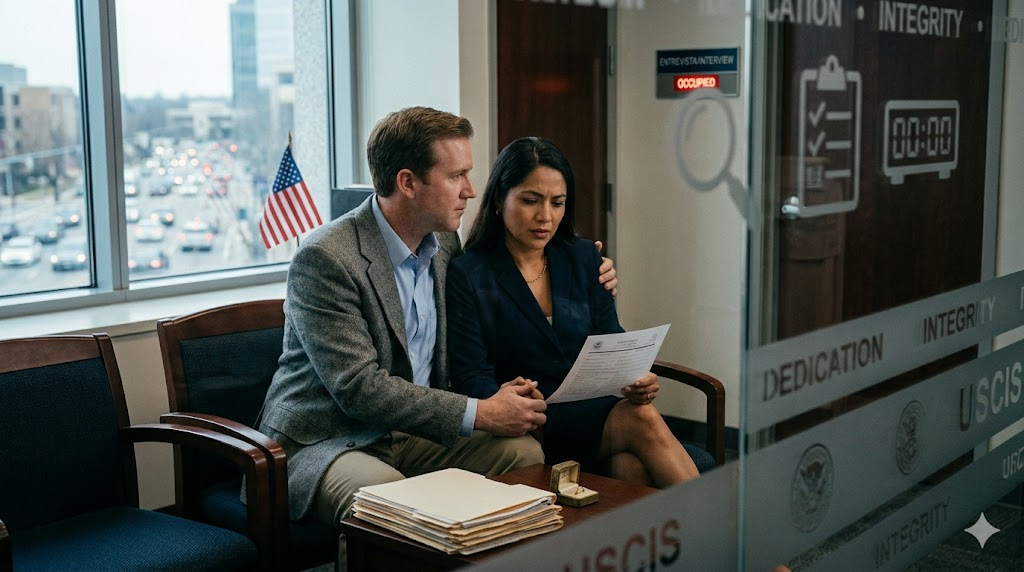
The “Triple Surveillance” Phenomenon: What Has Changed?
We’re no longer in the era when they only reviewed the lease agreement. Surveillance has now split into three fronts you must know to avoid walking in blind.
1. Digital and Social Tracking (The Algorithm’s Eye)
USCIS has dedicated units to verify the consistency of your public life. If your application states you live with your spouse in Miami, but your activity on Instagram or LinkedIn constantly places you in another city for “work” or “studies” without having declared it, you have a problem.
- Red flag: Inconsistencies between photo dates and the timeline of your relationship.
- Reality: Officers are authorized to review public profiles. This isn’t paranoia—it’s protocol.
2. Deep Financial Scrutiny
A joint credit card with a zero balance doesn’t impress anyone. USCIS looks for shared cash flow.
- What they look for: Who pays the utilities? Are both of you on the car insurance? Are there recurring deposits from both of you into the same account to pay rent?
- Common mistake: Opening bank accounts a week before the interview. That screams “fraud” from miles away.
3. The Psychological Factor in the Stokes Interview
If the officer senses doubt, they’ll move to the infamous “Stokes Interview,” where they separate the couple and ask ridiculously specific questions. (Which side of the bed does she sleep on? What color is his toothbrush?).

Process Breakdown: From Wedding to Permanent Residency
Don’t get lost in the legal maze. Here’s the breakdown of what truly matters in the critical phases:
Phase A: Adjustment of Status (Form I-485)
This is the stage where you prove you entered legally (in most cases) and that your marriage is the basis for your stay.
- Key point: The declaration of financial self-sufficiency. If you don’t have sufficient income, the sponsor must be as solid as a rock.
Phase B: Conditional Residency (First 2 Years)
If you’ve been married for less than two years at the time of approval, you’ll receive a conditional Green Card. This is the government’s “probation period.”

- The danger: Many relax during this time. Mistake. These two years are for accumulating more proof that the love is still alive and the bills are still being paid together.
Table: “Bona Fide” Evidence vs. Weak Evidence
| Type of Proof | Impact Level | Why it works/fails |
| Children in common | Maximum | It’s the definitive biological and social proof of a life project. |
| Joint property | High | No one risks their credit or home for a simple process. |
| Life/Health Insurance | High | Naming each other as beneficiaries shows mutual protection. |
| Letters from friends | Low/Medium | They’re easy to fake; they only serve as secondary support. |
| Vacation photos | Medium | They help with the timeline but don’t prove financial cohabitation. |
5 Mistakes That Trigger Fraud Alarms
The truth is that most rejected cases aren’t necessarily fake—they’re poorly documented. Here’s where people often slip up:
- Extreme age difference without explanation: It’s not illegal, but it will attract extra questions. You must demonstrate deep common interests.
- Not living together: If you live in separate homes for work, the burden of proof triples. You’ll need contracts, plane tickets, and records of constant calls.
- Marriage right after a deportation order: This is entering “hard mode.” Fraud is assumed unless you prove otherwise with overwhelming evidence.
- Lack of common language: If you speak Spanish and she speaks English, and neither speaks the other’s language… how do you communicate? Be prepared to explain it in detail.
- “Dirty” immigration history: Suspicious entries and exits or multiple previous marriages to foreigners.
Golden Tips for the Interview
Don’t go on the defensive. The officer is just doing their job.
- Be honest about small details: If you don’t remember what you had for dinner last Tuesday, say so. It’s more suspicious to have a perfect, rehearsed answer for everything.
- Dress matters: Don’t go in formal wear, but dress professionally. You’re at a business meeting with the U.S. government.
- Extreme organization: Bring a folder with dividers. If they ask for the lease agreement and you take 10 minutes to find it in a pile of crumpled papers, you’ll project disorganization and lack of seriousness.
“The system isn’t trying to punish love—it’s trying to filter out those who try to cut in line by using marriage as a toll.”
Image: ElHispanoParaTodos/PRESS